
Key takeaways
What this article covers, in order:
- Why this comes up / what goes wrong
- Step-by-step
- Example (fictional figures)
- Common mistakes
- Frequently asked questions
- Key takeaways
Fitness center accounting means keeping accurate records of all money coming in and going out of your gym or fitness business. This includes membership fees, personal training charges, sales of merchandise, rent, salaries, and GST filings. You must also reconcile bank statements and ensure your books reflect the actual financial position. This article explains why fitness center accounting is important, walks you through the key steps, shows a worked example, lists common mistakes, and answers typical questions.
Why this comes up / what goes wrong
Fitness business owners or accountants often struggle with accounting because fitness centers have varied revenue streams such as monthly memberships, drop-in fees, classes, merchandise sales, and sometimes event hosting. Managing these different incomes and expenses in spreadsheets or bill books can be time-consuming and prone to errors. GST compliance adds another layer of complexity, especially with invoicing and filing returns like GSTR-1 and GSTR-3B. Without clear processes, cash flow tracking and profitability analysis become difficult, leading to poor business decisions.
Step-by-step
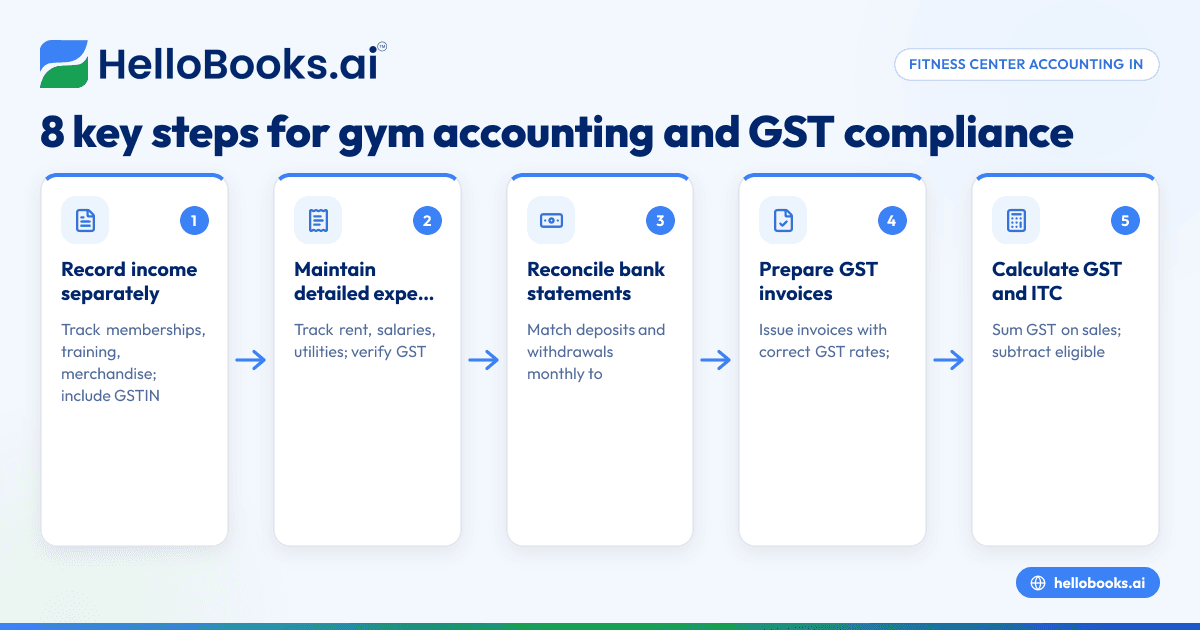
- Record all income sources separately
- Track membership fees, personal training, merchandise sales, and any other income in distinct categories.
- Check that invoices include GSTIN, HSN or SAC codes where applicable.
- Maintain detailed expense records
- Include rent, utilities, salaries, equipment purchases, and marketing costs.
- Verify bills and receipts for GST input credit eligibility.
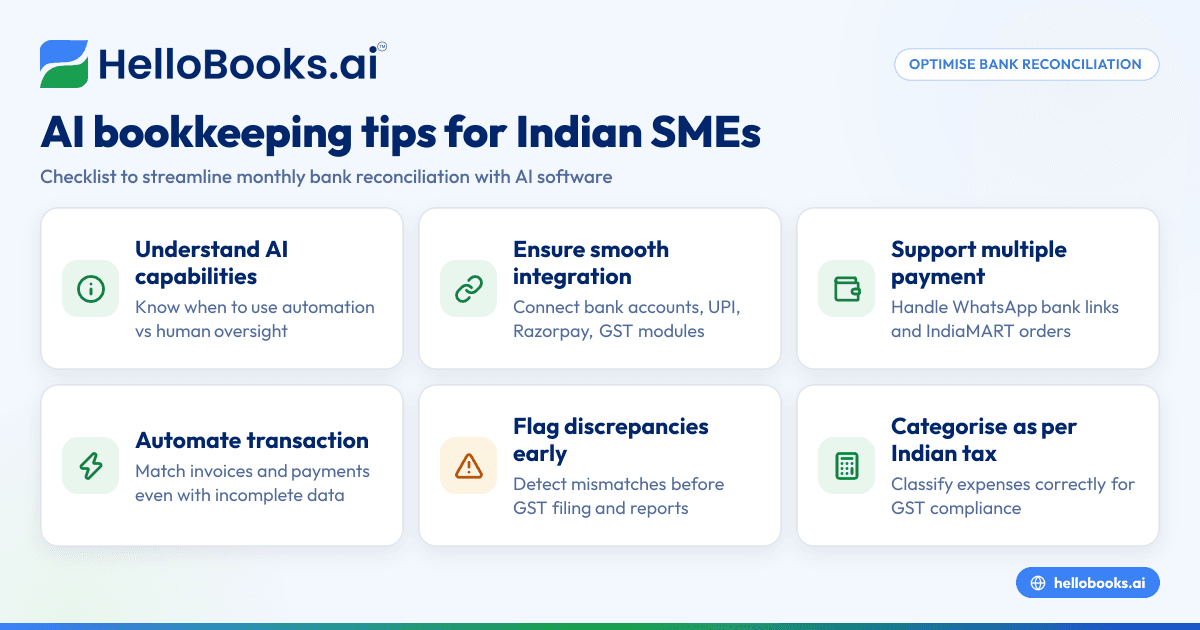
- Reconcile bank statements monthly
- Match bank deposits and withdrawals with your recorded transactions to catch discrepancies.
- Prepare GST-compliant invoices
- Issue invoices with correct GST rates for services and goods.
- Use GSTR-1 to report outward supplies and GSTR-3B for monthly return filing.
- Calculate GST liability and ITC accurately
- Sum GST collected on sales and subtract eligible input tax credit.
- Check for mismatches with GSTR-2B data.
- Maintain inventory records if selling merchandise
- Track opening stock, purchases, sales, and closing stock.
- Ensure stock valuation matches accounting records.
- Generate financial reports regularly
- Profit and loss statement, cash flow, and balance sheet help understand business health.
- Review compliance deadlines
- Mark GST filing dates and payment schedules to avoid penalties.
For more on managing local service business accounts, see Local service businesses.
Example (fictional figures)
Consider a gym in Bhopal for the month of March 2024.
- Membership fees collected: ₹1,50,000
- Personal training fees: ₹50,000
- Merchandise sales: ₹30,000
- Rent paid: ₹40,000
- Salaries paid: ₹60,000
- Equipment purchase: ₹20,000 (including GST ₹3,600)
Step 1: Calculate total sales and GST collected (Assuming 18% GST on services and goods)
Membership + training = ₹1,50,000 + ₹50,000 = ₹2,00,000
Merchandise sales = ₹30,000
GST on services = ₹2,00,000 × 18% = ₹36,000
GST on merchandise = ₹30,000 × 18% = ₹5,400
Total GST collected = ₹36,000 + ₹5,400 = ₹41,400
Step 2: Calculate input tax credit (ITC)
Equipment purchase GST = ₹3,600
Other expenses like rent and salaries are exempt from GST input credit.
ITC = ₹3,600
Step 3: Calculate GST payable
GST collected - ITC = ₹41,400 - ₹3,600 = ₹37,800
Step 4: Prepare GST returns
Report ₹2,00,000 + ₹30,000 = ₹2,30,000 as outward taxable supplies in GSTR-1.
Report ₹37,800 as GST liability in GSTR-3B.
This example shows how to separate income streams, calculate GST, and prepare returns.
Common mistakes
- Mixing income streams
- Prevent by categorising each revenue source separately in your records.
- Ignoring GST on merchandise sales
- Check GST rates carefully and include them in invoices.
- Not reconciling bank statements monthly
- Schedule monthly bank reconciliation to spot errors early.
- Missing deadlines for GST returns
- Use a calendar or reminders for filing dates to avoid penalties.
- Overlooking input tax credits
- Keep all purchase invoices and verify eligibility for ITC.
- Failing to maintain inventory records
- Track stock to avoid discrepancies between physical and book stock.
Learn more about GST invoicing best practices at GST invoicing.
Frequently asked questions
What accounting method suits a fitness center best?
Fitness centers commonly use cash or accrual accounting. Cash accounting records income and expenses when cash changes hands, while accrual accounting records them when earned or incurred. Choose based on your business size and tax requirements. Many small fitness centers start with cash accounting for simplicity.
Do fitness centers need to register for GST?
Yes, if your aggregate turnover exceeds the GST threshold (₹40 lakh for most states, ₹20 lakh for special category states) you must register for GST and file returns like GSTR-1 and GSTR-3B. Registration helps claim input tax credit and stay compliant. NEEDS EXPERT REVIEW
How to handle GST on membership fees?
Membership fees are considered supply of services and attract GST. You should issue GST-compliant invoices showing GST separately. The applicable GST rate depends on the service type but is often 18%. NEEDS EXPERT REVIEW
Can I use Excel or Tally for fitness center accounting?
Yes, many fitness centers use Excel or Tally for bookkeeping. However, manual data entry increases errors and effort. Using accounting software tailored to local service businesses can reduce mistakes and simplify GST compliance. See our guide on Local service businesses for more.
What reports should I generate monthly?
At minimum, generate a profit and loss statement, cash flow report, and bank reconciliation statement monthly. These help monitor financial health, cash availability, and detect discrepancies early.
Key takeaways
- Track all fitness center income and expenses separately for clarity.
- Maintain GST-compliant invoices and file GSTR-1 and GSTR-3B on time.
- Reconcile bank statements monthly to avoid errors.
- Keep detailed inventory records if selling merchandise.
- Use regular financial reports to monitor business health.
- Avoid common mistakes like mixing income streams and missing GST deadlines.
For fitness center owners and accountants, clear and consistent accounting practices are essential to running a profitable and compliant business. To get started with managing your accounting and GST filing, consider starting on the Free plan (200 transactions a year, GSTR-1 and 3B filing for one GSTIN).