


Key takeaways
What this article covers, in order:
- Why this comes up / what goes wrong
- Step-by-step
- Example (fictional figures)
- Common mistakes
- Doing this in HelloBooks
- Frequently asked questions
When running an ecommerce business in India, your accounting automation tool must handle the complexities of GST compliance, inventory tracking, and transaction reconciliation efficiently. Key features to look for include GST invoice validation, e-invoice generation with IRN, GSTR-2B reconciliation, OCR for supplier bills, and free tools for GSTIN validation. This article explains why these features are essential, how to evaluate them, and practical steps to choose the right tool.
Why this comes up / what goes wrong
Ecommerce businesses in India, such as a Flipkart seller in Bengaluru, a D2C skincare brand in Mumbai, or an Amazon home decor seller in Jaipur, face high volumes of transactions with multiple GSTINs, complex inventory, and strict GST compliance requirements. Manual bookkeeping using spreadsheets or bill books leads to errors, missed tax credits, and delayed filings. Without automation, reconciling GSTR-2B with purchases, validating GSTINs, and preparing GST-compliant invoices become time-consuming and error-prone.
Step-by-step
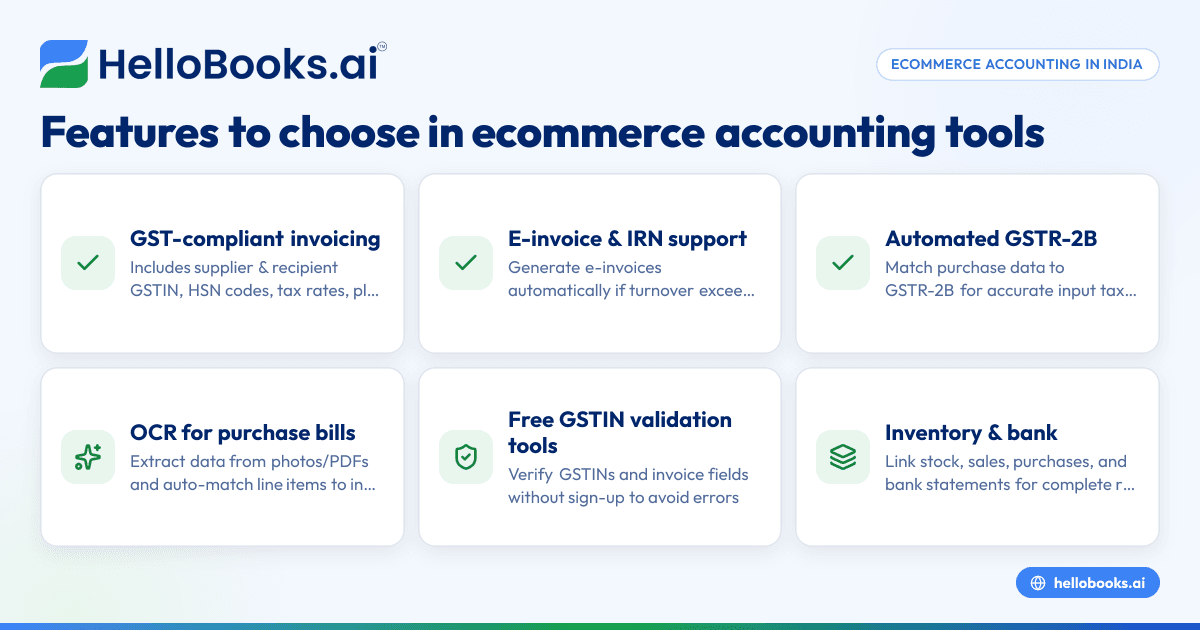
- Check GST Compliance Features Ensure the tool supports GST-compliant invoice creation including all mandatory fields as per Rule 46 of CGST (supplier and recipient GSTIN, HSN/SAC codes, tax rates, place of supply, etc.)[cgst-rule-46/rule46-particulars].
- Look for E-invoice and IRN Support If your turnover exceeds ₹5 crore, the tool should generate e-invoices with IRN automatically for B2B transactions as mandated from 1 August 2023[einvoice-threshold-5cr/einv-5cr-from-2023-08-01].
- Automated GSTR-2B Reconciliation The tool should automatically fetch and reconcile your purchase data with GSTR-2B to claim accurate ITC without manual matching.
- OCR for Purchase Bills Look for Optical Character Recognition (OCR) that captures supplier bills from photos or PDFs and auto-matches line items to inventory, reducing manual data entry.
- Free GST Validation Tools Features like GSTIN validation, invoice field checks, and HSN code search without sign-up help verify data accuracy early in the process.
- Inventory and Expense Tracking The tool should track inventory linked to sales and purchases and manage expenses to provide a complete financial picture.
- Bank Statement Reconciliation Upload bank statements to reconcile payments against invoices and expenses to ensure accurate cash flow records.
- Reporting and Filing Support Ensure it supports generating reports needed for GSTR-1 and GSTR-3B filing and provides reminders for compliance deadlines.
- User-Friendly Interface and Support Since many ecommerce sellers are not accounting experts, the tool should be easy to use and offer support for queries.
Example (fictional figures)
Consider an Amazon seller of home decor in Jaipur with the following data for July 2023:
- Total B2B sales: ₹12,00,000 (all GST applicable at 18%)
- Purchase bills scanned: ₹7,00,000
- GSTINs of suppliers validated
- E-invoices generated for all B2B sales
Calculations:
GST on sales = ₹12,00,000 × 18% = ₹2,16,000
Input tax credit (ITC) from purchases = ₹7,00,000 × 18% = ₹1,26,000
Net GST payable = ₹2,16,000 - ₹1,26,000 = ₹90,000
With an accounting automation tool that supports e-invoicing and GSTR-2B reconciliation, the seller can ensure all sales invoices have IRNs, supplier GSTINs are validated, purchase bills are auto-captured by OCR, and ITC matches GSTR-2B data, reducing errors and compliance risk.
Common mistakes
- Ignoring GST invoice rules: Not including mandatory invoice fields leads to invalid invoices and compliance issues. Prevent by using tools that validate invoices automatically.
- Skipping e-invoice generation when required: Businesses with turnover over ₹5 crore must issue e-invoices; missing this causes penalties. Choose software with IRN integration.
- Manual reconciliation of GSTR-2B: Time-consuming and error-prone. Use tools with automatic GSTR-2B reconciliation.
- Manual entry of purchase bills: Leads to data entry errors and lost ITC claims. Use OCR-enabled bill capture.
- Not validating GSTINs: Mistakes in GSTINs cause filing rejections. Use free GSTIN validation tools before filing.
- Overlooking inventory linkage: Without inventory tracking, stock mismatches occur. Choose software that links bills and invoices to inventory.
Doing this in HelloBooks
HelloBooks offers free India tools that let you validate GSTINs or check invoice fields without creating an account, helping you ensure GST compliance early (/tools). It also provides OCR for purchase bills, capturing supplier bills from photos or PDFs and auto-matching line items to your inventory, reducing manual effort (/ocr-scanning).
Frequently asked questions
What is the importance of e-invoicing for ecommerce sellers?
E-invoicing is mandatory for businesses with turnover exceeding ₹5 crore. It ensures invoices are authenticated with an IRN, reducing errors and streamlining GST returns. Ecommerce sellers must use tools that generate e-invoices automatically to comply.
How does OCR help with purchase bill management?
OCR technology reads bills from images or PDFs and extracts data automatically, reducing manual data entry errors and saving time. This is especially useful for ecommerce sellers with many supplier bills.
Can I validate GSTINs and invoices without signing up for software?
Yes, some tools offer free GSTIN validation and invoice field checking without requiring account creation, helping sellers verify data before filing.
Why is GSTR-2B reconciliation important for ecommerce businesses?
GSTR-2B reconciliation helps verify input tax credit claims by matching purchase data with supplier filings, preventing ITC mismatches and penalties.
How do I ensure my ecommerce invoices comply with GST rules?
Use software that creates GST-compliant invoices with all mandatory details such as supplier and recipient GSTIN, HSN codes, tax rates, and place of supply as per Rule 46 of CGST[cgst-rule-46/rule46-particulars].
Key takeaways
- Choose tools that support GST-compliant invoicing with all mandatory details.
- Ensure e-invoice generation with IRN for turnover above ₹5 crore.
- Use OCR to automate purchase bill entry and reduce errors.
- Validate GSTINs and invoice fields with free tools before filing.
- Automate GSTR-2B reconciliation to accurately claim ITC.
- Link inventory and bank reconciliation for complete accounting.
Start simplifying your ecommerce accounting by exploring HelloBooks’ free tools and OCR features. To get started, Start on the Free plan (200 transactions a year, GSTR-1 and 3B filing for one GSTIN).
For more on ecommerce accounting automation, see our guide for E-commerce and online sellers and learn about GST invoicing.


