


Key takeaways
What this article covers, in order:
- Why this comes up / what goes wrong
- Step-by-step
- Example (fictional figures)
- Common mistakes
- Frequently asked questions
- Key takeaways
An event driven accounting platform records financial transactions immediately when events such as sales, purchases, or payments happen. For event businesses in India—such as event planners, salon chains hosting events, or gyms organising workshops—this approach ensures accurate, real-time financial data and easier GST compliance.
Why this comes up / what goes wrong
Event businesses often face complex accounting challenges because they manage numerous transactions linked to different events, venues, vendors, and clients. Manual bookkeeping methods like spreadsheets or bill books can lead to delays and errors in recording sales, expenses, and GST invoicing. This results in reconciliation difficulties, missed GST deadlines, and inaccurate financial reports.
For example, an event planner in Jaipur might handle multiple client bookings, vendor payments, and advances simultaneously. Without an event driven accounting platform, tracking these transactions event-wise is cumbersome. This can cause confusion during GSTR-1 filing or ITC claims, especially if invoices are not linked to the correct event. The need to reconcile bank statements and GST returns manually increases the risk of mistakes.
Step-by-step
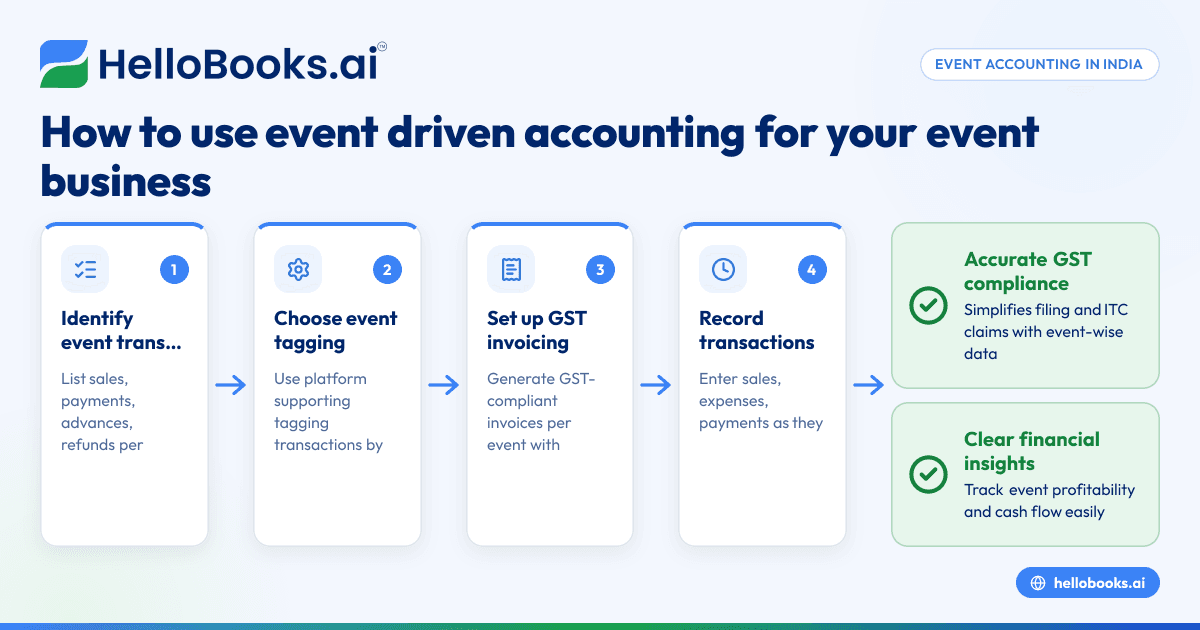
- Identify your event transaction types: List all financial activities related to your events, such as ticket sales, vendor payments, advance receipts, and refunds.
- Choose software or a system that supports event tagging: Ensure your accounting platform can tag transactions against specific events or projects for clear tracking.
- Set up GST invoicing per event: Generate GST-compliant invoices linked to each event, including HSN/SAC codes and GSTIN details, to simplify GSTR-1 filing.
- Record transactions immediately: Enter sales, expenses, and payments as soon as they occur to maintain real-time data accuracy.
- Reconcile bank statements regularly: Match your bank transactions with recorded events to catch discrepancies early.
- Monitor GST returns and deadlines: Use event-wise data to prepare GSTR-1 and GSTR-3B returns accurately and on time.
- Generate event-wise financial reports: Review profitability and cash flow per event to make informed business decisions.
- Review and adjust processes periodically: Check your accounting workflows for bottlenecks or errors and update your system or training accordingly.
This approach reduces manual data entry and errors, making GST compliance and financial management easier for event businesses. For more on managing local service businesses accounting, see Local service businesses.
Example (fictional figures)
Consider "Jaipur Events Co.", an event planner in Jaipur, recording a client booking on 15/03/2024:
- Event booking amount (assumed GST rate 18%): ₹1,00,000
- GST component calculation:
₹1,00,000 × 18% = ₹18,000
- Total invoice value:
₹1,00,000 + ₹18,000 = ₹1,18,000
- Vendor advance payment received on 10/03/2024: ₹30,000
- Vendor bill for supplies on 20/03/2024: ₹50,000 + 18% GST
₹50,000 × 18% = ₹9,000
Total vendor bill:
₹50,000 + ₹9,000 = ₹59,000
Steps taken:
- Record client invoice dated 15/03/2024 linked to the event.
- Tag vendor advance received on 10/03/2024 against the event.
- Record vendor bill dated 20/03/2024.
- Reconcile bank entries with these transactions.
- Prepare GSTR-1 and GSTR-3B for March using event-wise invoice data.
This helps Jaipur Events Co. track event profitability and GST compliance with clarity.
Common mistakes
- Not tagging transactions by event: Leads to confusion when reconciling or reporting. Prevent by always linking invoices and payments to specific events.
- Delaying transaction entry: Causes inaccurate cash flow and GST reporting. Prevent by recording transactions immediately.
- Ignoring GST details on invoices: Missing HSN/SAC codes or incorrect GSTINs cause filing errors. Prevent by using GST-compliant invoicing templates.
- Poor bank reconciliation: Unmatched transactions cause discrepancies. Prevent by reconciling bank statements regularly.
- Mixing personal and business expenses: Complicates accounting and GST claims. Prevent by maintaining separate accounts.
- Overlooking GST deadlines: Results in penalties. Prevent by tracking due dates and using reminders.
For more on GST invoicing best practices, see GST invoicing.
Frequently asked questions
What is an event driven accounting platform?
An event driven accounting platform records financial transactions as they happen, linked to specific events or projects. This real-time approach suits event businesses managing multiple simultaneous transactions.
How does it help with GST compliance?
By tagging invoices and expenses per event, it simplifies GSTR-1 and GSTR-3B filing, ensuring accurate tax reporting and easier ITC claims.
Can I use Excel or Tally for event driven accounting?
You can, but manual entry and tagging can be time-consuming and error-prone. Dedicated platforms streamline this process with automated tagging and reconciliation.
What should I look for when choosing such a platform?
Look for features like event tagging, GST-compliant invoicing, bank reconciliation support, and reporting capabilities aligned with your business size and transaction volume.
How often should I reconcile my accounts?
Monthly reconciliation is recommended to ensure your books match bank statements and GST returns, reducing errors and easing audits.
Are there platforms suited for local Indian service businesses?
Yes, platforms designed for local service businesses help manage GST invoicing, filing, and financial reports tailored to Indian tax rules. See HelloBooks for India for options.
Key takeaways
- An event driven accounting platform records transactions linked to specific events immediately.
- It helps event businesses manage multiple transactions efficiently and improves GST compliance.
- Tagging transactions by event and prompt data entry prevent errors and simplify reconciliation.
- Regular bank reconciliation and GST filing are critical to avoid penalties.
- Choosing software with GST invoicing and reporting features tailored for local service businesses is beneficial.
Start managing your event business accounts with confidence. Start on the Free plan (200 transactions a year, GSTR-1 and 3B filing for one GSTIN).


