
Key takeaways
What this article covers, in order:
- Why this comes up / what goes wrong
- Step-by-step
- Example (fictional figures)
- Common mistakes
- Doing this in HelloBooks
- Frequently asked questions
To evaluate Reckon accounting software for your projects, start by checking its features against your startup or tech business needs. Consider how it manages project accounting, invoicing, expense tracking, and compliance with Indian GST rules. This guide helps you assess Reckon with clear steps, an example, and tips to avoid common mistakes.
Why this comes up / what goes wrong
Owners and accountants at Indian startups and technology companies often struggle to find accounting software that fits their project-based workflows. Reckon is known internationally but may lack specific features needed for Indian GST compliance or integration with local banking and invoicing standards. Without a proper evaluation, businesses risk choosing software that complicates reconciliation, invoicing, or GST filing, leading to wasted time and potential compliance risks.
Step-by-step
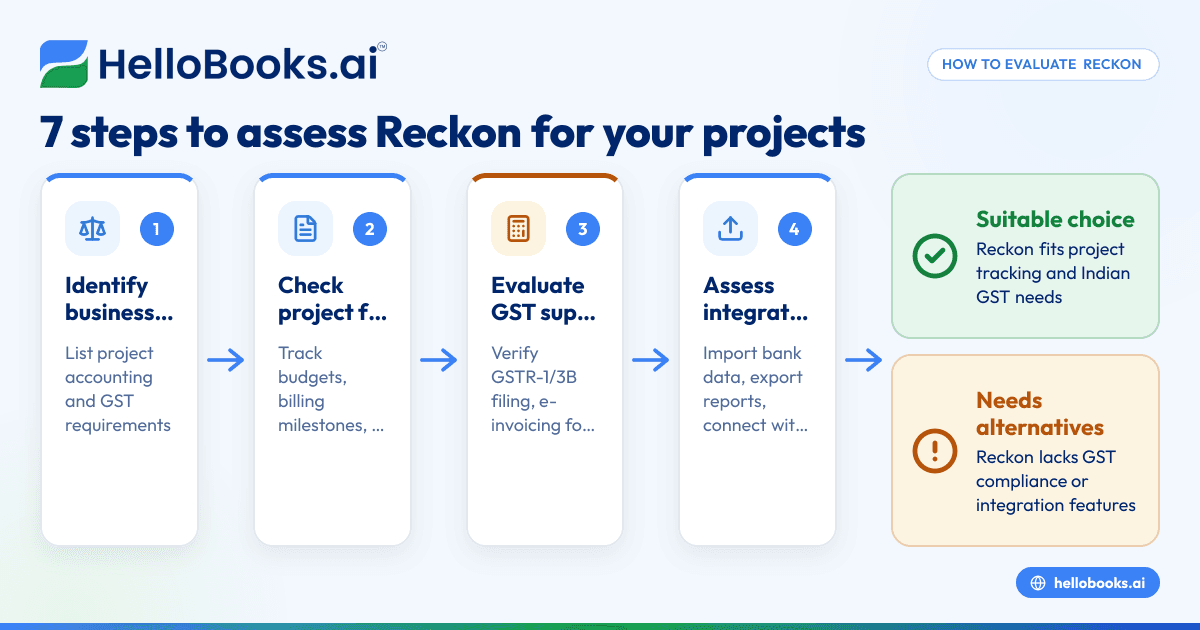
- Identify your business needs clearly: List your project accounting requirements, such as tracking costs by project, billing clients per milestone, and handling multiple GSTINs if applicable.
- Check Reckon’s project management features: Verify if Reckon supports detailed project tracking, budget vs actual reporting, and integrates with your invoicing process.
- Evaluate GST compliance support: Confirm Reckon’s capability for GST invoicing, e-invoicing if your turnover crosses the threshold, GSTR-1 and GSTR-3B filing, and reconciliation tools suitable for Indian GST.
- Assess integration and data import/export options: See if Reckon can import bank statements, export reports in formats usable for your accountant, and integrate with tools you use like Tally or Excel.
- Test usability and support: Consider the ease of use for your team and the availability of customer support in India, including language support if needed.
- Compare pricing and scalability: Check Reckon’s pricing model against your budget and whether it can scale as your startup grows.
- Request a trial or demo: Use Reckon’s trial to test real project data and see how it fits your workflows.
For alternatives tailored for Indian startups, see accounting software for small business and accounting software for startups.
Example (fictional figures)
Consider a Bengaluru-based SaaS startup with 12 employees managing a new product development project.
- Project budget: ₹25,00,000
- Expenses incurred by 31/05/2024: ₹10,00,000
- Invoices raised to clients: ₹8,00,000
Using Reckon, the accountant tracks:
- Budget vs actual expenses: ₹25,00,000 - ₹10,00,000 = ₹15,00,000 remaining
- Outstanding invoices: ₹8,00,000
- GST collected on invoices (assumed 18%): ₹8,00,000 × 18% = ₹1,44,000
- GST payable after input tax credit (ITC) on expenses (assumed 18%): ₹10,00,000 × 18% = ₹1,80,000
GST liability calculation:
- GST collected: ₹1,44,000
- ITC claimed: ₹1,80,000
- Net GST payable: ₹1,44,000 - ₹1,80,000 = -₹36,000 (GST credit to carry forward)
This example shows the need for software that can handle project budgets, invoicing, and GST calculations accurately.
Common mistakes
- Ignoring GST compliance features: Choose software without checking if it supports GSTR-1/3B filing and e-invoicing requirements. Prevent this by verifying GST capabilities upfront.
- Overlooking project-specific tracking: Not all accounting software supports detailed project cost tracking. Avoid this by testing project management features during evaluation.
- Assuming international software fits Indian tax rules: Reckon is global but may lack localized GST workflows. Confirm Indian GST compliance explicitly.
- Neglecting integration needs: Without smooth bank statement import or data export, reconciliation becomes manual and error-prone. Check integration options carefully.
- Not involving end-users in testing: Accountants and owners should both test software usability to ensure adoption.
- Skipping cost vs features comparison: Expensive software may have unused features, while cheaper options might lack essentials. Balance cost with your requirements.
For more on software suited to Indian startups, visit accounting software in India.
Doing this in HelloBooks
HelloBooks offers the Noor assistant on WhatsApp, which understands Hindi, English, and Hinglish. Owners who prefer working in Hinglish on WhatsApp can ask Noor questions about their books easily. This feature helps small businesses and startups get quick clarifications on accounting and GST compliance without navigating complex software interfaces. Learn more at HelloBooks for India.
Frequently asked questions
How does Reckon compare with other accounting software for startups?
Reckon offers solid project accounting features but may lack full Indian GST compliance and integration options. Startups should compare Reckon with local software that supports GSTR filings and e-invoicing.
Can Reckon handle GST e-invoicing for Indian businesses?
Reckon’s support for Indian GST e-invoicing is limited. Businesses crossing the e-invoicing threshold must ensure their software can generate IRN and QR codes as per government standards. NEEDS EXPERT REVIEW
What should I ask Reckon before buying?
Ask about Indian GST compliance, project tracking capabilities, bank statement import, multi-GSTIN support, and customer support availability in India.
Is there a free alternative tailored for Indian startups?
HelloBooks offers a Free plan with up to 200 transactions per year, including GSTR-1 and GSTR-3B filing for one GSTIN, suitable for small startups.
How to evaluate Reckon’s usability for my finance team?
Request a trial and involve your accountants and owners in testing day-to-day tasks like invoicing, GST filing, and project cost tracking.
Key takeaways
- Clearly define your project accounting and GST compliance needs before evaluating Reckon.
- Verify Reckon’s support for Indian GST invoicing, filing, and reconciliation.
- Test Reckon’s project tracking and invoicing features with real data.
- Avoid common mistakes like ignoring GST features and integration needs.
- Consider HelloBooks’ Noor assistant on WhatsApp for easy queries in Hinglish.
- Compare Reckon with other software tailored for Indian startups and technology companies.
Evaluate Reckon thoroughly to ensure it fits your startup’s accounting workflows and GST compliance. For an Indian startup-friendly option, consider starting with HelloBooks Free plan which supports GSTR filing and up to 200 transactions per year. Visit Start on the Free plan (200 transactions a year, GSTR-1 and 3B filing for one GSTIN) to begin.