


Key takeaways
What this article covers, in order:
- Why this comes up / what goes wrong
- Step-by-step
- Example (fictional figures)
- Common mistakes
- Frequently asked questions
- Key takeaways
Ecommerce accounting means keeping detailed and accurate records of your online sales, expenses, purchases, GST filings, and inventory. This lets you understand your business's financial health and ensures compliance with Indian tax laws. This guide is designed specifically for Indian ecommerce sellers such as Flipkart or Amazon sellers and D2C brands, explaining key accounting steps, common errors, and practical tips.
Why this comes up / what goes wrong
Ecommerce business owners and their accountants often face challenges because of multiple sales channels, varying GST rates, inventory management, and reconciling payments received from marketplaces. Many sellers use spreadsheets, Tally, or manual bill books but struggle with:
- Tracking GST on sales made through marketplaces and claiming input tax credit (ITC) from GSTR-2B.
- Managing multiple GSTINs if operating in different states.
- Reconciling payments from marketplaces like Flipkart or Amazon, which pay after deducting their commissions and fees.
- Handling returns, cancellations, and refunds that affect revenue and GST calculations.
- Maintaining clear inventory records to calculate cost of goods sold and for GST compliance.
These challenges often lead to errors in GSTR-1 and GSTR-3B filings, resulting in penalties or blocked ITC claims.
Step-by-step
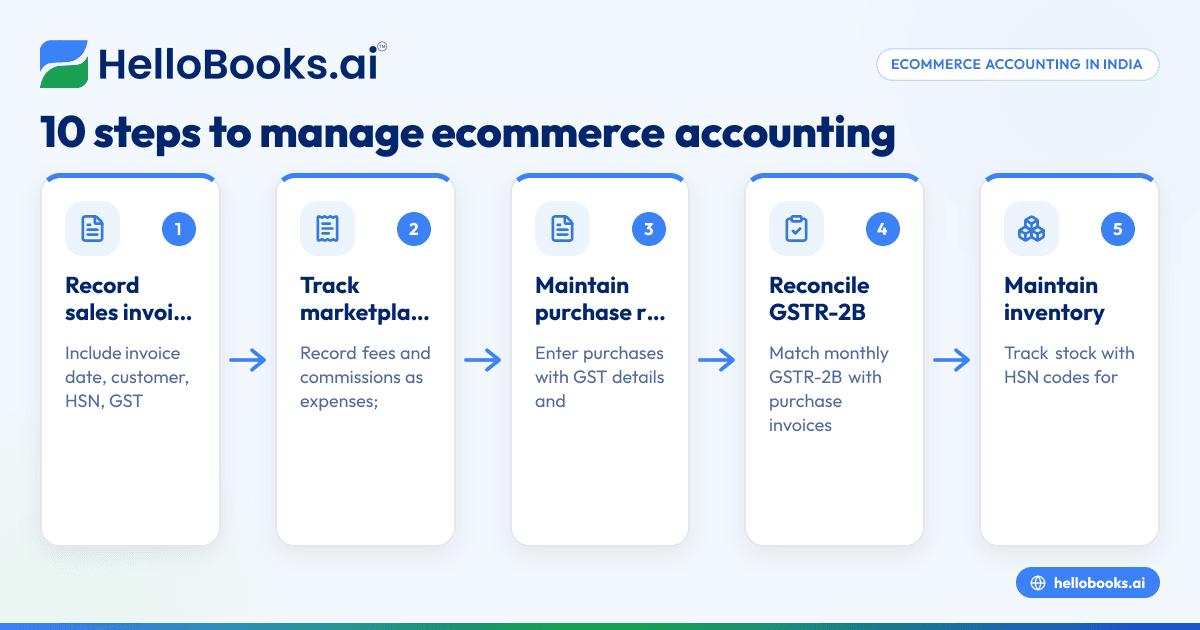
- Record all sales invoices accurately
- Capture sales from your ecommerce platforms or marketplaces.
- Include invoice date, customer details, HSN/SAC codes, GST rates, and amounts.
- Check if the sale is intra-state (CGST + SGST) or inter-state (IGST).
- Track marketplace fees and commissions
- Record fees deducted by Flipkart, Amazon, or others as expenses.
- Verify marketplace payment statements to reconcile with recorded sales.
- Maintain purchase and expense records
- Enter all purchases and expenses with GST details.
- Collect GST-compliant bills from suppliers.
- Reconcile GSTR-2B with purchase records
- Download GSTR-2B monthly to verify input tax credit eligibility.
- Match GSTR-2B data with your purchase invoices to avoid ITC mismatches.
- Maintain inventory records
- Track stock purchased, sold, and returned.
- Use HSN codes for inventory items to comply with GST requirements.
- File GSTR-1 and GSTR-3B on time
- Prepare GSTR-1 with all outward supplies.
- File GSTR-3B summarising sales, purchases, and GST liability.
- Handle returns and refunds
- Adjust sales and GST figures for cancelled orders or returns.
- Issue credit notes where applicable.
- Reconcile bank statements and payments
- Match payments received with recorded sales.
- Identify any delays or short payments from marketplaces.
- Maintain books regularly
- Update records weekly or monthly to avoid backlog.
- Review reports for discrepancies.
- Review and audit annually
- Prepare financial statements.
- Ensure compliance with GST and income tax laws.
For more details on invoicing in ecommerce, see GST invoicing. For ecommerce business specifics, visit E-commerce and online sellers.
Example (fictional figures)
Consider a Mumbai-based D2C skincare brand selling ₹1,50,00,000 worth of products in March 2024 with an assumed GST rate of 18%.
- Total sales = ₹1,50,00,000
- GST on sales = ₹1,50,00,000 × 18% = ₹27,00,000
- Marketplace commission (assumed 10%) = ₹1,50,00,000 × 10% = ₹15,00,000
- GST on commission (assumed 18%) = ₹15,00,000 × 18% = ₹2,70,000
- Purchases from suppliers = ₹70,00,000 with 18% GST = ₹12,60,000
Calculations:
- Total GST collected = ₹27,00,000
- Input GST credit = ₹12,60,000
- Marketplace GST expense = ₹2,70,000
GST payable in GSTR-3B:
= GST collected - (Input GST credit + Marketplace GST expense)
= ₹27,00,000 - (₹12,60,000 + ₹2,70,000)
= ₹27,00,000 - ₹15,30,000
= ₹11,70,000
This ₹11,70,000 is the GST liability to be paid for March 2024.
Common mistakes
- Not reconciling GSTR-2B with purchase invoices
- Prevent this by downloading GSTR-2B monthly and matching it with your purchase invoices to claim correct ITC.
- Ignoring marketplace commission GST
- Record marketplace fees and GST properly to avoid underreporting expenses and GST liability.
- Delaying bookkeeping
- Update your records regularly to prevent errors and last-minute rush during filing.
- Incorrect GST rates or HSN codes
- Verify HSN codes and GST rates for each product category to ensure accurate tax calculation.
- Not adjusting for returns or cancellations
- Issue credit notes and adjust GST promptly to reflect true sales figures.
- Failing to reconcile payments received
- Match bank statements with sales records to identify discrepancies or delayed payments.
Learn more about ecommerce GST filing at E-commerce and online sellers.
Frequently asked questions
What GST rates apply to ecommerce sales?
GST rates depend on the product category. Most goods fall under 5%, 12%, 18%, or 28%. Verify the correct HSN code for each product to apply the right GST rate.
Do ecommerce sellers need to file GSTR-1 separately?
Yes, ecommerce sellers must file GSTR-1 monthly or quarterly, reporting all outward supplies. This is separate from GSTR-3B, which summarises tax liability.
How to claim input tax credit on marketplace fees?
Marketplace fees attract GST and can be claimed as ITC if you have a valid tax invoice from the marketplace and the GST is paid.
Is inventory management necessary for GST compliance?
Yes, maintaining inventory records with HSN codes helps in accurate GST filings and audit readiness.
What are the consequences of late GST filing for ecommerce sellers?
Late filing can lead to penalties and interest charges, and may block input tax credit claims. Timely filing is essential.
Key takeaways
- Record all sales and expenses with correct GST details.
- Reconcile GSTR-2B and marketplace payments monthly.
- Track inventory with HSN codes for GST compliance.
- File GSTR-1 and GSTR-3B timely to avoid penalties.
- Adjust for returns and cancellations promptly.
- Maintain regular bookkeeping to reduce errors.
Start managing your ecommerce accounting efficiently. Start on the Free plan (200 transactions a year, GSTR-1 and 3B filing for one GSTIN).


