
Key takeaways
What this article covers, in order:
- Why this comes up / what goes wrong
- Step-by-step
- Example (fictional figures)
- Common mistakes
- Frequently asked questions
- Key takeaways
Dental office bookkeeping involves detailed recording of all financial transactions, including patient fees, sale of medicines, lab tests, staff salaries, rent, and GST compliance. Dental clinics and diagnostic labs have unique bookkeeping needs because they handle multiple service types, different GST treatments, and varied payment methods.
Why this comes up / what goes wrong
Many Indian dental clinics and diagnostic labs keep their books in spreadsheets, Tally, or manual bill books. This often causes errors such as missed GST filings, incorrect categorisation of income and expenses, and reconciliation difficulties. For example, a two-doctor dental clinic in Chennai may find it challenging to separate GST on medicines from exempt dental services or to track advance payments from patients. Similarly, a diagnostic lab in Lucknow may struggle to reconcile payments received via cash, bank transfers, and insurance claims. These issues delay GSTR-1 and GSTR-3B filing and can lead to penalties.
Step-by-step
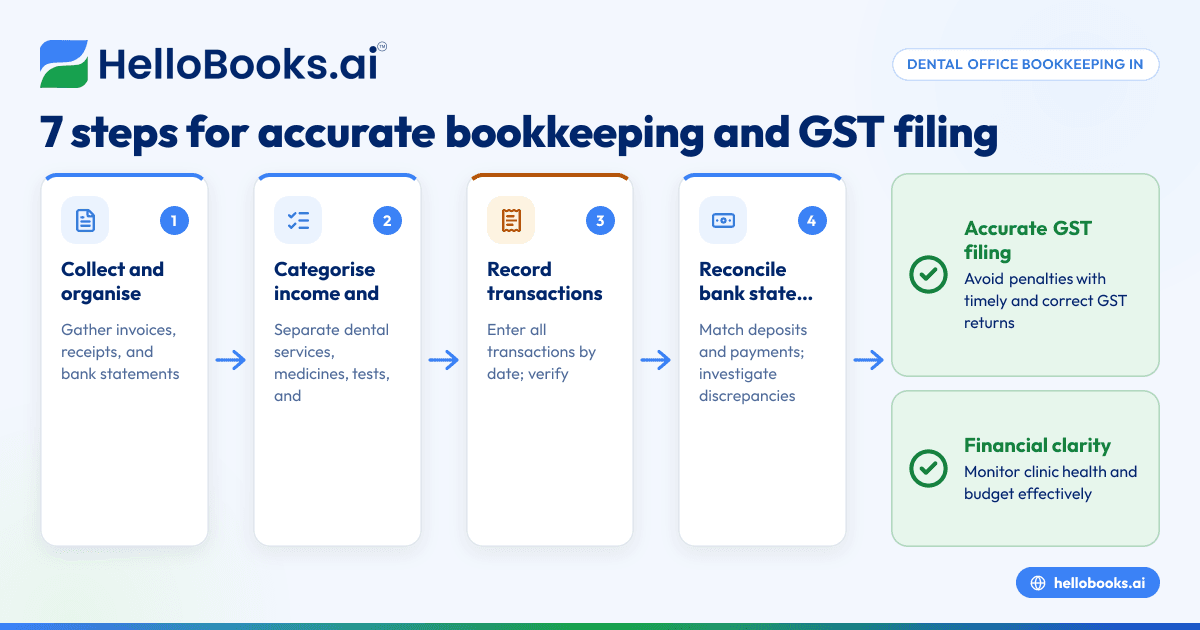
- Collect and Organise Financial Documents Daily Gather all invoices, receipts, payment slips, and bank statements every day. Check that each document is complete and legible to avoid missing data.
- Categorise Income and Expenses Clearly Separate income into dental services, sale of medicines, and laboratory tests. Classify expenses as staff salaries, rent, utilities, consumables, and GST paid. Clear categorisation helps with accurate GST filing and financial analysis.
- Record Transactions Chronologically Enter all transactions by date in your ledger or spreadsheet. Verify amounts and GST rates applied. Dental services are often GST exempt, while medicines and lab tests may attract GST at different rates. Confirm applicable GST rates carefully. NEEDS EXPERT REVIEW
- Reconcile Bank Statements Monthly Match bank deposits with recorded income and payments with expenses. Investigate discrepancies such as unrecorded cash payments, bank charges, or delayed deposits.
- Prepare and File GST Returns Accurately Use your records to file GSTR-1 (outward supplies) and GSTR-3B (summary return). Ensure invoices have correct GSTIN, HSN/SAC codes, and invoice numbers. Check input tax credit (ITC) eligibility carefully.
- Maintain Inventory Records for Medicines and Supplies Track stock levels to manage reorder points and GST compliance on purchases. Keep purchase invoices organised.
- Review Financial Reports Regularly Generate monthly profit and loss statements and balance sheets to monitor the financial health of your clinic or lab and plan budgets.
For more on bookkeeping automation, see AI bookkeeping and industry-specific advice at Clinics, labs and healthcare.
Example (fictional figures)
Consider a two-doctor dental clinic in Chennai for July 2023:
- Total dental services billed (assumed GST exempt): ₹3,00,000
- Sale of medicines (taxable at 12% GST): ₹50,000
- Expenses:
- Staff salaries: ₹1,20,000
- Rent: ₹30,000
- Dental supplies (including GST 12%): ₹40,000
GST calculation on medicines sold:
₹50,000 × 12% = ₹6,000 (Output GST)
GST paid on supplies:
₹40,000 × 12% = ₹4,800 (Input GST)
Net GST payable:
₹6,000 - ₹4,800 = ₹1,200
Monthly reconciliation:
- Total income recorded: ₹3,50,000
- Total expenses: ₹1,90,000
- GST payable: ₹1,200
This example shows how to separate exempt and taxable sales, calculate GST, and reconcile expenses for filing returns.
Common mistakes
- Mixing personal and clinic expenses Prevent by maintaining separate bank accounts and clear documentation for business expenses only.
- Incorrect GST classification Prevent by consulting GST notifications or a tax expert for healthcare services to apply the right GST rates.
- Delayed bank reconciliation leading to errors Prevent by scheduling monthly bank statement reconciliation to catch discrepancies early.
- Not maintaining inventory records Prevent by regularly checking stock and recording purchase invoices to avoid GST compliance issues.
- Incomplete invoice details Prevent by using standard invoice formats including GSTIN, invoice number, and HSN/SAC codes.
- Ignoring ITC eligibility rules Prevent by verifying supplier GST compliance before claiming input tax credits.
For detailed guidance, visit Clinics, labs and healthcare.
Frequently asked questions
What GST rates apply to dental services and medicines?
Dental services are often exempt from GST, but medicines sold may attract GST at 5%, 12%, or other rates depending on the item. Confirm rates with official GST notifications. NEEDS EXPERT REVIEW
How do I reconcile cash and digital payments in my clinic?
Maintain daily cash registers and bank deposit slips. Record all payments in your ledger and reconcile with bank statements monthly to identify discrepancies.
Can I claim input tax credit on dental supplies?
Yes, if the supplies are used for business and the supplier has complied with GST rules. Keep purchase invoices and verify GSTIN of suppliers.
How often should I file GST returns for my dental clinic?
Monthly filing of GSTR-1 and GSTR-3B is required for most GST-registered businesses. Some small taxpayers may follow quarterly filing under QRMP scheme. NEEDS EXPERT REVIEW
What records should I keep for GST audits?
Maintain invoices, payment proofs, bank statements, inventory records, and GST returns for at least six years as per GST rules. NEEDS EXPERT REVIEW
For more on bookkeeping for healthcare, see HelloBooks for India.
Key takeaways
- Separate income and expenses by category for accurate GST compliance.
- Reconcile bank statements monthly to avoid errors.
- Maintain complete and standardised invoices with GST details.
- Track inventory of medicines and dental supplies carefully.
- File GSTR-1 and GSTR-3B timely using reconciled data.
- Avoid mixing personal and business finances.
Start managing your dental office bookkeeping efficiently. Start on the Free plan (200 transactions a year, GSTR-1 and 3B filing for one GSTIN).