
Key takeaways
What this article covers, in order:
- Why this comes up / what goes wrong
- Step-by-step
- Example (fictional figures)
- Common mistakes
- Frequently asked questions
- Key takeaways
Dental accounting software is essential for dental clinics and practices to efficiently manage their financial records, billing, and GST compliance. Unlike generic accounting software, dental accounting software often includes features tailored to healthcare providers, such as tracking patient payments, managing lease accounting for equipment, and handling accounts receivable specific to dental services.
Why this comes up / what goes wrong
Dental business owners or accountants often face challenges managing accounts because dental clinics have unique billing cycles, multiple revenue streams (consultations, procedures, lab tests), and regulatory compliance requirements like GST invoicing and filing. Many still use spreadsheets, Tally, or manual bill books, leading to time-consuming data entry and reconciliation errors. They search for dental accounting software to simplify these tasks, improve accuracy, and maintain compliance.
Dental practices may also struggle with lease accounting for expensive dental equipment and tracking accounts receivable from patients and insurance. Selecting software that understands these nuances can save hours each month and reduce mistakes.
Step-by-step
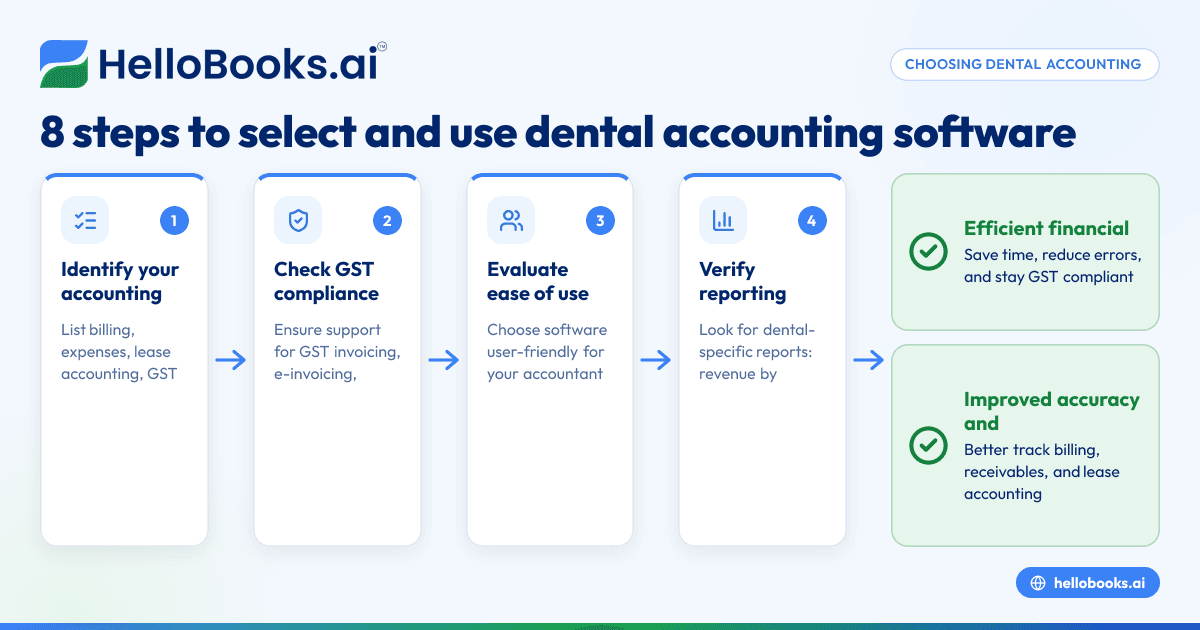
- Identify your clinic’s accounting needs: List all financial tasks including billing patients, managing expenses, lease accounting for equipment, GST invoicing, and filing. Check if you need features like accounts receivable tracking or inventory management for dental supplies.
- Check GST compliance features: Ensure the software supports GST invoicing, e-invoicing if applicable, and filing of GSTR-1 and GSTR-3B returns. This is crucial for Indian dental businesses.
- Evaluate ease of use for your team: The software should be user-friendly for your accountant or finance lead, especially if they are used to spreadsheets or Tally.
- Verify reporting capabilities: Look for financial reports tailored to healthcare or dental practices, such as revenue by procedure, outstanding patient payments, and expense categorisation.
- Consider lease accounting support: If your clinic finances dental equipment through leases, check if the software can handle lease schedules and depreciation.
- Compare pricing and plans: Choose software that fits your budget and offers scalability as your practice grows.
- Test with a trial or demo: Use trial versions to see if the software meets your workflow and integrates well with your existing tools.
- Check for local support and updates: Prefer software that updates regularly for GST changes and offers India-based customer support.
For more on accounting software suited for small businesses like clinics, see accounting software for small business and accounting software in India.
Example (fictional figures)
A two-doctor dental clinic in Chennai uses dental accounting software to manage monthly billing and GST.
- Total patient invoices for March 2024: ₹3,50,000
- GST applicable (assumed illustrative rate): 18%
- Expenses (rent, supplies, staff salaries): ₹1,50,000
Calculations:
GST on sales = ₹3,50,000 × 18% = ₹63,000
Total sales including GST = ₹3,50,000 + ₹63,000 = ₹4,13,000
Net income before expenses = ₹3,50,000
Expenses = ₹1,50,000
Net income after expenses = ₹3,50,000 - ₹1,50,000 = ₹2,00,000
GST payable after input tax credit (assumed ITC on expenses at 18%) = ₹1,50,000 × 18% = ₹27,000
GST to pay = GST on sales - ITC = ₹63,000 - ₹27,000 = ₹36,000
The software helps generate invoices with GST, tracks payments, and prepares GSTR-1 and GSTR-3B returns for filing.
Common mistakes
- Using generic accounting software without dental-specific features: Prevent by choosing software that can handle dental billing and accounts receivable.
- Ignoring GST compliance needs: Prevent by verifying the software supports GST invoicing, e-invoicing, and filing.
- Not tracking lease accounting for equipment: Prevent by selecting software that manages lease schedules if you finance dental equipment.
- Manual data entry causing errors: Prevent by using software with import features or integration to reduce manual entry.
- Overlooking reporting needs specific to dental clinics: Prevent by ensuring the software provides reports on patient payments, revenue by procedure, and expenses.
- Choosing software without local support or updates: Prevent by selecting products with India-based support and regular GST updates.
For advice on bookkeeping automation, see AI bookkeeping.
Frequently asked questions
What is the best accounting software for dental clinics?
The best software depends on your clinic size and needs. Look for features like GST compliance, billing management, lease accounting, and dental-specific reports. Testing demos helps find the right fit.
How does dental practice accounting software handle accounts receivable?
It tracks patient invoices, due dates, and payments, helping you follow up on outstanding amounts. Some software also manages insurance claims and payment plans.
Can I use general accounting software for my dental practice?
Yes, but you may miss features specific to dental billing and lease accounting. This can lead to more manual work and errors.
Do dental accounting software solutions support GST filing?
Most Indian dental accounting software supports GST invoicing and filing of GSTR-1 and GSTR-3B returns, which is mandatory for registered businesses.
Is lease accounting important for dental clinics?
Yes, because dental equipment is often leased or financed. Proper lease accounting helps track payments and depreciation accurately.
How can I simplify bookkeeping for my dental clinic?
Automate data entry, use software with bank statement import, and maintain consistent expense categorisation. Consider software designed for small business accounting in India.
Key takeaways
- Dental accounting software is tailored to manage clinic-specific billing, GST compliance, and lease accounting.
- Check for GST invoicing, e-invoicing, and filing features before choosing software.
- Use software with reporting features specific to dental practices for better financial insights.
- Avoid manual errors by choosing software that supports import and automation.
- Lease accounting support is important if your clinic finances dental equipment.
- Test software demos and ensure local support before committing.
Choosing the right dental accounting software can save time and improve accuracy in your financial management. To explore software options suitable for your clinic, start on the Free plan (200 transactions a year, GSTR-1 and 3B filing for one GSTIN) at HelloBooks pricing.