


Key takeaways
What this article covers, in order:
- Why this comes up / what goes wrong
- Step-by-step
- Example (fictional figures)
- Common mistakes
- Doing this in HelloBooks
- Frequently asked questions
Construction accounting involves managing many suppliers, subcontractors, retention amounts, and staged payments, which makes month-end reconciliation complex and time-consuming. Project accountants in construction firms often spend excessive hours matching supplier invoices, bank payments, and GST data, leading to costly delays and errors.
Why this comes up / what goes wrong
In construction businesses such as a civil contractor in Nagpur or an interior contractor in Hyderabad, project accountants handle numerous purchase bills and GST invoices. Retention amounts withheld by clients complicate invoice matching and payment tracking. Supplier invoices may be missing or mismatched in GST returns, causing ITC claim errors. Bank statements contain many transactions that need to be matched with ledger entries. Without automation, these tasks require manual data entry and reconciliation, which is prone to errors and delays, risking inaccurate GST returns and financial reports.
Step-by-step
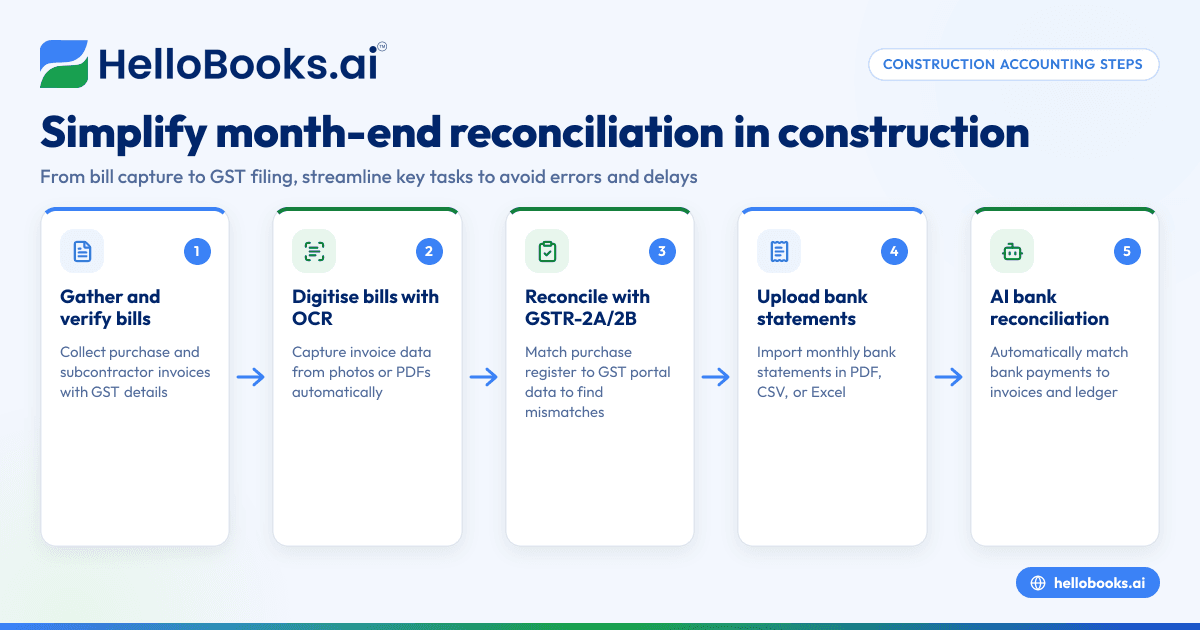
- Gather all purchase bills and invoices: Collect supplier bills, subcontractor invoices, and expense receipts. Verify each bill includes correct GSTIN, HSN/SAC codes, and invoice details.
- Digitise purchase bills: Use OCR-based tools to capture bills from photos or PDFs, avoiding manual entry errors.
- Reconcile purchase register against GSTR-2A and GSTR-2B: Match your purchase invoices with GST portal data to identify missing or mismatched invoices before filing GSTR-3B.
- Obtain monthly bank statements: Download bank statements in PDF, CSV, or Excel formats from your bank.
- Upload bank statements and use AI reconciliation: Use software that automatically matches bank transactions with invoices and ledger entries, highlighting exceptions.
- Review and resolve exceptions: Investigate unmatched transactions or discrepancies in GST invoices and bank entries.
- Account for retention and advances: Track retention amounts held by clients separately and adjust accounting entries accordingly.
- Prepare financial reports and file GST returns: After reconciliation, generate reports and file GSTR-1 and GSTR-3B accurately.
For more details, see bank reconciliation software and GSTR-2B reconciliation and ITC.
Example (fictional figures)
A civil contractor in Nagpur has the following for March 2024:
- Purchase bills total ₹5,00,000 including GST.
- Retention withheld by client: ₹50,000.
- Bank statement shows ₹4,50,000 paid to suppliers.
Step 1: Upload purchase bills using OCR.
Step 2: Match purchase register to GSTR-2B. Suppose ₹4,80,000 worth of invoices appear in GSTR-2B; ₹20,000 is missing.
Step 3: Upload bank statement and AI matches ₹4,50,000 payments to invoices.
Step 4: Confirm retention ₹50,000 is recorded as payable.
Calculations:
Purchase bills total = ₹5,00,000
Retention withheld = ₹50,000
Payments made = ₹4,50,000
Expected payments = Purchase bills - Retention = ₹5,00,000 - ₹50,000 = ₹4,50,000
The bank payment matches expected payment, confirming accuracy.
The ₹20,000 missing from GSTR-2B should be followed up with the supplier to avoid ITC issues.
Common mistakes
- Not reconciling purchase register with GSTR-2B: Leads to claiming ITC on missing invoices. Prevent by regularly checking GST purchase data.
- Manual data entry of bills: Causes errors and wastes time. Use OCR to automate bill capture.
- Ignoring bank statement discrepancies: Missed or duplicate payments cause errors. Use AI reconciliation to find mismatches.
- Failing to track retention amounts: Results in incorrect payment and revenue recognition. Maintain clear retention ledgers.
- Delaying reconciliation until month-end: Causes last-minute rush and errors. Reconcile weekly or biweekly.
- Not reviewing exceptions flagged by software: Unresolved exceptions lead to inaccurate books. Always review flagged items.
More tips on avoiding errors are in accounting software for small business.
Doing this in HelloBooks
HelloBooks offers GSTR-2A/2B reconciliation and ITC tracking that flags missing or mismatched supplier invoices before you claim ITC in GSTR-3B. You can upload monthly bank statements in PDF, CSV, or Excel formats, and HelloBooks uses AI to automatically match transactions to your ledger without manual re-typing. Supplier purchase bills can be captured quickly using OCR from photos or PDFs, reducing data entry time and errors. These features help construction project accountants reduce month-end reconciliation headaches and improve accuracy. Learn more at GSTR-2B reconciliation and ITC and bank reconciliation.
Frequently asked questions
What is month-end reconciliation in construction accounting?
Month-end reconciliation involves matching purchase invoices, bank payments, and GST data to ensure your books are accurate before filing returns. It is critical in construction due to multiple suppliers and retention amounts.
How does GST 2B reconciliation help project accountants?
GSTR-2B reconciliation compares your purchase register with GST portal data to highlight missing or mismatched invoices, preventing ITC claim errors and penalties.
Can AI bank statement reconciliation work without live bank feeds?
Yes. You can upload bank statements manually in formats like PDF or Excel. AI then matches transactions to invoices and ledger entries, reducing manual work.
Why is OCR useful for purchase bills?
OCR technology extracts data from photos or PDFs of bills automatically, saving time and reducing errors compared to manual data entry.
How should retention amounts be handled in accounting software?
Retention amounts withheld by clients should be tracked separately as payable liabilities and adjusted when released to ensure accurate cash flow and revenue reporting.
Key takeaways
- Construction accounting requires accurate matching of purchase bills, GST invoices, and bank payments.
- Automate bill entry using OCR to reduce manual data entry errors.
- Regularly reconcile purchase register with GSTR-2B before filing GSTR-3B.
- Upload bank statements monthly and use AI reconciliation to match payments.
- Track retention amounts clearly to avoid payment and revenue errors.
- Use software features like HelloBooks’ GSTR-2B reconciliation, AI bank statement matching, and OCR bill capture to reduce month-end reconciliation workload.
Start managing your construction accounting efficiently. Start on the Free plan (200 transactions a year, GSTR-1 and 3B filing for one GSTIN).


