
Key takeaways
What this article covers, in order:
- How agency accounting works in the UAE
- A chart of accounts that fits a UAE marketing agency
- Retainers should not all hit income on day one
- Media spend and production costs: revenue or pass-through?
- Work done but not yet billed should not disappear
- UAE VAT records matter as much as the invoice itself
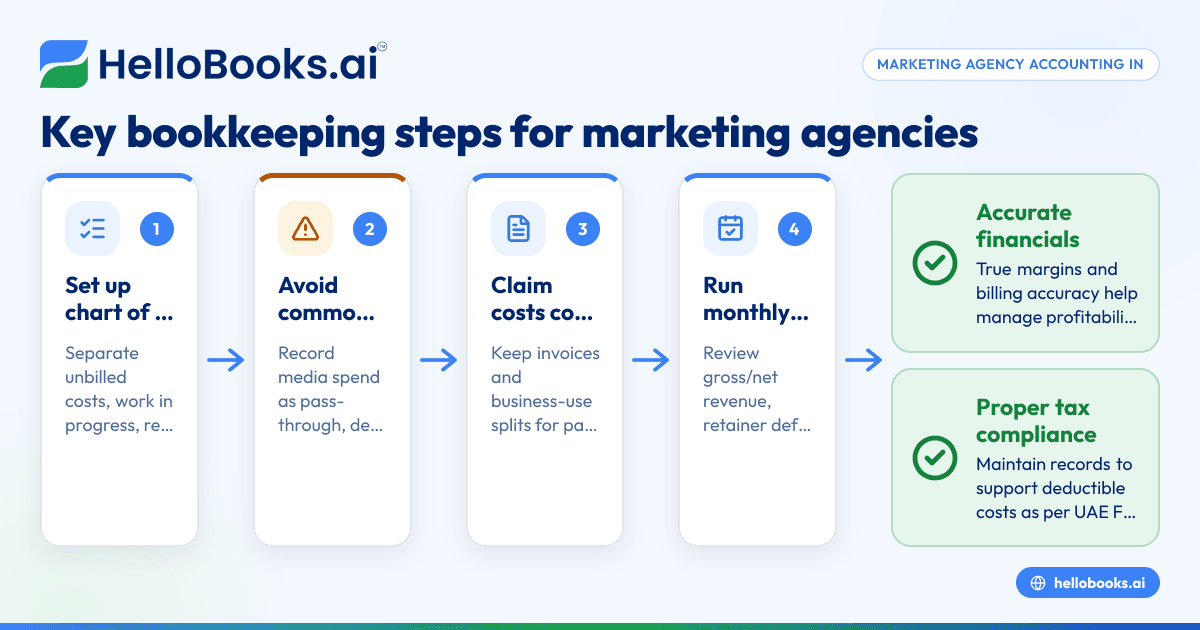
The UAE accounting setup for a marketing agency should separate fee income, pass-through client spend, deferred retainer income, and unbilled work from day one, because that is what keeps your books usable for management, VAT and corporate tax. In practice, that means recording in AED, keeping invoice and receipt evidence for the Federal Tax Authority, and making sure your bookkeeping reflects how agency work is actually sold and delivered under UAE rules rather than a generic service-business template.
How agency accounting works in the UAE
A marketing agency in the UAE rarely earns revenue in a smooth, simple way. One client pays a monthly retainer in dirham before the month starts. Another approves a campaign now but asks for the invoice later. A third asks the agency to buy media or production services on its behalf and recover the cost afterward. If all of that is pushed into a basic income-and-expense ledger, the numbers become misleading very quickly.
For UAE businesses, the bookkeeping has to serve several purposes at once:
- it should show what the agency actually earned from its own services;
- it should keep support for VAT treatment under the Federal Decree-Law on Value Added Tax and the guidance published by the Federal Tax Authority on the FTA website and EmaraTax;
- it should support corporate tax analysis under the Corporate Tax Law, formally Federal Decree-Law No. 47 of 2022 on the Taxation of Corporations and Businesses, with current details published by the Ministry of Finance and the Federal Tax Authority;
- it should make month-end management reporting usable, especially when founders want to know client profitability, receivables and cash flow.
That is why a UAE agency usually needs accounts that are more specific than a default template.
A chart of accounts that fits a UAE marketing agency
The point is not the numbering. The point is the separation. If your agency is in Dubai, Abu Dhabi, Sharjah or a free zone such as Jebel Ali, the same logic applies: keep lines distinct enough that you can answer tax, audit and management questions without rebuilding the books in a spreadsheet.
A practical structure often includes:
- Fee income from strategy, creative, social, performance or campaign management
- Reimbursable client costs
- Pass-through media or production spend
- Deferred retainer income
- Unbilled revenue or work completed but not yet invoiced
- Trade receivables
- Contractor and freelance costs
- Software and subscription costs
- Staff costs and WPS-related payroll clearing where relevant
- VAT control accounts
The distinction between reimbursable client costs and your own agency costs matters. So does the distinction between cash received and income earned. A payment arriving in your UAE bank account against an IBAN is not automatically revenue for that month just because the cash is there.
If you use accounting software for small business, set the ledger up around these realities before you start issuing invoices. Reclassifying a full year afterward is where agencies lose time and confidence in their numbers.
Retainers should not all hit income on day one
A monthly retainer is one of the easiest places to overstate revenue.
If a client pays in advance for a month of ongoing work, the accounting question is not only when the dirham lands in the bank. The question is when the service is earned. For management accounts, many agencies record the receipt first and then release it into income as work is delivered through the month. That gives a truer view of performance, especially when one month starts with a large collection run and another does not.
The VAT position must be checked against the UAE VAT Law, executive regulations and the Federal Tax Authority's current guidance on tax invoices, time of supply and record keeping, published through the FTA website and EmaraTax. The exact treatment depends on the facts, so avoid assuming your management timing and tax timing are identical without review.
Illustrative and invented numbers only: suppose an agency receives AED 12,000 from a client on the first day of a month for ongoing campaign management. For internal reporting, it may initially credit deferred income and then recognise AED 6,000 by mid-month and AED 6,000 by month-end as the work is performed. This illustration leaves out any VAT analysis, contract wording and specific FTA guidance, so the tax treatment NEEDS EXPERT REVIEW.
The operational lesson is simple: if retainers are material, your books should show what is still unearned at month-end.
Media spend and production costs: revenue or pass-through?
This is the classic agency distortion.
If you buy ad spend, video production, printing, event materials or influencer costs and then recharge them to the client, you need to decide whether they are:
- costs incurred as principal, forming part of your own revenue model; or
- pass-through amounts incurred as agent on behalf of the client.
That conclusion affects both commercial reporting and, potentially, tax treatment. In the UAE, the right answer turns on the underlying contract, invoicing structure, who controls the supply, and the current guidance issued under the VAT framework by the Federal Tax Authority. For corporate tax and financial reporting, the distinction also matters because grossing up pass-through spend can make the business look larger and less profitable than it really is.
A practical agency ledger therefore benefits from separate accounts for:
- media purchased on behalf of clients;
- rebilled client costs;
- production costs that belong to the agency's own delivery;
- third-party spend awaiting recharge.
Illustrative and invented numbers only: imagine a client approves AED 18,000 of platform media spend and your agency charges an additional AED 4,000 service fee. If the AED 18,000 is truly pass-through under the contractual facts, management may want to view margin on the AED 4,000 fee rather than on AED 22,000 of gross billings. This illustration leaves out legal drafting, VAT treatment, and whether the agency acted as principal or agent, so the final treatment NEEDS EXPERT REVIEW.
The bookkeeping objective is not sophistication for its own sake. It is to stop gross billings from pretending to be agency income.
Work done but not yet billed should not disappear
Agencies often finish a campaign stage, deliver assets, or complete a reporting cycle before the invoice is issued. If the books only move when the invoice is sent, one month looks weak and the next month looks artificially strong.
That is why many agencies track unbilled revenue or work in progress for management accounts. This is especially helpful when:
- the agency works on fixed-fee projects across more than one month;
- a statement of work has milestones but billing trails delivery;
- client approval holds up invoicing after substantial work is complete.
This is not a licence to book optimistic revenue. It is a prompt to align internal reporting with delivery reality, backed by contracts, approvals and evidence. The financial reporting basis you use and any tax implications should be reviewed with your accountant.
If your team issues invoices from smart invoicing workflows and keeps delivery evidence attached to client records, month-end is easier because finance can see which jobs are complete, which are pending approval and which are already billed.
UAE VAT records matter as much as the invoice itself
For a marketing agency, VAT risk is often less about complicated products and more about weak records.
The Federal Tax Authority expects proper tax invoices, supporting purchase documents and records that can explain the business purpose of costs. Current requirements, including invoice content and record-keeping rules, are published under the UAE VAT legislation and FTA guidance on the official FTA channels and EmaraTax. Because those rules can change, the current figures and conditions should always be checked there.
For an agency, the records worth keeping close to each transaction include:
- the client contract or statement of work;
- the sales invoice and, where relevant, the client's TRN;
- supplier bills for media, production, freelancers and software;
- evidence showing whether a cost was the agency's own cost or a client cost to be recharged;
- receipts for out-of-pocket expenses;
- proof of payment from the bank statement;
- credit notes or revised approvals if campaign scope changes.
This is where good bookkeeping software helps in a very unglamorous but important way. When purchase bills are captured from a photo or PDF using OCR, and when receipts are attached to entries at the time of posting, the file is far easier to defend later. For agencies with high transaction volume, expense management software can reduce the scramble for missing documents at VAT review time.
Corporate tax means agency bookkeeping now needs cleaner classifications
The UAE's Corporate Tax Law changed the standard for "good enough" bookkeeping. Even if your agency is small, you still need books that can support the tax position you take under Federal Decree-Law No. 47 of 2022 and the decisions and guidance issued by the Ministry of Finance and the Federal Tax Authority.
You should not treat this as a question only for year-end. Month by month, your records should make it possible to identify:
- service income versus reimbursements and pass-through amounts;
- contractor and freelancer costs;
- staff-related costs;
- software subscriptions and overheads;
- entertainment or mixed-purpose spending that may need review;
- balances between mainland entities and free zone entities, where relevant.
Free zone agencies have an extra reason to keep classifications clean. If your structure involves a free zone entity, the tax analysis may depend on the nature of the income, counterparties, substance and conditions under the applicable law and published guidance. The current criteria are not something to carry around from memory; they must be checked in the latest official materials from the Ministry of Finance and the FTA. Any simplified statement here would NEEDS EXPERT REVIEW.
The practical point is that a UAE agency's ledger should help answer tax questions before the adviser asks them.
Bank reconciliation is not admin; it is where agency errors surface
Marketing agencies tend to have messy bank activity: client retainers, partial payments, expense reimbursements, card charges for platforms, staff out-of-pocket claims, refunds and supplier settlements. If you skip reconciliations, the books drift quickly.
In the UAE, where payments may arrive through local transfers linked to an IBAN, through cards, or through newer rails such as Aani, narration quality can vary. Reconciliation becomes the place where finance confirms what a receipt actually relates to.
A useful workflow is to upload the bank statement each month and match receipts and payments against invoices, supplier bills and expense claims. That is especially valuable when multiple receipts from one client hit the account across the month, or when a campaign platform refund appears long after the original charge. Using bank reconciliation software and ai-bookkeeping support can cut down the manual matching, but the agency still needs human review for unusual items like pass-through costs, director expenses or misapplied client receipts.
For owner-managed agencies, this is often the fastest way to catch three common problems:
- old receivables that were actually paid but never matched;
- supplier costs posted twice from both a receipt and a card line;
- client spend sitting in the wrong account and distorting revenue.
Inventory is rare for agencies, but not always irrelevant
Many marketing agencies have no inventory in the traditional sense. But some do hold promotional merchandise, event materials, printed collateral, point-of-sale items or packaging stock for campaigns. If yours does, track it properly instead of burying everything in a general expense account.
That matters because campaign profitability can swing depending on whether unused stock is still on hand at month-end or fully consumed. If you manage branded materials across repeated client activations, inventory tracking can help separate what has been purchased, what has been deployed and what remains available.
This is especially relevant for agencies handling experiential campaigns, retail displays or event kits in places like Jebel Ali logistics facilities or third-party warehouses. Even then, keep the accounting objective modest: accurate stock records, sensible cost allocation and a usable month-end close.
The reports a UAE agency should read every month
A clean ledger only becomes useful when it produces reports you actually read.
For most UAE marketing agencies, the monthly pack should include:
- Profit and loss by month, with pass-through spend clearly separated from fee income
- Receivables ageing, so old client balances are chased before cash gets tight
- Payables and unpaid supplier bills, especially for freelancers and media vendors
- Deferred income or retainer balance movement
- Unbilled work or work in progress, if used for management reporting
- Cash flow view from bank movements in AED
- Client or campaign profitability where your records support it
This is where integrated financial reports matter more than extra dashboard decoration. Founders usually want answers to basic questions: which clients actually make money, what costs are waiting to be rebilled, and whether the month's collections match the work already delivered.
What to look for in software if you run a UAE agency
A UAE agency does not need every feature under the sun. It needs software that makes the boring accounting disciplines easier to maintain.
Useful capabilities for this kind of business include being able to create professional invoices, capture purchase bills from PDFs and photos, reconcile uploaded bank statements against client receipts and supplier payments, keep expense evidence attached to transactions, and produce reliable financial reports from the same records used for day-to-day bookkeeping. If agency owners approve spending on the move, a mobile app on iOS and Android helps keep receipt capture from slipping into month-end chaos. For teams that prefer quick queries in chat, Noor on WhatsApp can be practical for asking bookkeeping questions in English, Hindi or Hinglish.
If you are comparing options, start with whether the system can support your invoicing, bookkeeping, receipt capture and reporting discipline rather than chasing generic claims. You can explore HelloBooks from the UAE page, book a demo, or review plans at /in/pricing.
For a marketing agency in the UAE, the best accounting setup is usually the one that keeps fee income, pass-through costs, VAT evidence, bank reconciliation and month-end reporting clean enough that both management and tax conversations start from the same set of books.