
Key takeaways
What this article covers, in order:
- Build your books around sites, contracts, and supervisors
- Separate recurring service income from one-off cleaning work
- Labour is your biggest cost, so split payroll and subcontractors properly
- Consumables, machines, and stock need more discipline than many service firms expect
- GST for cleaning services is mostly a workflow issue, not just a filing issue
- Collections matter as much as sales because many clients pay late
India cleaning businesses need accounts that show, quickly, which client sites actually make money, whether your GST invoices match what goes to the GST Portal, and which payments are still stuck in receivables. The practical setup is to track revenue and costs by site or contract, separate payroll from subcontract labour, record consumables properly, and keep bank, GST, and customer collections aligned. If you do that well, your rupee-level reporting becomes useful for decisions instead of just year-end compliance.
Build your books around sites, contracts, and supervisors
A cleaning business is service-heavy, but the accounting trouble usually comes from treating it as too simple. You may invoice one office park every month, handle one-off deep-clean jobs for apartments, deploy teams across several buildings, and buy chemicals, mops, liners, and machines centrally. If all of that lands in one sales account and a few broad expense heads, your profit and loss statement stops answering the questions you actually care about.
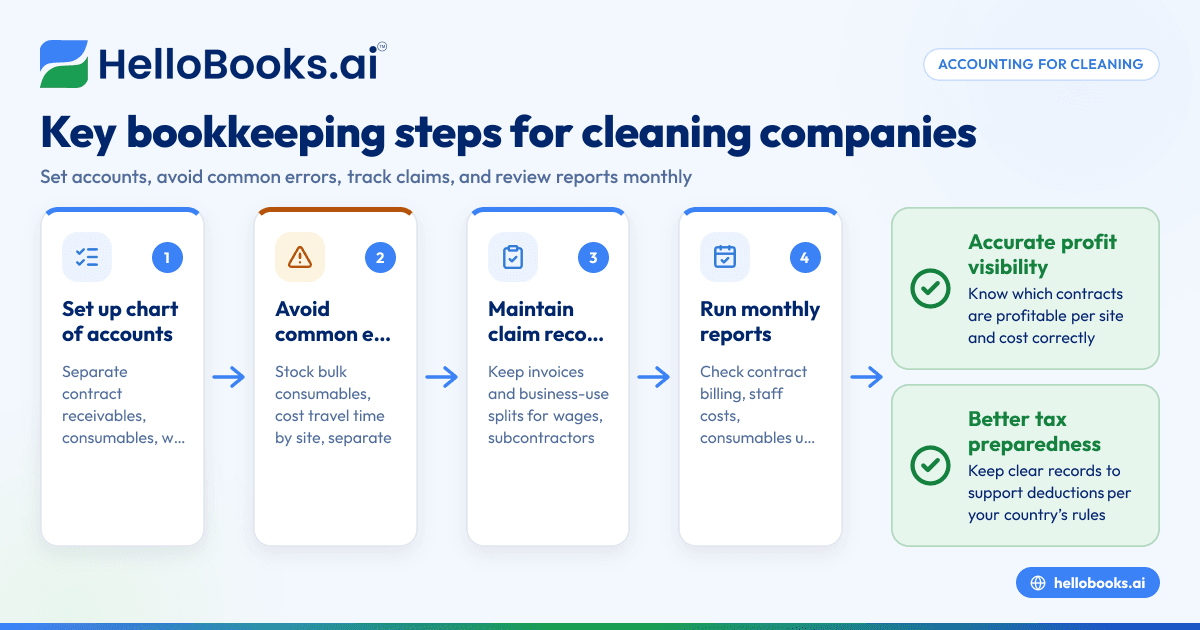
For most Indian operators, the right structure is not hundreds of ledgers. It is a sensible chart of accounts plus tracking by site, contract, or customer group. In practice, that often means separating:
- recurring housekeeping contracts from one-time jobs
- payroll staff from subcontract cleaners
- consumables bought for stock from consumables used on jobs
- equipment repairs from regular supplies
- customer advances from normal receivables
- GST output and input ledgers from the operating accounts
- TDS receivable where a customer has deducted tax under the Income Tax Act, 1961, as administered by the Central Board of Direct Taxes; current provisions are published by the Income Tax Department and in the Act itself
If a mall site in Pune needs extra labour every week while a Bengaluru corporate office pays on time and uses fewer materials, your books should make that visible. Good accounting for cleaning is really operational accounting.
When software lets you tag invoices, purchases, and collections consistently, monthly financial reports become useful instead of decorative. That matters more than fancy year-end formatting.
Separate recurring service income from one-off cleaning work
A monthly contract and a post-construction deep-clean may both be “cleaning revenue,” but they behave differently. One is predictable and often billed on agreed cycles. The other may involve higher staffing intensity, more chemicals, extra machine hire, and slower collection because approvals sit with a different department.
If you combine them, you lose margin visibility.
A practical revenue structure for a cleaning business in India often separates:
- periodic facility or housekeeping contracts
- deep cleaning
- specialised work such as sofa, carpet, glass, or facade cleaning
- disinfection or niche treatment work where relevant
- incidental charges such as consumables billed separately
This also matters for GST invoicing. Under the Central Goods and Services Tax Act, 2017, the Integrated Goods and Services Tax Act, 2017, and related rules administered by CBIC through GSTN on the GST Portal, invoice particulars, place-of-supply treatment, return reporting, and current rate notifications are published through official notifications, circulars, and the GST Portal. If you need the current treatment for a particular service bundle, verify the latest official publication before issuing or filing.
For businesses serving clients across states, place of supply determines whether the tax heads on the invoice are CGST plus SGST or IGST. A wrong split can flow into GSTR-1 incorrectly and then create mismatch headaches in GSTR-3B. Software that automatically applies the place-of-supply logic from the customer GSTIN and invoice facts can reduce that risk, especially when one team bills clients in more than one state.
If you create invoices directly in a system built for smart invoicing, the sales data used for collection follow-up and the sales data used for GST stay connected, which is exactly what a service business needs.
Labour is your biggest cost, so split payroll and subcontractors properly
In cleaning, labour usually decides whether a contract survives. Many owners know their total wage bill but still cannot tell whether a site is underpriced because the cost is pooled at company level.
You should normally separate at least these buckets:
- employee wages
- supervisor salaries
- temporary labour
- subcontract cleaning charges
- staff travel and local conveyance
- uniforms and safety gear
- PF, ESI, bonus, or other statutory employment costs where applicable
That split matters for management and for compliance. Payroll staff and subcontractors do not create the same paperwork trail. Customers may deduct TDS from your invoices; you may also need to record TDS on certain vendor payments depending on the facts and the current law. The governing provisions sit under the Income Tax Act, 1961, with administration by the Income Tax Department; current sections, rates, thresholds, and filing requirements are published on official government sources and should be checked there before action.
For a cleaning business, another common accounting error is posting wages monthly but not assigning them to the contracts that consumed the labour. Even if your formal books stay ledger-based, keep a parallel site-costing view. If one supervisor covers five sites, apportion that cost on a rational basis and use the same basis every month.
Here is an illustrative and invented picture, not a legal or tax computation, and it leaves out employer statutory contributions, depreciation, finance costs, and any unusual adjustments. Suppose a client contract brings in ₹1,80,000 for a month. Direct site wages are ₹95,000, subcontract support is ₹18,000, chemicals consumed are ₹14,000, transport is ₹6,000, and an allocated supervisor cost is ₹12,000. On those invented figures, the site contribution before overhead allocation is ₹35,000. If the same client constantly asks for weekend attendance that pushes labour up by even ₹10,000 in a later month, the contract economics change fast. That is why site-level costing matters more than broad annual averages.
Consumables, machines, and stock need more discipline than many service firms expect
Cleaning companies often think inventory is only for traders. In practice, a service business with regular chemical and supply usage still needs stock control. Floor cleaners, toilet chemicals, garbage liners, tissue, gloves, mops, pads, and machine accessories may be bought centrally but consumed across many sites.
If every purchase is expensed immediately with no visibility of stock on hand, three problems appear:
- margins jump around month to month for no operational reason
- pilferage and excess issue are hard to detect
- urgent repeat buying inflates costs and disrupts service delivery
A simple system is often enough: record purchases into consumables inventory where appropriate, issue stock to sites, and review usage against contract size. You do not need a manufacturing-style setup. You do need consistency.
For machines such as scrubbers, vacuums, jetting units, and polishers, keep capital purchases separate from repairs and maintenance. Otherwise your monthly reports overstate or understate true operating cost.
If your team is moving from Tally or parallel Excel stock sheets, a tally alternative with inventory tracking can reduce duplicate entry while still letting you preserve historical structure. For firms already attached to Tally processes, a connector or migration path matters because the real problem is usually not accounting theory; it is getting the old data and the new workflow to coexist long enough for adoption.
GST for cleaning services is mostly a workflow issue, not just a filing issue
Most GST problems in cleaning businesses begin long before filing. They begin when the wrong customer GSTIN is used, the service description is too vague, the state on the invoice is wrong, a reverse charge situation is ignored where relevant, or a purchase bill is captured late.
Under the GST law administered by CBIC and implemented through GSTN and the GST Portal, the current rules on tax invoices, e-invoice applicability, return reporting, input tax credit conditions, and e-way bill requirements are published through the GST Portal, CBIC notifications, and the relevant Acts and Rules. Do not rely on memory for live numbers such as thresholds or timelines; check the official publications or get professional advice.
For a cleaning business, the workflow usually looks like this:
- issue a proper GST invoice with the right GSTIN, service details, and tax head split
- if e-invoicing applies to your business under current official rules, generate the IRN and signed QR through the notified system
- capture supplier bills promptly so eligible input tax credit can be reviewed against GSTR-2A and GSTR-2B
- file GSTR-1 and GSTR-3B from the same underlying books so the sales data agrees
- review customer-wise outstanding invoices because GST may already be reported even when cash is delayed
This is where integrated gst return filing software helps only if the invoicing discipline is already sound. HelloBooks is useful here because the invoice creation, tax-head split, GSTR-1, GSTR-3B, and GSTR-2A/2B reconciliation sit in one flow rather than across separate spreadsheets. If your purchases come in as photos or PDFs, OCR on purchase bills also reduces late entry, which is often the real reason ITC tracking becomes messy.
Some cleaning businesses also move consumables or machines between sites. Whether an e-way bill is needed depends on the facts and the current law as published by CBIC and the e-way bill system; check the official rules for current applicability. If you do need one, creating it from invoice data instead of retyping consignment details lowers avoidable errors, and that is exactly where e-way bill software earns its keep.
Collections matter as much as sales because many clients pay late
A profitable cleaning contract can still damage the business if collection cycles are stretched. Corporate clients may pay after internal sign-off, attendance confirmation, PO matching, or vendor portal approval. Housing societies and smaller offices may pay by UPI or IMPS quickly one month and then slip the next month. Larger entities may prefer NEFT or RTGS.
That means your accounts receivable process has to be tighter than “we sent the bill.” You want to see:
- invoices raised but not yet due
- overdue invoices by age
- unapplied receipts sitting in the bank
- deductions such as TDS or short payments
- advances from clients awaiting adjustment
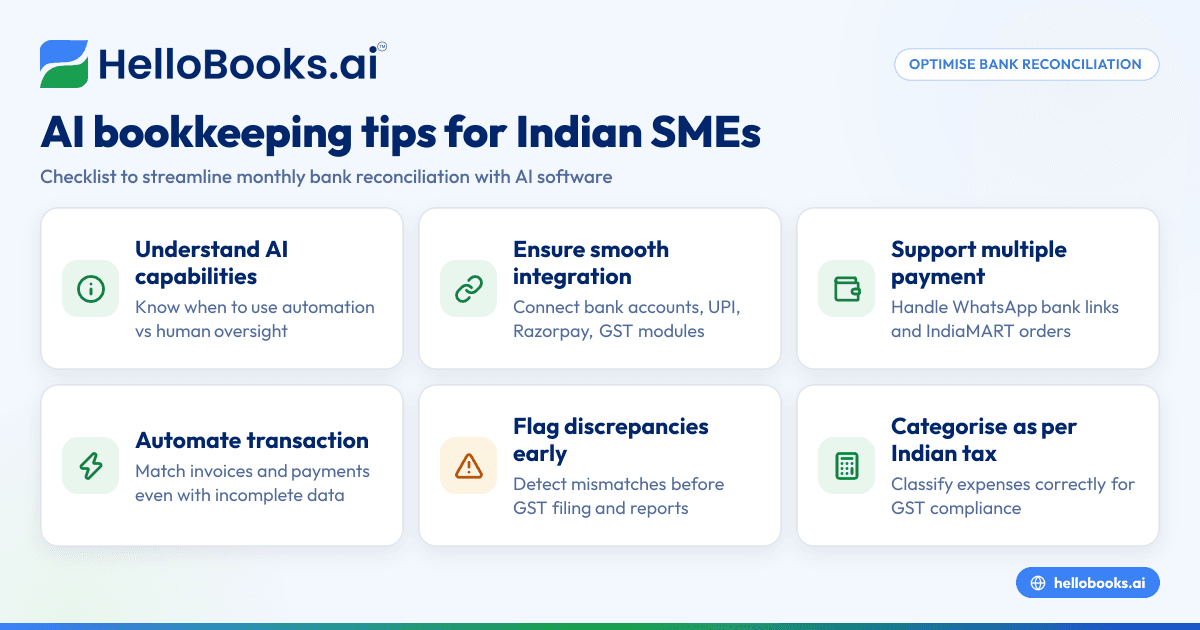
Uploading a bank statement and reconciling it against invoices is often more practical for Indian SMEs than waiting for perfect bookkeeping discipline. When receipts arrive in mixed amounts and references are inconsistent, AI-assisted matching can save time, but only if someone still reviews exceptions. That is especially true when a client deducts TDS or pays against multiple sites in one remittance.
For this part of the workflow, bank reconciliation software is not just about tidy books. It is about finding out which invoices are actually still open and which were paid through a bank transfer with poor narration. A cleaning business that handles dozens of monthly contracts will feel this immediately.
If your owner or operations head spends most of the day on-site, mobile access also matters. Being able to review receivables, record expenses, or raise an invoice from iOS or Android is practical, not optional.
Multi-state cleaning businesses need state-wise discipline
Many cleaning firms start in one city and then expand through client referrals. The accounting challenge changes the moment you operate across more than one state. Now you may be dealing with multiple GSTINs, different billing locations, inter-state supplies, staff movement, and state-wise profitability.
At that stage, two habits become important:
- keep each registration’s books and return data clearly segmented
- avoid running the second or third state from ad hoc Excel trackers
A multi-GSTIN setup is not only for compliance. It helps management see whether the Hyderabad operation is self-sustaining or whether the Mumbai branch is carrying too much central overhead. If your accounting system allows unlimited users, a branch supervisor, central accounts person, and external accountant can all work without sharing logins or sending ledgers over WhatsApp every day.
This also intersects with law outside GST. If you are a company, corporate record-keeping obligations sit under the Companies Act, 2013, administered by the Ministry of Corporate Affairs through MCA systems. If you collect or process employee and customer personal data, the Digital Personal Data Protection framework is also relevant; current obligations should be checked against official government publications and legal advice. Accounting software does not remove those obligations, but it should at least support cleaner, role-based internal processes.
The monthly review that keeps a cleaning business healthy
The best accounting setup is the one your team will actually maintain. For cleaning businesses, that usually means a monthly review built around operations rather than purely around finance jargon.
Review these every month:
- site-wise revenue and direct labour cost
- subcontractor dependence by client
- consumables purchased versus consumed
- receivables ageing and disputed invoices
- bank reconciliation items not yet explained
- GST sales in books versus GST sales prepared for filing
- purchase bills missing from supplier reporting where ITC is being tracked
- TDS deducted by customers but not yet reflected in records
That monthly discipline matters more than year-end cleanup. If you leave corrections until the accountant asks for data in March, you will spend time reconstructing attendance, chasing missing purchase invoices, and explaining bank entries from six months ago.
A practical toolset helps, but only if it follows the way Indian businesses actually work: invoice today, receive money by UPI or NEFT later, upload the bank statement, reconcile the receipt, capture vendor bills from a photo, and then file GSTR-1 and GSTR-3B from the same underlying records. That is the kind of flow HelloBooks supports, and it is why the software is more useful when the goal is daily control, not just final filing.
If you want to validate GST details before issuing bills or reviewing vendor data, the free India tools are useful starting points, including the GSTIN validator and GST reconciliation checker. For businesses comparing systems before switching, start from the India product page at /in or review current plans at /in/pricing.
What “good accounting” looks like for this business in practice
For a cleaning company, good accounting is not elegant theory. It means you can answer, in rupees, five practical questions without opening ten files:
- Which contracts make money after labour and consumables?
- Which clients are overdue, and by how much?
- Do the books agree with what you are filing under GST?
- Are purchase bills and ITC being captured on time?
- Is expansion into another state actually improving the business?
If your current setup cannot answer those, the fix is usually not adding more spreadsheets. It is redesigning the books around the realities of Indian cleaning work: GST, GSTIN-based invoicing, e-invoice and IRN where applicable, bank statement uploads, TDS adjustments, inventory for consumables, and site-level profitability.
That is the accounting backbone a cleaning business in India actually needs.