
Key takeaways
What this article covers, in order:
- Set up the books around how an Indian workshop actually earns
- Parts, labour and sublet work should never be blended into one sales figure
- Work in progress matters when vehicles stay in the shop across month-end
- GST in a garage is mostly about clean source records, not last-minute return prep
- Inventory for spare parts is where many workshops lose money quietly
- Insurer, fleet and corporate receivables need separate control
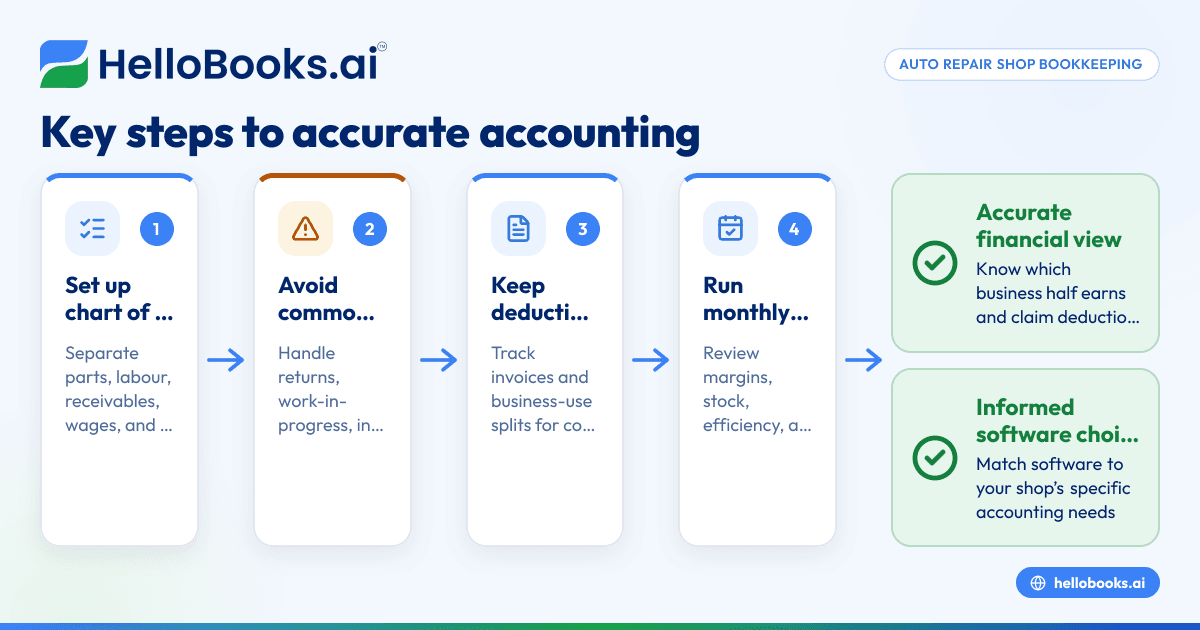
India auto repair shops should keep accounts that separate parts sales, labour income, insurer or warranty receivables, and GST treatment on every job card from day one. For a garage, workshop, or service centre, that is the difference between knowing whether a vehicle repair actually made money and guessing from the bank balance. In practice, you need a chart of accounts built for parts and labour, tight stock records, clean GST invoices, and monthly reconciliation between the shop floor, the bank statement, and the GST Portal.
Set up the books around how an Indian workshop actually earns
A motor workshop in India rarely earns from a single line item. One job may include spare parts, consumables, labour, outsourced wheel alignment, towing recovery, and an insurance claim settlement. If all of that is posted into one income ledger, you lose the ability to answer basic questions:
- Are labour jobs profitable on their own?
- Which parts are moving fast and which are dead stock?
- How much money is stuck with insurers, fleet clients, or corporate customers?
- Does the GST on outward supplies match the tax invoices you issued?
- Are supplier bills reflected in GSTR-2B so input tax credit can be tracked properly?
A workable Indian chart of accounts usually separates these heads:
- Parts inventory
- Consumables inventory
- Work in progress for vehicles still in the shop
- Trade receivables from retail customers
- Receivables from insurers and warranty providers
- Labour revenue
- Parts revenue
- Sublet revenue for outsourced jobs billed onward
- Cost of parts consumed
- Technician wages and contract labour
- Sublet costs
- Freight or local delivery inward
- GST input and output ledgers by tax head where relevant
- TDS receivable or payable where applicable under the Income-tax Act, 1961, if a corporate customer deducts tax at source or the shop deducts on qualifying payments
For many garages, the real problem is not a lack of bookkeeping software but a default setup copied from a general trading business. A repair shop is half inventory business and half service business. Your books should reflect that from the first invoice.
Parts, labour and sublet work should never be blended into one sales figure
In India, a repair invoice often goes out to a vehicle owner, a fleet operator, or an insurer. If parts and labour are merged into one amount, you cannot see gross margin properly, and GST review becomes harder because the tax position depends on the nature of the supply and the invoice details maintained under the Central Goods and Services Tax Act, 2017 and related State GST laws, administered by the Central Board of Indirect Taxes and Customs, or CBIC, through GSTN and the GST Portal.
A better practice is to bill with separate lines for:
- each spare part or assembly
- each labour activity
- any painting or denting package
- any outsourced service such as alignment or machining
- discounts, if any
That structure helps in three places at once:
First, job profitability becomes visible. Second, stock reduces accurately when parts are fitted. Third, GSTR-1 can be built from actual invoices instead of a month-end summary created in a rush.
If the business issues GST invoices regularly, software that applies the right CGST and SGST or IGST split based on place of supply and customer GSTIN reduces a common workshop error: charging local tax heads on an inter-state transaction, or the reverse. For a shop that has crossed the e-invoicing applicability under the CGST Rules, the current turnover threshold and scope are published through CBIC notifications and the GST Portal; those figures should always be checked there before relying on them. With HelloBooks, eligible businesses can generate the IRN and signed QR as the invoice is saved instead of handling portal JSON separately.
Work in progress matters when vehicles stay in the shop across month-end
A repair shop in India often opens a job in one month and delivers the vehicle in the next. Parts may have been issued from stock, outside labour may have been incurred, and technician time has already been spent. If you expense everything immediately without recognizing work in progress, one month can look artificially weak and the next month artificially strong.
Work in progress is especially important for:
- accident repairs awaiting insurer approval
- engine rebuilds
- body shop work spread across several days
- vehicles held up for imported parts
- fleet maintenance jobs where billing is delayed until a service batch closes
Here is an illustrative and invented situation, not a legal or accounting opinion, and it leaves out depreciation, overhead absorption, and any insurer-specific adjustments. Suppose a workshop in Pune starts a repair on 28 March. By 31 March it has fitted parts worth an invented ₹18,000, used consumables of an invented ₹2,000, and incurred invented labour cost of ₹9,000, but the invoice is raised only on 3 April after final inspection. If the full ₹29,000 invented cost is dumped into March expense with no work in progress, March profitability looks worse than the job actually was. Recording that amount as illustrative work in progress until billing gives management a truer monthly picture.
This is not just for management reporting. It affects how confidently the owner can read the P&L, discuss results with the accountant, and explain inventory movement.
GST in a garage is mostly about clean source records, not last-minute return prep
For auto repair shops in India, GST trouble usually starts with poor source records rather than difficult law. The usual issues are:
- customer GSTIN captured wrongly
- HSN or SAC not maintained consistently
- tax invoice missing fields required by Rule 46 of the CGST Rules NEEDS EXPERT REVIEW
- goods and services mixed without proper itemisation
- credit notes for returned parts not linked back to original invoices
- supplier bills booked late, so GSTR-2B matching gets messy
- inter-state jobs billed with the wrong tax head split
The current invoice particulars, e-invoice applicability, return formats, and filing process are published by CBIC, GSTN, and on the GST Portal. A workshop should rely on those official publications and on its CA for interpretation when facts are unclear.
Operationally, garages benefit from keeping GST records close to the job card:
- every outward invoice raised from the actual repair order
- every inward spare-parts bill captured as soon as it arrives
- every purchase checked against supplier GSTIN and tax details
- every month’s books tied back to GSTR-1, GSTR-3B, and GSTR-2B before filing
HelloBooks is useful here because the same invoice entry can produce a GST invoice, handle the place-of-supply tax split, and then flow into GST return filing software for direct GSTR-1 and GSTR-3B filing. On the purchase side, OCR can pull details from supplier bills, and GSTR-2A/2B reconciliation helps the shop track whether input tax credit is supported by supplier reporting before it is considered in GSTR-3B.
Inventory for spare parts is where many workshops lose money quietly
Most Indian auto workshops do not fail on big headline costs. They leak profit through inventory: fast-moving filters not reordered on time, expensive parts lying dead on the shelf, supplier returns not booked, and parts issued to a vehicle but never invoiced.
At a minimum, the parts process should answer four questions:
- What came in from suppliers?
- What was fitted to which vehicle?
- What was returned to the supplier or customer?
- What remains in stock today?
This matters even more when you work with OEM spares, aftermarket alternatives, battery replacements, tyres, oils, and job-specific procurements. A manual stock register or Tally-only posting done once a month often misses real-time issues on the workshop floor.
A practical method is:
- create item records for regular spare parts and consumables
- record purchases from supplier bills promptly
- issue parts against the repair job when fitted, not weeks later
- reverse stock when a part is removed and returned
- review non-moving stock and negative stock monthly
If your current process is spread across paper job cards, Excel, and Tally, migration matters. HelloBooks can help a business moving from Tally alternative workflows because it supports Tally migration and connection, while also keeping inventory movement and financial reports in the same system. That is more useful for a workshop than maintaining one stock view in the service bay and another in accounts.
Insurer, fleet and corporate receivables need separate control
In India, many repair shops do not get paid immediately by the driver who brought in the car. Payment may come from:
- an insurance company
- a surveyor-approved settlement route
- a fleet operator
- a leasing company
- a corporate customer with credit terms
- a manufacturer warranty program
If all debtors are grouped together, ageing becomes unreadable. The owner sees a large receivable balance but cannot tell whether the delay sits with one insurer, one fleet contract, or dozens of retail customers.
A better setup keeps separate customer masters and, where needed, separate revenue views for:
- retail walk-in jobs
- insurance jobs
- warranty jobs
- fleet or B2B maintenance contracts
This also helps with TDS. Where a payer deducts tax at source under the Income-tax Act, 1961, the applicable section, rate, threshold, certificate process, and reporting are set by that law and published by the Income Tax Department; any current figure should be checked there and with your tax adviser. The accounting point is simpler: the workshop should record the gross bill, the amount received, and the TDS component as a recoverable tax credit in the books rather than writing off the difference as discount.
Here is another illustrative and invented situation, and it leaves out timing differences in credit, disputes, and GST treatment nuances. Suppose a fleet customer is billed an invented ₹50,000 plus applicable tax per contract terms, and then remits an invented ₹49,000 after an invented TDS deduction of ₹1,000. If the shop records only the bank receipt, turnover and tax credit tracking both become distorted. The right accounting treatment depends on the exact facts and current law, so the treatment used should be confirmed by the accountant.
Reconcile the bank statement, job cards and GST data every month
For many small and mid-sized workshops, the month-end close breaks because three data sets never agree:
- workshop job cards
- invoices and purchase entries
- bank receipts and payments
A typical Indian service centre may receive money through UPI, NEFT, RTGS, IMPS, cash, card settlements, or insurer transfers. If the owner relies only on SMS alerts or passbook-style checking, old dues remain open, duplicate receipts go unnoticed, and expenses get posted late.
Monthly bank reconciliation should therefore do more than tick entries. It should answer:
- Which invoices were paid and by whom?
- Which receipts are advances?
- Which debits are business expenses not yet booked?
- Which cheques or transfers are still uncleared?
- Do bank deposits tie back to actual workshop invoices?
HelloBooks fits this process well because the owner can upload the bank statement and let AI-assisted matching reconcile receipts and payments against invoices and ledger entries, reducing manual re-typing. For a busy garage owner who spends the day on the shop floor, that is often more realistic than trying to maintain a perfect accounts spreadsheet. You can read more on bank reconciliation software and accounting software India.
E-way bill and e-invoice are relevant for some workshop movements, not every repair
Not every repair job triggers the same logistics and invoice obligations. But some auto businesses in India do need to think beyond the service invoice itself.
Situations where this comes up include:
- transfer of goods between branches in different states
- dispatch of spare parts to another workshop or mobile service location
- large-value movement of goods where e-way bill rules apply under the CGST Act, SGST Acts and related Rules, with current limits and exceptions published by CBIC and on the e-way bill system portal
- businesses covered by e-invoicing under CBIC notifications and GST Portal guidance
A workshop with more than one GSTIN, or operations in different states, should be especially careful about place of supply, stock movement documentation, and which GSTIN is issuing the invoice. HelloBooks supports multi-GSTIN use and can raise e-way bills from invoice data so consignment details do not need to be typed twice. For the businesses to which e-invoicing applies, IRN generation from the invoice record itself also reduces mismatch risk. See e-invoicing software and e-way bill software.
The monthly reports that actually help an Indian repair shop owner
A workshop owner does not need fifty reports. A useful month-end pack is short and specific:
- parts revenue versus parts cost
- labour revenue versus technician cost
- job-wise profitability for high-value repairs
- insurer and fleet receivables ageing
- stock on hand and negative stock exceptions
- purchase bills missing from GSTR-2B
- bank reconciliation summary
- GST liability and ITC tracking
Those reports are only trustworthy if they come from the same source entries used for invoicing, purchases, stock and returns. That is why stitched-together tools often create friction: one app for invoices, another for inventory, a third for GST, and WhatsApp messages filling the gaps. In an Indian shop where the owner may review figures on the move, a mobile workflow also matters. HelloBooks provides reporting from the same records used for invoices, inventory and GST, and the mobile app on iOS and Android lets owners check basics without waiting to reach the office. If they prefer quick questions in Hindi, English or Hinglish, Noor on WhatsApp can help them understand what is happening in the books.
Before you change software, check these workshop-specific requirements
If your accountant already works in Tally, you do not need a dramatic overnight switch. But before choosing any bookkeeping system for an auto repair shop in India, verify that it can handle:
- GST-compliant invoicing with correct tax head split
- item-wise parts tracking and stock reduction
- service and parts on the same invoice without confusion
- purchase bill capture from photos or PDFs
- GSTR-1 and GSTR-3B filing from recorded entries
- GSTR-2A/2B reconciliation for ITC tracking
- bank statement upload with matching to invoices and expenses
- more than one GSTIN if you operate across states
That is the practical checklist. Fancy dashboards matter less than getting day-to-day accounting right.
If you want to see how this works in practice, start with smart invoicing, inventory, or book a demo. If you are comparing options for India rather than accepting a generic global template, HelloBooks also has local tools such as the GSTIN validator and GST reconciliation checker, and pricing information is on /in/pricing.