


Key takeaways
What this article covers, in order:
- Why this comes up / what goes wrong
- Step-by-step
- Example (fictional figures)
- Common mistakes
- Frequently asked questions
- Key takeaways
Cloud based construction accounting software is designed to meet the unique financial and compliance needs of contractors and construction businesses. It enables easy management of billing, retention amounts, GST invoicing, expense tracking, and project costing without being tied to a single computer. This article explains why construction businesses seek such software, guides you through the selection process, provides a practical example, highlights common errors, and answers typical questions.
Why this comes up / what goes wrong
Construction business owners and accountants in India often struggle with managing complex billing cycles, retention money, GST compliance, and tracking multiple projects simultaneously. Many still rely on Excel sheets, Tally, or manual books, which consume time and increase errors. Cloud based software promises accessibility from any location, real-time updates, and easier compliance with GST invoicing and filing. However, construction-specific needs like handling retention, progress billing, and project cost allocation require software tailored or configurable for construction workflows.
Contractors must also ensure timely GST filing (GSTR-1, GSTR-3B) and reconcile input tax credits accurately. Without cloud software, errors in data entry or delayed filing can lead to penalties. Hence, the search for "cloud based construction accounting software" is common among civil contractors in cities like Nagpur or interior contractors in Hyderabad who want to streamline their accounts and GST compliance.
Step-by-step
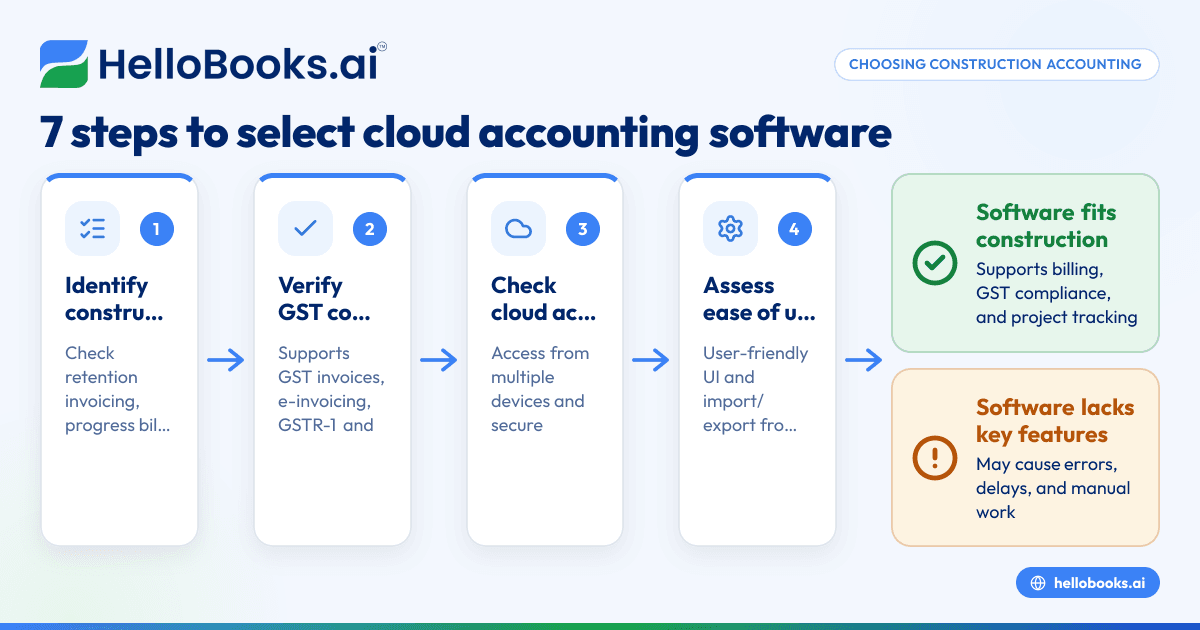
- Identify Construction-Specific Features Needed: Check if the software supports retention invoicing, progress billing, project-wise expense tracking, and GST invoice formats including HSN/SAC codes.
- Verify GST Compliance Capabilities: Ensure the software can generate GST-compliant invoices, handle e-invoicing if applicable, and assist with GSTR-1 and GSTR-3B filing.
- Check Accessibility and Cloud Reliability: Confirm the software is truly cloud-based, allowing access from multiple devices and locations with secure data storage.
- Assess Ease of Use and Integration: Look for user-friendly interfaces and options to import or export data from Excel or Tally to reduce manual entry.
- Evaluate Reporting and Reconciliation Tools: The software should provide project-wise financial reports, bank statement reconciliation, and ITC tracking.
- Consider Support and Training: Check for available customer support and resources to help your team adapt to the software.
- Trial and Compare Pricing Plans: Use free trials to test features before committing; compare plans based on transaction limits and GST filing support.
These steps help narrow down software that fits construction business workflows and GST compliance needs. For more insights, see accounting software for small business and accounting software in India.
Example (fictional figures)
A civil contractor in Nagpur bills a client ₹5,00,000 for a project milestone on 10/02/2024 with 10% retention. GST is assumed at 18% for illustration.
- Invoice amount before GST = ₹5,00,000
- Retention (10%) = ₹5,00,000 × 10% = ₹50,000
- Amount billed excluding retention = ₹5,00,000 - ₹50,000 = ₹4,50,000
- GST on billed amount = ₹4,50,000 × 18% = ₹81,000
- Total invoice value = ₹4,50,000 + ₹81,000 = ₹5,31,000
The contractor records ₹50,000 as retention receivable, to be invoiced later when retention is released. GST invoices must clearly show retention separately. This billing can be tracked project-wise in cloud software, facilitating GST filing and cash flow management.
Common mistakes
- Ignoring Retention Management: Not tracking retention separately causes confusion in billing and GST calculations. Prevent by using software that supports retention invoicing.
- Using Generic Accounting Software: Software without construction features leads to manual work and errors. Choose software designed or configurable for construction workflows.
- Delaying GST Filing: Late filing risks penalties. Use software with GST return filing reminders and integration.
- Not Reconciling Input Tax Credit (ITC): Missing ITC reconciliation causes tax losses. Software with GSTR-2B reconciliation helps avoid this.
- Relying Solely on Desktop Software: Limits access and real-time updates. Cloud software allows multiple users and remote access.
- Skipping Training: Lack of user training leads to underutilisation and mistakes. Invest time in learning software features.
For more on construction accounting needs, visit Contractors and construction.
Frequently asked questions
What features should a cloud based construction accounting software have?
It should support retention invoicing, progress billing, project-wise expense tracking, GST-compliant invoicing, e-invoicing if applicable, GST return filing (GSTR-1, GSTR-3B), and bank reconciliation.
Can cloud accounting software handle GST compliance for construction businesses?
Yes, many cloud accounting solutions include GST invoicing, e-invoice generation, and filing of returns such as GSTR-1 and GSTR-3B, which are essential for compliance.
Is cloud software secure for financial data?
Reputable cloud accounting software uses secure servers and encryption to protect data. Always check for security certifications and data backup policies.
How does cloud accounting help contractors with multiple projects?
Cloud software enables project-wise tracking of income and expenses, real-time updates accessible from anywhere, and consolidated financial reports for better decision-making.
Can I migrate data from Tally or Excel to cloud software?
Many cloud accounting platforms offer import tools to migrate data from Excel or Tally, reducing manual data entry and errors.
Key takeaways
- Choose cloud accounting software with construction-specific features like retention and progress billing.
- Ensure GST compliance capabilities including invoicing and return filing are included.
- Cloud access improves collaboration and real-time financial management.
- Avoid common mistakes like ignoring retention or delaying GST filing by using suitable software.
- Project-wise tracking and reconciliation tools help manage multiple construction projects efficiently.
Start on the Free plan (200 transactions a year, GSTR-1 and 3B filing for one GSTIN) at HelloBooks pricing.


