


Key takeaways
What this article covers, in order:
- Why this comes up / what goes wrong
- Step-by-step
- Example (fictional figures)
- Common mistakes
- Frequently asked questions
- Key takeaways
Business finance software in NC is designed to help small and growing Indian businesses streamline financial management tasks such as accounting, GST invoicing, filing GSTR-1 and GSTR-3B returns, and bank statement reconciliation. Using the right software reduces manual data entry, improves accuracy, and saves time.
Why this comes up / what goes wrong
Many small business owners in India start with manual bookkeeping methods like spreadsheets, Tally, or physical bill books. As their business grows, these methods become time-consuming and prone to errors. Managing GST invoicing, filing returns, and reconciling bank statements manually can lead to compliance risks and missed deadlines. Searching for "business finance software in NC" shows the need for a reliable tool that simplifies these financial tasks and ensures GST compliance.
Step-by-step
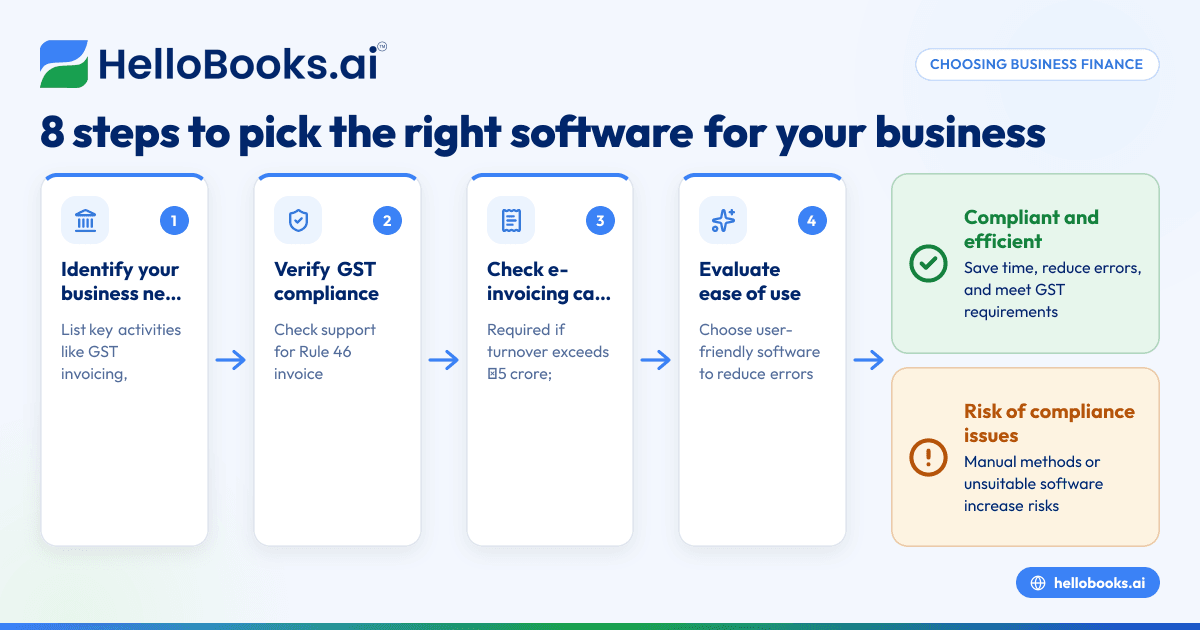
- Identify Your Business Needs: List your key financial activities such as GST invoicing, e-invoicing (if your turnover exceeds ₹5 crore), GSTR-1 and GSTR-3B filing, bank reconciliation, expense tracking, and inventory management.
- Verify GST Compliance Features: Confirm the software supports mandatory invoice particulars as per Rule 46, including supplier and recipient GSTIN, HSN/SAC codes, tax rates, and signatures. Also, check if it supports GSTR-1 and GSTR-3B filing.
- Check for E-invoicing Capability: If your aggregate turnover exceeds ₹5 crore, the software should generate IRNs and QR codes for e-invoices as required from 1 August 2023.
- Evaluate Ease of Use: Choose software with a user-friendly interface suited to your accounting knowledge to avoid errors and speed adoption.
- Assess Data Import and Export Options: Ensure you can import data from Tally or Excel and export GST returns easily.
- Review Reporting and Reconciliation Features: Look for clear financial reports (profit and loss, balance sheet) and bank statement reconciliation to detect discrepancies.
- Consider Scalability: The software should handle multiple GSTINs and increased transaction volumes as your business grows.
- Check Support and Updates: Reliable customer support and timely updates for GST rule changes are critical.
For more on software suited to small businesses in India, see accounting software for small business and accounting software in India.
Example (fictional figures)
A Delhi-based electronics retailer issues GST-compliant invoices totaling ₹3,00,000 in March 2024, with an assumed GST rate of 18%.
- Taxable value = ₹3,00,000
- CGST = ₹3,00,000 × 9% = ₹27,000
- SGST = ₹3,00,000 × 9% = ₹27,000
- Total GST = ₹27,000 + ₹27,000 = ₹54,000
- Total invoice value = ₹3,00,000 + ₹54,000 = ₹3,54,000
The retailer uses the software to file GSTR-1 and GSTR-3B, which automatically populates data from invoices and reconciles it with bank statements.
Common mistakes
- Ignoring GST Invoice Requirements: Not checking if the software supports all mandatory invoice particulars under Rule 46 can cause compliance issues. Prevent this by verifying software features carefully.
- Skipping Bank Reconciliation: Manual reconciliation is error-prone and time-consuming. Use software that supports bank statement uploads and automatic reconciliation.
- Choosing Complex Software: Difficult interfaces lead to mistakes and slow adoption. Pick software that is easy to navigate with good help resources.
- Not Planning for Growth: Selecting software that cannot handle multiple GSTINs or higher transaction volumes limits your future needs. Choose scalable solutions.
- Overlooking Support and Updates: GST rules change often. Lack of vendor support or updates can cause filing errors. Confirm the vendor’s update policy.
- Neglecting Data Import Features: Without import options from Excel or Tally, manual data entry increases workload and errors. Ensure the software supports imports.
Frequently asked questions
What is the best business finance software in NC for small businesses?
The best software depends on your specific needs, such as GST invoicing, filing, and reconciliation. Look for software that supports GST compliance, ease of use, and scalability. See HelloBooks for India for options tailored to Indian small businesses.
Does business finance software in NC support GST e-invoicing?
If your aggregate turnover exceeds ₹5 crore, you must issue e-invoices for B2B supplies from 1 August 2023. Choose software that generates IRNs and QR codes for e-invoices as per government notifications.
Can I use business finance software in NC if I currently use Tally or Excel?
Yes. Many software solutions allow importing data from Tally or Excel to reduce manual entry. This helps maintain consistency while upgrading your accounting processes.
How does business finance software help with GST filing?
Such software automates data compilation for GSTR-1 and GSTR-3B returns, reducing errors and saving time. It also helps reconcile input tax credit with GSTR-2B.
Is bank statement reconciliation included in business finance software in NC?
Most modern software supports uploading bank statements for automatic reconciliation with recorded transactions, helping detect discrepancies early.
For more guidance, see accounting software for small business.
Key takeaways
- Clearly define your financial management needs before choosing software.
- Ensure the software complies with GST invoice and filing rules, including Rule 46.
- Prioritise ease of use and scalability to support business growth.
- Select software with bank statement upload and reconciliation features to avoid manual errors.
- Confirm vendor support and timely updates for GST rule changes.
- Use software that supports importing data from Excel or Tally to ease transition.
Choosing the right business finance software in NC can save time and reduce errors in accounting and GST compliance. To start, consider trying HelloBooks on the Free plan (200 transactions a year, GSTR-1 and 3B filing for one GSTIN) at HelloBooks pricing.


