


Key takeaways
What this article covers, in order:
- Why this comes up / what goes wrong
- Step-by-step
- Example (fictional figures)
- Common mistakes
- Doing this in HelloBooks
- Frequently asked questions
Billing software for retail shops is essential to manage sales, generate tax-compliant invoices, and maintain accurate records without manual errors. Retailers like kirana stores, mobile-accessory shops, and apparel outlets need software that handles GST invoicing, inventory tracking, and compliance with Rule 46 invoice particulars.
Why this comes up / what goes wrong
Retail business owners or accountants often struggle with manual billing using spreadsheets, Tally, or bill books. This leads to errors in tax calculations, missing invoice details required under GST Rule 46, and delays in filing GSTR-1 and GSTR-3B returns. Retail shops have many small transactions daily, making manual entry time-consuming and prone to mistakes. Without software tailored for retail, owners spend excessive time reconciling sales, managing inventory, and ensuring GST compliance.
Step-by-step
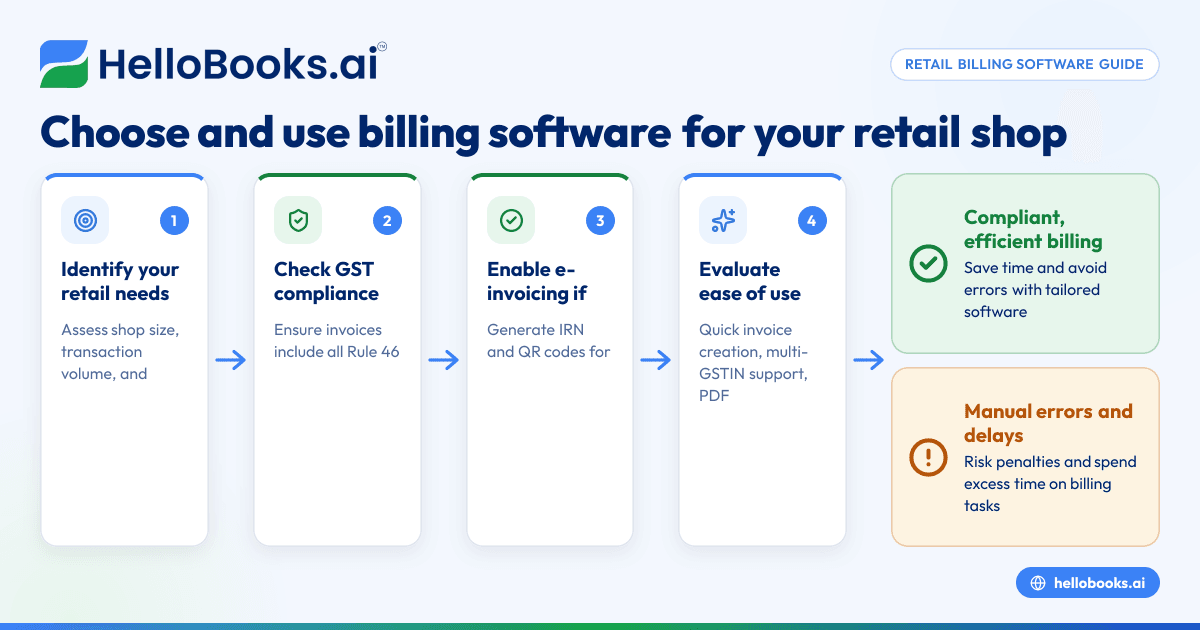
- Identify your retail business needs: Consider your shop size, transaction volume, and inventory complexity. For example, a kirana store in Indore may need simple billing with GST compliance, while a two-outlet apparel store in Lucknow requires inventory and multi-location management.
- Check GST compliance features: Ensure the software creates GST invoices with all Rule 46 particulars, including CGST/SGST or IGST splits and HSN/SAC codes. The invoice should include supplier and recipient details, invoice number, date, taxable value, tax rate, and tax amount.
- Look for e-invoicing capability: If your business turnover exceeds ₹5 crore, the software must generate an Invoice Reference Number (IRN) and QR code on B2B invoices, as mandated from 1 August 2023. This saves time by sending invoices directly to the NIC portal.
- Evaluate ease of use: The software should allow quick invoice creation, support multiple GSTINs if applicable, and enable sending invoices as PDFs by email.
- Consider inventory and purchase bill management: Features like OCR for purchase bills help capture supplier bills from photos or PDFs, reducing manual data entry.
- Verify reporting and filing support: Check if the software generates GSTR-1 and GSTR-3B reports and helps with reconciliation against GSTR-2B.
- Compare pricing and plans: Some software offers free plans with limited transactions, suitable for small shops, while others have paid plans with advanced features.
- Test customer support and integration: Confirm support availability and if the software integrates with your existing tools or accounting systems.
Example (fictional figures)
Consider "Rajesh Kirana Store" in Indore issuing a GST invoice on 12/04/2024 for goods sold to a registered customer with GSTIN. Assume the taxable value is ₹48,000 with a CGST and SGST rate of 9% each.
- Taxable value = ₹48,000
- CGST = ₹48,000 × 9% = ₹4,320
- SGST = ₹48,000 × 9% = ₹4,320
- Total tax = ₹4,320 + ₹4,320 = ₹8,640
- Invoice total = ₹48,000 + ₹8,640 = ₹56,640
The invoice includes:
- Supplier name, address, GSTIN
- Unique invoice number and date
- Recipient name, address, GSTIN
- HSN code of goods
- Quantity and unit
- Taxable value after any discount
- Tax rates and amounts for CGST and SGST
- Place of supply
- Signature or digital signature
This invoice can be generated using compliant billing software to ensure Rule 46 requirements are met.
Common mistakes
- Incomplete invoice details: Missing recipient GSTIN or HSN codes. Prevent by using software that auto-fills these fields from customer records and product master.
- Ignoring e-invoicing requirements: Businesses above ₹5 crore turnover must generate IRN and QR codes. Avoid penalties by choosing software with e-invoicing support.
- Manual data entry errors: Typing mistakes in taxable values or tax rates cause wrong tax calculation. Use software with automated tax calculations.
- Not reconciling purchase bills: Overlooking supplier bills leads to incorrect ITC claims. Use software that captures bills accurately from photos or PDFs.
- Using non-compliant invoice formats: Invoices not following Rule 46 can be rejected during audits. Always use GST-ready invoice formats.
- Neglecting invoice numbering rules: Invoice numbers must be unique and consecutive for a financial year. Software should enforce this automatically.
Doing this in HelloBooks
HelloBooks offers GST invoicing that creates compliant tax invoices with the correct CGST/SGST or IGST split and HSN/SAC codes from the customer's GSTIN, ensuring all Rule 46 fields are consistently filled. For businesses exceeding the ₹5 crore turnover e-invoicing threshold, HelloBooks generates the IRN and signed QR code automatically when saving B2B invoices, saving time compared to manual JSON uploads to the portal. Additionally, HelloBooks supports OCR for purchase bills, capturing supplier bills from photos or PDFs to reduce manual entry errors. These features help retail shops maintain accurate billing and GST compliance efficiently.
Frequently asked questions
What features should I look for in retail billing software?
Look for GST-compliant invoicing with Rule 46 particulars, e-invoicing support if applicable, inventory management, purchase bill capture, and reporting for GST returns. Ease of use and pricing are also important. Visit the Retail shops page for more industry-specific insights.
Is free billing software suitable for a retail shop?
Free software can be enough for small shops with low transaction volumes, offering basic GST invoicing and limited transactions per year. Growing shops may need paid plans for advanced features like e-invoicing and inventory.
How does e-invoicing affect retail billing software?
Retailers with turnover above ₹5 crore must generate IRN and QR codes on B2B invoices. Billing software with e-invoicing integration automates this process, ensuring compliance and saving time.
Can billing software help with GST return filing?
Some billing software generates GSTR-1 and GSTR-3B reports and helps reconcile input tax credit using GSTR-2B data, simplifying GST filing for retail businesses.
How do I verify that my invoices comply with GST rules?
Use tools like the GST invoice validator to check invoice format and details against Rule 46 requirements.
Key takeaways
- Use billing software that creates GST-compliant invoices with all mandatory Rule 46 details.
- Businesses with turnover over ₹5 crore must use e-invoicing with IRN and QR codes on B2B invoices.
- Automate purchase bill entry using OCR to reduce errors and improve ITC accuracy.
- Avoid common mistakes like incomplete invoice data, manual tax calculation errors, and non-compliant formats.
- HelloBooks offers GST invoicing, e-invoicing, and OCR for bills tailored to retail business needs.
- Test software features, pricing, and support before choosing for your retail shop.
Start managing your retail billing efficiently with HelloBooks. Start on the Free plan (200 transactions a year, GSTR-1 and 3B filing for one GSTIN).


