
Key takeaways
What this article covers, in order:
- Why this comes up / what goes wrong
- Step-by-step
- Example (fictional figures)
- Common mistakes
- Doing this in HelloBooks
- Frequently asked questions
The best accounting software for small manufacturing businesses in India must support inventory management, GST invoicing, purchase bill automation, and financial reporting tailored to the manufacturing process. This article explains why this choice is important, the steps to select the right software, a detailed example for a small manufacturer, common pitfalls, and how HelloBooks can help with OCR for purchase bills.
Why this comes up / what goes wrong
Small manufacturing business owners and accountants often struggle with manual bookkeeping using spreadsheets, Tally, or bill books. They face challenges managing raw material purchases, tracking finished goods inventory, reconciling supplier bills, and ensuring timely GST compliance. Manufacturing businesses like auto-components MSMEs in Pune, packaging manufacturers in Ahmedabad, or pump makers in Coimbatore need software that reduces data entry time and errors while supporting GST invoicing and reconciliation.
Without industry-specific features, businesses spend excessive time on data entry and reconciliation, risking errors in GST filings and financial reports. This leads to delayed compliance, penalties, and poor financial visibility.
Step-by-step
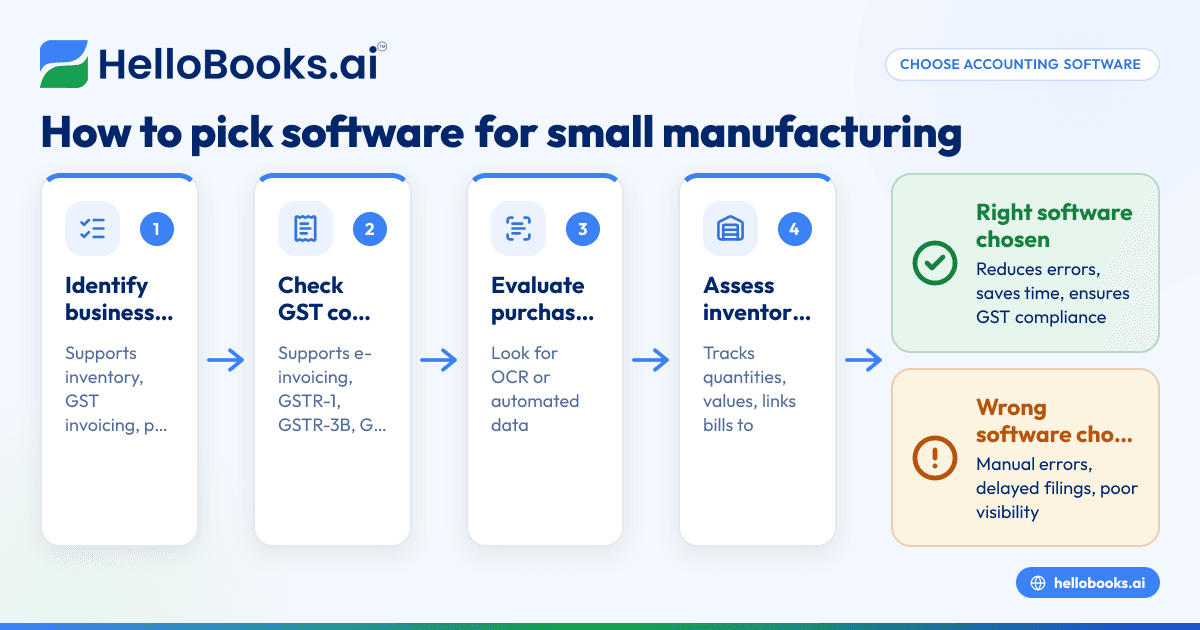
- Identify your business needs: Check if the software supports inventory tracking for raw materials and finished goods, GST invoicing, purchase bill entry, and financial reporting specific to manufacturing.
- Check GST compliance features: Ensure the software supports GST invoicing, e-invoicing if applicable, GSTR-1 and GSTR-3B filing, and reconciliation with GSTR-2B.
- Evaluate purchase bill handling: Look for OCR or automated data capture features that reduce manual entry of supplier bills, which are frequent in manufacturing.
- Assess inventory management: Confirm the software can track inventory quantities, values, and link purchase bills to inventory updates.
- Review reporting capabilities: The software should generate profit and loss statements, balance sheets, and inventory reports that help monitor manufacturing costs and profitability.
- Consider ease of use and integration: The software should be easy for your accountant or finance lead to use, and ideally integrate with your existing tools like Excel or Tally.
- Compare pricing and support: Check the pricing plans and availability of customer support to ensure you get value for money.
For more general guidance on accounting software options, see accounting software in India and accounting software for small business.
Example (fictional figures)
Consider an auto-components MSME in Pune purchasing raw materials and managing inventory. On 15/05/2024, they receive a supplier bill for raw materials worth ₹1,20,000 plus 18% GST.
Purchase value = ₹1,20,000
CGST @ 9% = ₹1,20,000 × 9% = ₹10,800
SGST @ 9% = ₹1,20,000 × 9% = ₹10,800
Total bill amount = ₹1,20,000 + ₹10,800 + ₹10,800 = ₹1,41,600
The software should capture this bill via OCR, auto-match the line items to existing inventory, and update stock quantities accordingly. It should also create the corresponding GST entries for input tax credit.
Later, when filing GSTR-3B, the business can use the software to reconcile input tax credit from GSTR-2B with purchase bills, ensuring accuracy.
Common mistakes
- Ignoring inventory features: Not choosing software that tracks inventory leads to inaccurate stock and cost records. Prevent this by confirming inventory management capability.
- Manual bill entry errors: Typing purchase bills manually causes errors and wastes time. Avoid this by using OCR features to capture bills automatically.
- Overlooking GST reconciliation: Failing to reconcile GSTR-2B ITC with purchase bills results in incorrect GST claims. Prevent by choosing software with reconciliation tools.
- Choosing generic software: Using non-industry-specific software can miss manufacturing nuances like raw material tracking. Select software tailored or adaptable to manufacturing needs.
- Neglecting report customization: Not having reports suited to manufacturing costs and profitability hides business insights. Ensure software offers relevant financial and inventory reports.
For more on mistakes to avoid in small business accounting software, see Manufacturing.
Doing this in HelloBooks
HelloBooks offers OCR for purchase bills, allowing small manufacturers to capture supplier bills from photos or PDFs instead of manual entry. The OCR automatically reads line items and matches them to existing inventory, saving time and reducing errors. This feature helps manufacturers manage their purchase bills efficiently and maintain accurate inventory records.
Learn more about OCR scanning at HelloBooks for India.
Frequently asked questions
What features should small manufacturing businesses look for in accounting software?
They should look for inventory management, GST invoicing and filing, purchase bill automation (like OCR), financial reporting, and reconciliation tools. These features help manage manufacturing costs and GST compliance effectively.
Can small manufacturers use Tally or Excel instead of accounting software?
While Tally and Excel are common, they often require manual data entry, increasing errors and time spent. Dedicated accounting software with automation features is more efficient and reduces compliance risks.
How does OCR for purchase bills help manufacturing businesses?
OCR captures bill details automatically from photos or PDFs, reducing manual entry errors and saving time. It also links bills to inventory, improving stock accuracy.
Is GST e-invoicing mandatory for small manufacturers?
GST e-invoicing is mandatory for businesses exceeding a certain turnover threshold. Small manufacturers below this threshold may not need it, but software should support e-invoicing if applicable. NEEDS EXPERT REVIEW
How can I ensure accurate GST filing for my manufacturing business?
Use software that supports GSTR-1 and GSTR-3B filing, and reconciles ITC with GSTR-2B data. Regular reconciliation prevents errors and penalties.
For more details, see Manufacturing.
Key takeaways
- Choose accounting software with inventory tracking and GST compliance features tailored for manufacturing.
- Automate purchase bill entry using OCR to reduce errors and save time.
- Regularly reconcile GST input tax credit with GSTR-2B to ensure accurate filings.
- Avoid generic software that lacks manufacturing-specific functions.
- Use software that provides detailed financial and inventory reports for better business insights.
Start managing your small manufacturing business accounting efficiently with HelloBooks. You can Start on the Free plan (200 transactions a year, GSTR-1 and 3B filing for one GSTIN) today.