


Key takeaways
What this article covers, in order:
- Why this comes up / what goes wrong
- Step-by-step
- Example (fictional figures)
- Common mistakes
- Doing this in HelloBooks
- Frequently asked questions
AI bookkeeping software for startups automates routine accounting tasks like data entry, bank statement reconciliation, and GST filing, helping startups focus on growth instead of paperwork. This article covers why startups seek AI bookkeeping, step-by-step adoption guidance, a worked example with realistic INR figures, common pitfalls, and how HelloBooks supports these needs.
Why this comes up / what goes wrong
Startups, especially those in tech hubs like Bengaluru, Hyderabad, and Gurugram, often begin with manual bookkeeping using spreadsheets, Tally, or bill books. As they grow, they face challenges such as:
- Excessive time spent entering transactions and reconciling bank statements manually.
- Difficulty ensuring accurate GST invoicing and timely filing of returns like GSTR-1 and GSTR-3B.
- Errors in matching purchase bills and managing inventory.
- Lack of automation leading to delayed financial insights and compliance risks.
For example, a 12-person SaaS startup in Bengaluru may have dozens of daily transactions across multiple payment methods, making manual bookkeeping error-prone and time-consuming. AI bookkeeping software offers startups a way to automate these repetitive tasks, reduce errors, and comply with GST regulations efficiently.
Step-by-step
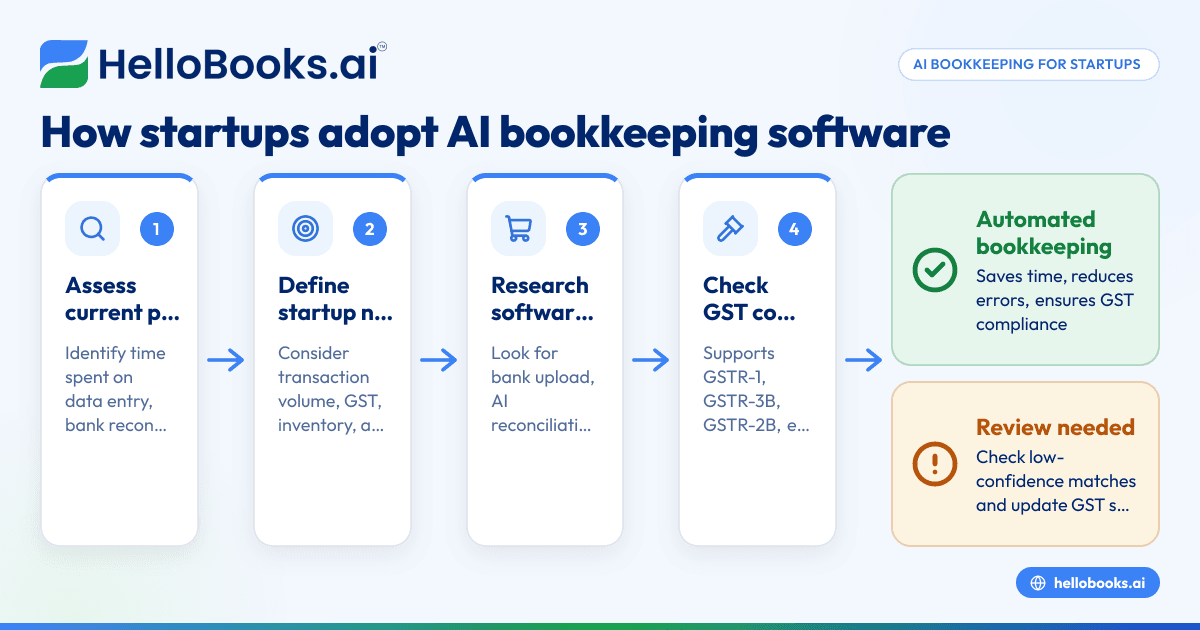
- Assess your current bookkeeping process: Identify where most time is spent—data entry, bank reconciliation, GST invoicing, or expense tracking. Check if you use spreadsheets, Tally, or manual bill books.
- Define your startup’s needs: Consider transaction volume, GST compliance complexity, inventory management, and reporting requirements. For example, a fintech startup in Gurugram may need detailed reconciliation and GST invoice automation.
- Research AI bookkeeping software options: Look for features like bank statement upload and AI reconciliation, OCR for purchase bills, GST invoicing, and e-invoicing support.
- Check software compatibility with Indian GST rules: Ensure it supports GSTR-1 and GSTR-3B filing, GSTR-2B reconciliation, and e-invoice generation according to Indian regulations.
- Plan data migration and training: Prepare to upload existing data and train your team on the software interface and workflows.
- Test with a pilot month: Upload bank statements, match transactions, and generate invoices to verify accuracy and ease of use.
- Review reports and compliance outputs: Confirm that GST returns and financial reports meet statutory requirements.
- Iterate and optimize: Use AI suggestions to improve categorisation and reduce manual corrections over time.
For more details on accounting software suited for startups, see Startups and technology companies and for general guidance, visit accounting software for small business.
Example (fictional figures)
Consider a 12-person SaaS startup in Bengaluru that processed the following in July 2023:
- Total sales (GST inclusive): ₹12,00,000
- Purchase bills (GST inclusive): ₹5,00,000
- Bank statement shows ₹11,50,000 received (some payments pending clearance)
Assuming an illustrative GST rate of 18% (CGST 9% + SGST 9%) for sales and purchases:
Calculate GST on sales:
₹12,00,000 ÷ 1.18 = ₹10,16,949 (net sales)
₹12,00,000 - ₹10,16,949 = ₹1,83,051 (GST collected)
Calculate GST on purchases:
₹5,00,000 ÷ 1.18 = ₹4,23,729 (net purchases)
₹5,00,000 - ₹4,23,729 = ₹76,271 (GST paid)
ITC claim:
Input Tax Credit (ITC) = ₹76,271
GST payable:
GST collected - ITC = ₹1,83,051 - ₹76,271 = ₹1,06,780
The startup uploads the July bank statement PDF to AI bookkeeping software, which auto-matches ₹11,50,000 receipts to invoices without re-typing. Purchase bills are scanned via OCR, auto-filling ledger entries.
This automation speeds up reconciliation and prepares accurate GSTR-1 and GSTR-3B filings.
Common mistakes
- Not verifying AI matches carefully: AI can auto-match transactions but may err. Always review low-confidence matches in the exception queue.
- Ignoring GST compliance updates: Startups must keep software settings updated for GST rule changes to avoid filing errors.
- Failing to capture all purchase bills: Missing supplier bills leads to lost ITC claims. Use OCR capture to ensure bills are recorded.
- Delaying bank statement uploads: Upload monthly statements promptly to avoid backlog and late reconciliations.
- Overlooking inventory impact: For startups with inventory, ensure purchase bills link to inventory items to track stock accurately.
- Not training staff adequately: Without proper training, users may underutilize AI features or make manual errors.
Refer to AI bookkeeping for more insights on avoiding these mistakes.
Doing this in HelloBooks
HelloBooks supports startups with two key AI capabilities:
- Bank statement upload and AI reconciliation (India): Upload your monthly bank statement as PDF, CSV, or Excel. AI automatically matches receipts to invoices and ledger entries, eliminating manual re-typing. High-confidence matches clear automatically, while others go to an exception queue for review. This speeds up reconciliation and reduces errors. Learn more at /bank-reconciliation-software.
- OCR for purchase bills: Capture supplier bills by uploading photos or PDFs. OCR reads line items and auto-matches them to inventory and ledger entries, saving manual entry time. Details at /ocr-scanning.
These features help startups streamline bookkeeping and GST compliance.
Frequently asked questions
What is the difference between AI bookkeeping and AI accounting software for startups?
AI bookkeeping focuses on automating data entry, bank reconciliation, and bill capture, whereas AI accounting software includes broader features like financial reporting and tax filing. Many solutions, including HelloBooks, combine both.
Can AI bookkeeping software handle GST compliance for startups?
Yes, AI bookkeeping software designed for India supports GST invoicing, e-invoicing, and filing of returns like GSTR-1 and GSTR-3B, helping startups comply with tax laws efficiently.
Is manual data entry still needed with AI bookkeeping?
Some manual review is necessary, especially for low-confidence matches or exceptions. However, AI reduces the volume of manual entry significantly.
How does AI reconciliation work with Indian banks?
You upload bank statements as PDFs or CSVs. AI parses transactions, matches them against invoices and expenses on date, amount, and vendor patterns, and auto-clears high-confidence matches.
Can startups use AI bookkeeping software without prior accounting experience?
Yes, many AI bookkeeping tools are designed for ease of use, with guided workflows and automation that reduce the need for deep accounting knowledge.
For more questions, see accounting software in India.
Key takeaways
- AI bookkeeping software automates data entry, bank reconciliation, and GST compliance for startups.
- Startups should evaluate transaction volume, GST needs, and inventory before choosing software.
- Uploading bank statements and bills for AI processing saves time and reduces errors.
- Regular review of AI matches and staying updated on GST rules prevent compliance issues.
- HelloBooks offers AI reconciliation and OCR bill capture tailored for Indian startups.
Start your startup’s AI bookkeeping journey with HelloBooks. Start on the Free plan (200 transactions a year, GSTR-1 and 3B filing for one GSTIN) today to simplify your accounting and GST compliance.


