


Key takeaways
What this article covers, in order:
- Why this comes up / what goes wrong
- Step-by-step
- Example (fictional figures)
- Common mistakes
- Frequently asked questions
- Key takeaways
Agriculture farm accounting is essential for tracking profitability, managing cash flow, and complying with GST and other tax regulations. Whether you run a commission agency at a grain mandi or a seed and fertiliser dealership, keeping accurate records helps you make informed decisions and avoid penalties.
Why this comes up / what goes wrong
Many agriculture business owners and accountants struggle with farm accounting because of the diversity of transactions and seasonal nature of farming. For instance, commission agents at grain mandis in Ludhiana handle multiple clients and varying commission rates, while seed and fertiliser dealers in Guntur deal with inventory purchases, sales, and credit payments. Without proper accounting, it’s easy to lose track of income, expenses, GST compliance, and inventory, leading to errors and financial stress.
Step-by-step
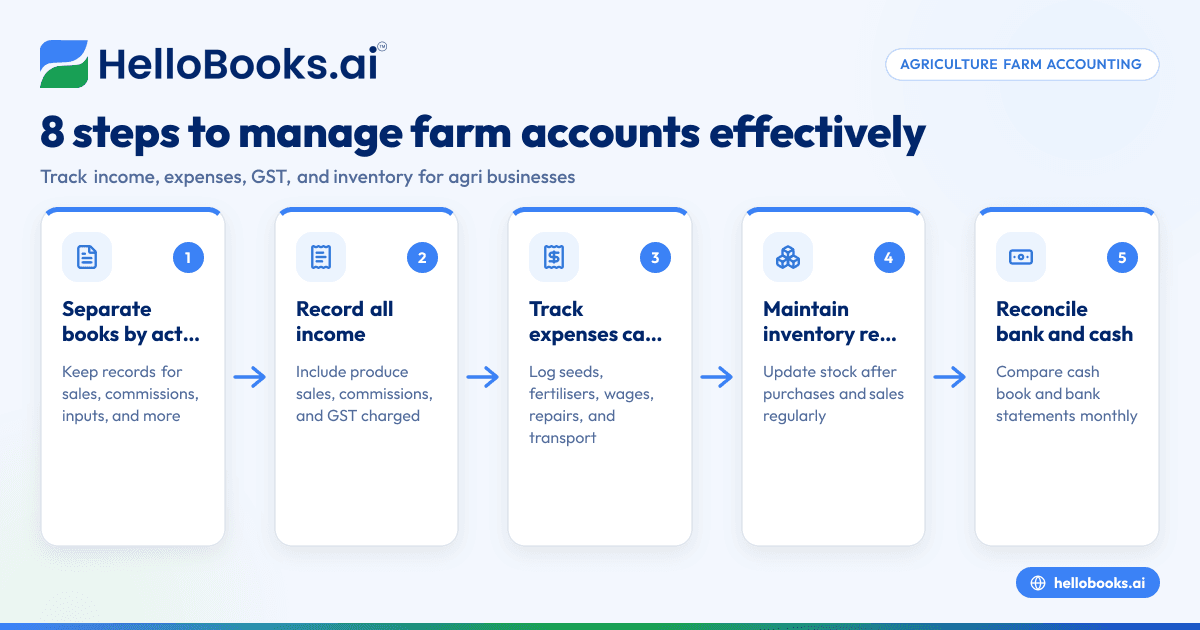
- Maintain separate books for different activities: For example, keep separate records for crop sales, livestock, input purchases, and commissions. Check that each transaction is dated and supported by invoices or bills.
- Record all income accurately: Include sales of produce, commissions earned, and other farm-related income. Verify that GST is charged correctly on invoices as per applicable rates.
- Track expenses carefully: Record all costs including seeds, fertilisers, labour wages, equipment repairs, and transportation. Ensure bills and receipts are collected and matched with payments.
- Maintain inventory records: For seed and fertiliser dealers, update stock levels after each purchase and sale. Check physical stock matches book records regularly.
- Reconcile bank and cash transactions monthly: Compare your cash book and bank statements to find discrepancies early.
- Prepare GST returns timely: File GSTR-1 and GSTR-3B for your GSTIN as required. Check input tax credit (ITC) claims against supplier invoices and GSTR-2B.
- Review financial reports periodically: Generate profit and loss statements and balance sheets to understand your business health.
- Keep records organised for audits and assessments: Store all documents safely for at least 8 years as per GST rules.
For more details on GST invoicing and agricultural allied businesses, see GST invoicing and Agricultural trading and agri businesses.
Example (fictional figures)
Consider a seed and fertiliser dealer in Guntur for the month of March 2024.
- Sales of seeds: ₹1,50,000 (including GST at an assumed illustrative rate of 5%)
- Sales of fertilisers: ₹2,00,000 (including GST at an assumed illustrative rate of 12%)
- Purchase of seeds: ₹80,000 (including GST at 5%)
- Purchase of fertilisers: ₹1,20,000 (including GST at 12%)
- Labour wages paid: ₹30,000 (no GST)
Calculate GST collected on sales:
Seeds GST = ₹1,50,000 × 5/105 = ₹7,143 (approx)
Fertilisers GST = ₹2,00,000 × 12/112 = ₹21,429 (approx)
Total GST collected = ₹7,143 + ₹21,429 = ₹28,572
Calculate GST paid on purchases:
Seeds GST input = ₹80,000 × 5/105 = ₹3,810 (approx)
Fertilisers GST input = ₹1,20,000 × 12/112 = ₹12,857 (approx)
Total GST paid = ₹3,810 + ₹12,857 = ₹16,667
Net GST payable = GST collected - GST paid = ₹28,572 - ₹16,667 = ₹11,905
The dealer should pay ₹11,905 as GST for the month after filing returns.
Common mistakes
- Mixing personal and business expenses: Prevent this by maintaining separate bank accounts and cash books for your farm business.
- Not keeping proper invoices or bills: Always collect and file GST-compliant invoices to support your input tax credit claims.
- Ignoring inventory tracking: Regularly update stock records to avoid stockouts or excess stock, especially for seed and fertiliser dealers.
- Delayed GST filing: Set reminders to file GSTR-1 and GSTR-3B on time to avoid penalties.
- Incorrect GST rates applied: Verify GST rates applicable to different agri products and services to ensure correct tax calculations.
- Not reconciling bank statements: Monthly reconciliation helps detect errors or fraud early.
For more on GST invoicing and agricultural allied businesses, consult GST invoicing and Agricultural trading and agri businesses.
Frequently asked questions
What are the key records to maintain for agriculture farm accounting?
Maintain sales and purchase invoices, expense receipts, inventory logs, bank and cash books, and GST return filings. Keeping these organised helps track business performance and comply with tax regulations.
How do agriculture businesses handle GST compliance?
Agriculture businesses must charge GST on taxable supplies and file GSTR-1 and GSTR-3B returns timely. Input tax credit can be claimed on purchases with valid invoices. Regular reconciliation of GSTR-2B with purchase records helps prevent errors.
Is inventory management important for seed and fertiliser dealers?
Yes, accurate inventory management prevents losses and ensures availability. Record stock received and sold, and perform periodic physical verification.
Can I use Excel or Tally for farm accounting?
Yes, many small businesses use Excel or Tally for bookkeeping. However, these require manual data entry and reconciliation. For GST invoicing and filing, dedicated software or services can simplify compliance.
What are the challenges unique to agriculture farm accounting?
Seasonal income, multiple product types, credit sales, and varying GST rates add complexity. Proper record-keeping and periodic review help manage these challenges.
For more guidance on agriculture allied businesses, see Agricultural trading and agri businesses.
Key takeaways
- Keep separate, detailed records for all income, expenses, and inventory.
- Collect and preserve GST-compliant invoices for sales and purchases.
- Perform monthly bank and cash reconciliations to detect discrepancies.
- File GST returns (GSTR-1 and GSTR-3B) timely to avoid penalties.
- Regularly review financial reports to understand business health.
- Inventory management is crucial for seed and fertiliser dealers.
Start managing your agriculture farm accounts with confidence. To try simple accounting and GST filing, Start on the Free plan (200 transactions a year, GSTR-1 and 3B filing for one GSTIN).


