


Key takeaways
What this article covers, in order:
- Why this comes up / what goes wrong
- Step-by-step
- Example (fictional figures)
- Common mistakes
- Frequently asked questions
- Key takeaways
Agency accounting software is tailored to meet the complex needs of agencies that handle multiple clients, projects, and billing models. Unlike generic accounting software, it supports detailed project tracking, time-based billing, client-wise reporting, and GST compliance relevant to service providers. This article explains why agency owners and accountants seek such software, how to evaluate options, a practical example for an Indian digital agency, common pitfalls, and answers to common queries.
Why this comes up / what goes wrong
Agency business owners and accountants often struggle with managing their finances using generic tools like Excel, Tally, or basic accounting software. Agencies, especially in IT and professional services, handle multiple projects simultaneously, each with different billing terms such as fixed price, hourly rates, or retainer fees. They also face frequent GST compliance tasks including invoicing, filing GSTR-1 and 3B, and reconciling input tax credits.
Without specialised software, agencies spend excessive time on manual data entry, reconciling client payments against invoices, tracking expenses per project, and preparing financial reports. Errors can lead to delayed GST filings, incorrect tax claims, and cash flow issues. Hence, owners look for agency accounting software that can automate workflows, integrate client billing, and simplify tax compliance.
Step-by-step
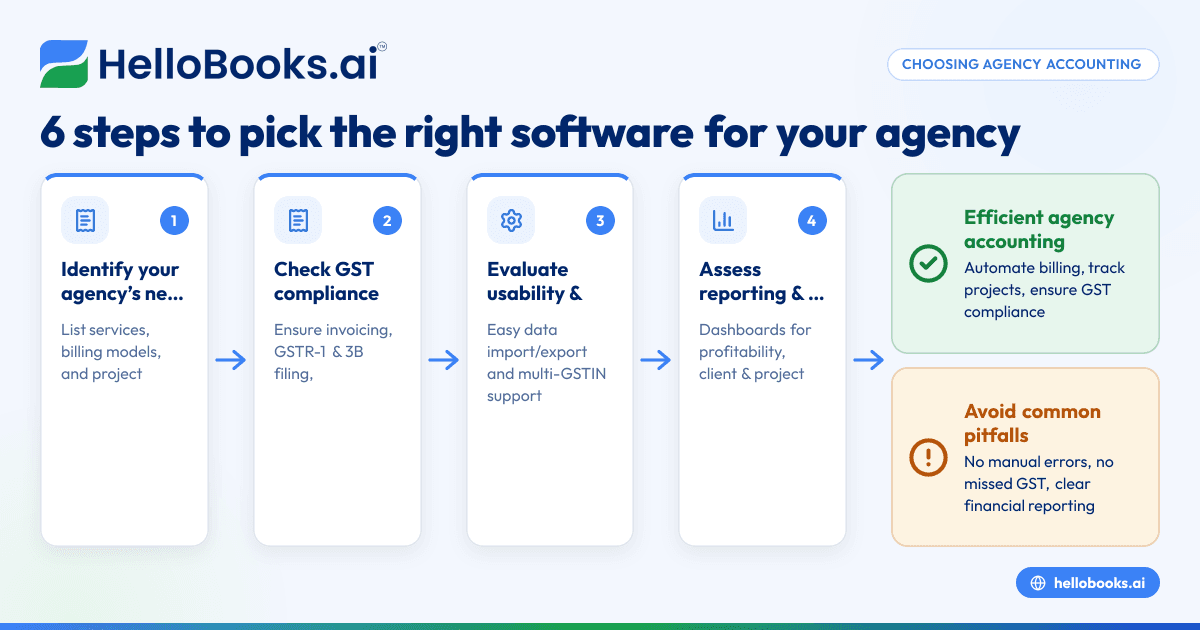
- Identify Your Agency’s Needs
- List the types of services you provide (creative, IT, consulting).
- Note your billing models (hourly, fixed price, retainer).
- Check if you need project-wise expense tracking and inventory management.
- Check GST Compliance Features
- Ensure the software supports GST invoicing with HSN/SAC codes.
- Verify it can file GSTR-1 and GSTR-3B returns.
- Look for bank statement reconciliation and GSTR-2B reconciliation features.
- Evaluate Usability and Integration
- Choose software with easy data import/export (e.g., Excel, Tally).
- Confirm it supports multiple GSTINs if your agency operates in different states.
- Check if it can generate professional invoices and reports.
- Assess Reporting and Financial Insights
- Look for dashboards that show project profitability and cash flow.
- Ensure the software can generate client-wise and project-wise financial statements.
- Consider Support and Scalability
- Find out the availability of customer support.
- Check if the software can scale as your agency grows or adds services.
- Compare Pricing and Plans
- Review pricing plans for transaction limits and GST filing features.
- Choose a plan that fits your current size with room to grow.
For more on agency-specific accounting, see IT and professional services and for general options, visit accounting software for small business.
Example (fictional figures)
Consider a digital agency in Pune that completed a client project in April 2024. They billed ₹3,50,000 at a fixed price with GST at an assumed illustrative rate of 18% (CGST 9% + SGST 9%). They incurred ₹50,000 in project expenses.
- Project revenue: ₹3,50,000
- GST on invoice: ₹3,50,000 × 18% = ₹63,000
- Total invoice amount: ₹3,50,000 + ₹63,000 = ₹4,13,000
- Project expenses: ₹50,000
- GST credit on expenses (assumed 18%): ₹50,000 × 18% = ₹9,000
- Net GST payable: ₹63,000 - ₹9,000 = ₹54,000
The agency uses the software to generate the invoice with GST details, track expenses by project, and prepare GSTR-1 and 3B returns. The reconciliation feature matches bank payments of ₹4,13,000 against the invoice automatically.
Common mistakes
- Using generic accounting software without project tracking
- Prevent by choosing software designed for agencies that supports project-wise accounting.
- Ignoring GST compliance features
- Prevent by verifying the software can generate GST-compliant invoices and file returns.
- Manual data entry leading to errors
- Prevent by selecting software with import features and bank reconciliation.
- Not tracking expenses by project
- Prevent by using software that allows expense allocation to specific projects.
- Overlooking multi-GSTIN handling
- Prevent by confirming support for multiple GSTINs if operating in multiple states.
- Choosing software without reporting capabilities
- Prevent by ensuring the software provides clear financial and project reports.
For more on avoiding mistakes in agency accounting, see accounting software in India.
Frequently asked questions
What is the best accounting software for creative agencies?
Creative agencies benefit from software that supports project-based billing, time tracking, and client management. Look for features like GST invoicing, expense tracking, and detailed reporting tailored to creative workflows. Many software options cater to these needs, so compare based on your agency size and billing complexity.
How does accounting software help advertising agencies?
Advertising agencies handle multiple clients and campaigns simultaneously. Accounting software helps by automating invoicing, tracking campaign expenses, managing retainers, and ensuring GST compliance. It reduces manual errors and saves time on reconciliation and tax filings.
Can I use generic accounting software for my advertising agency?
While possible, generic software often lacks project-specific features needed by agencies, such as detailed client billing and project expense tracking. Using agency accounting software designed for professional services improves accuracy and efficiency.
Is GST compliance included in agency accounting software?
Most agency accounting software designed for India includes GST invoicing, GSTR-1 and GSTR-3B filing, and reconciliation features. Confirm these capabilities before choosing software.
How to choose accounting software for an IT services firm?
Focus on software that supports multiple billing models, GST compliance, project expense tracking, and financial reporting. Evaluate ease of use, integration with existing tools like Tally or Excel, and customer support.
Key takeaways
- Agency accounting software handles multiple clients and projects with specialised billing and expense tracking.
- GST compliance features like invoicing, return filing, and reconciliation are essential.
- Evaluate software based on your agency’s billing models, reporting needs, and GSTIN requirements.
- Avoid manual data entry and generic software that lacks project-specific features.
- Use software that scales with your agency and supports multiple GSTINs if needed.
Start on the Free plan (200 transactions a year, GSTR-1 and 3B filing for one GSTIN) at HelloBooks pricing to experience agency accounting software tailored for Indian businesses.


