


Key takeaways
What this article covers, in order:
- Why this comes up / what goes wrong
- Step-by-step
- Example (fictional figures)
- Common mistakes
- Doing this in HelloBooks
- Frequently asked questions
Accounting software for media and publishing businesses must accommodate varied income sources such as subscriptions, advertising, and content sales, while managing expenses and GST compliance accurately. This article guides small business owners through choosing the right software, avoiding common pitfalls, and understanding how automation can reduce manual work.
Why this comes up / what goes wrong
Media and publishing businesses in India often face accounting challenges due to multiple billing models including subscriptions, ad revenues, and project-based work. They also deal with complex GST rules on services and goods, and frequent supplier bills for printing, distribution, and freelance content creation. Many small business owners still rely on spreadsheets, Tally, or manual bill books, which leads to time-consuming data entry, errors, and delays in GST filing. They need software that simplifies GST invoicing, reconciles supplier bills, and generates financial reports without requiring expert accounting knowledge.
Step-by-step
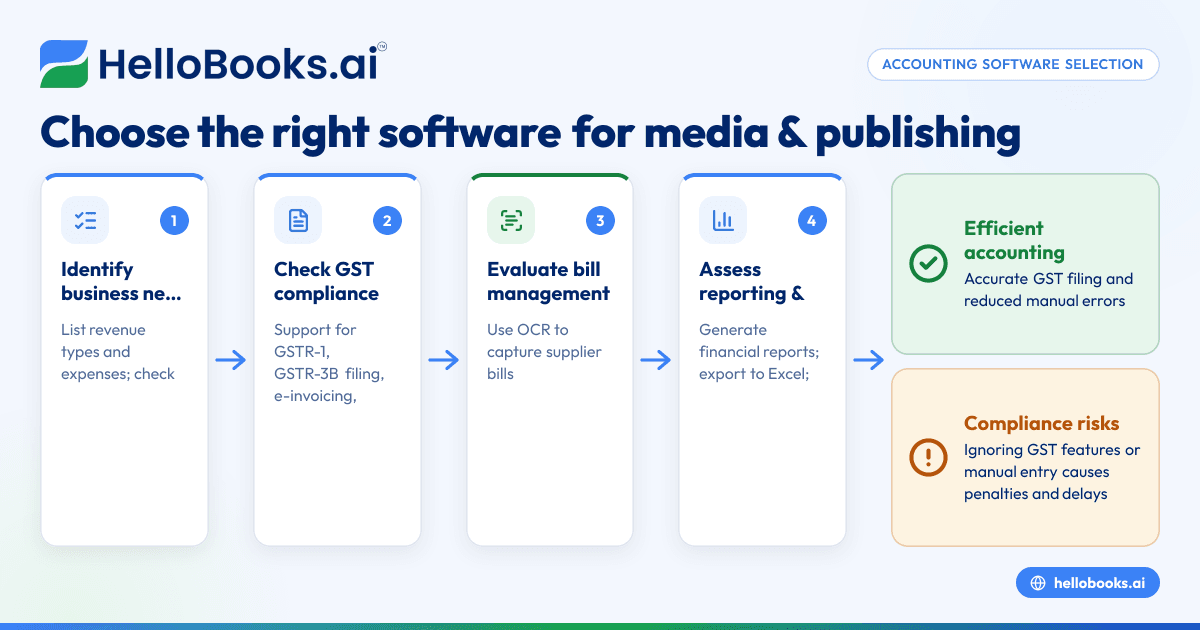
- Identify your business needs: List your revenue types, such as ad sales, subscriptions, and content licensing, and your expense categories like printing, distribution, and freelancers. Check if the software supports GST invoicing for both goods and services.
- Check GST compliance features: Ensure the software can handle GSTR-1 and GSTR-3B filing, e-invoicing if applicable, and supports reconciliation of input tax credit (ITC) with GSTR-2B.
- Evaluate bill management: Look for OCR capabilities to automatically capture purchase bills from photos or PDFs to reduce manual entry, especially for frequent supplier bills.
- Assess reporting and integration: The software should generate clear financial reports and support exports to Excel or integration with your existing tools like Tally or spreadsheets.
- Consider ease of use and support: Since many media owners are not accounting experts, choose software with a simple interface and good customer support.
- Compare pricing and plans: Review pricing to fit your budget, considering transaction limits and GST filing features.
- Test with a free trial or demo: Before finalizing, try the software with your actual data or sample transactions.
For more general guidance, see our accounting software for small business and accounting software in India articles.
Example (fictional figures)
Consider a small publishing house, "BookWorld Media," with the following transactions in March 2024:
- Subscription revenue: ₹1,50,000 (assumed GST 18%)
- Advertising revenue: ₹80,000 (assumed GST 18%)
- Printing supplier bill: ₹50,000 plus 18% GST
Calculate GST on revenues:
Subscription GST = ₹1,50,000 × 18% = ₹27,000
Advertising GST = ₹80,000 × 18% = ₹14,400
Total GST collected = ₹27,000 + ₹14,400 = ₹41,400
Calculate GST on purchase bill:
Supplier GST = ₹50,000 × 18% = ₹9,000
Net GST payable (GSTR-3B) = GST collected - GST paid
= ₹41,400 - ₹9,000 = ₹32,400
BookWorld Media files GSTR-1 with ₹2,30,000 sales (₹1,50,000 + ₹80,000) and GSTR-3B with net GST payable ₹32,400.
This example shows the need to track multiple revenue streams and input bills accurately for GST compliance.
Common mistakes
- Ignoring GST compliance features: Leads to penalties. Always verify the software supports GSTR-1 and GSTR-3B filing.
- Manual entry of purchase bills: Causes errors and wastes time. Use OCR-enabled software to capture bills automatically.
- Overlooking multiple revenue types: Failing to configure different GST rates or invoice types can cause incorrect tax calculations.
- Not reconciling ITC regularly: Missing input tax credit claims. Perform monthly reconciliation with GSTR-2B.
- Choosing software without reports: Makes financial analysis difficult. Ensure the software provides clear reports.
- Not testing software before purchase: May lead to usability issues. Use free trials to check suitability.
Refer to HelloBooks for India for software that addresses some of these issues.
Doing this in HelloBooks
HelloBooks offers OCR for purchase bills, allowing media and publishing businesses to capture supplier bills directly from photos or PDFs instead of manual entry. This saves time and reduces errors in recording expenses. Learn more about this feature at /ocr-scanning.
Frequently asked questions
What GST features should media and publishing businesses look for in accounting software?
Look for GSTR-1 and GSTR-3B filing, e-invoicing if your turnover requires it, and GST reconciliation tools like GSTR-2B matching to claim correct ITC.
Can I use accounting software if I currently use Tally or Excel?
Yes, many software solutions allow data import/export or integration with Tally and Excel, easing the transition and avoiding duplicate work. This helps maintain continuity while upgrading your accounting processes.
How does OCR for purchase bills help my business?
OCR automates data entry by reading bills from photos or PDFs, reducing errors and saving time compared to manual entry. This is especially useful for media businesses with frequent supplier bills.
Is it necessary to reconcile ITC every month?
Yes, regular reconciliation with GSTR-2B ensures you claim the correct input tax credit and avoid GST notices. It helps maintain accurate tax records and prevents compliance issues.
Can small media businesses file GST returns through accounting software?
Yes, many accounting software products support GST return filing for small businesses, simplifying compliance and reducing manual work.
For more on accounting software choices, see accounting software for small business.
Key takeaways
- Media and publishing businesses need software that handles diverse revenues, GST invoicing, and supplier bill management.
- Verify GST compliance features including GSTR-1, GSTR-3B filing, and ITC reconciliation.
- Use OCR-enabled software to automate purchase bill entry and reduce errors.
- Test software usability and reporting capabilities before purchase.
- Regular GST reconciliation prevents compliance issues and financial errors.
Start managing your media or publishing business accounts efficiently with HelloBooks. You can Start on the Free plan (200 transactions a year, GSTR-1 and 3B filing for one GSTIN).


