


Key takeaways
What this article covers, in order:
- Why this comes up / what goes wrong
- Step-by-step
- Example (fictional figures)
- Common mistakes
- Doing this in HelloBooks
- Frequently asked questions
Accounting software with AI capabilities specifically designed for construction companies can significantly ease the burden of managing complex financial transactions, retention billing, and GST compliance. Construction businesses often deal with multiple projects, supplier bills, labour costs, and retention amounts that require precise tracking and reconciliation. AI software helps by automating data entry, matching bank transactions, and capturing purchase bills using OCR, reducing manual effort and errors.
Why this comes up / what goes wrong
Owners and accountants in construction companies face unique challenges. For example, a civil contractor in Nagpur may bill clients with retention amounts that are paid months later. Managing these retention receivables alongside regular invoices can be cumbersome in spreadsheets or basic accounting software. Similarly, an interior contractor in Hyderabad handles multiple supplier bills, labour payments, and GST filing across projects. Manual bookkeeping leads to time-consuming reconciliation and frequent errors, delaying financial insights and compliance.
AI accounting software tailored for construction helps solve these pain points by automating repetitive tasks like invoice matching and bank reconciliation, while also simplifying GST returns filing. However, not all software suits construction workflows, so choosing the right one requires careful evaluation.
Step-by-step
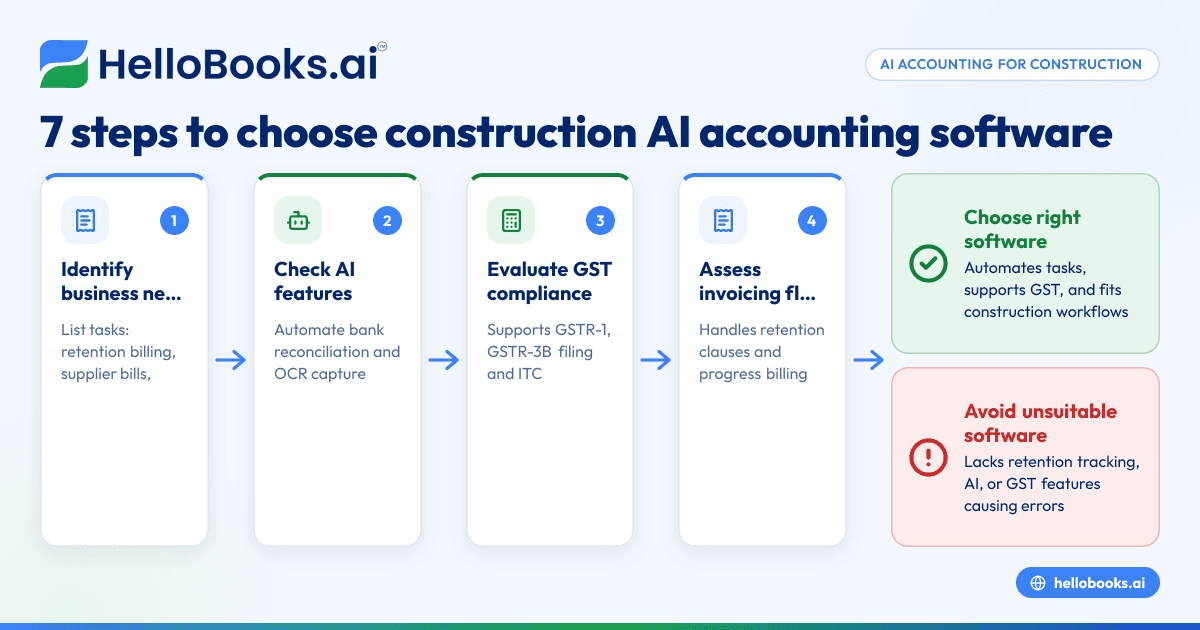
- Identify your business needs: List your key accounting tasks—retention billing, supplier bill management, GST compliance, inventory tracking, and bank reconciliation.
- Check for AI capabilities: Ensure the software can automate bank statement reconciliation and use OCR to capture purchase bills from PDFs or photos, reducing manual data entry.
- Evaluate GST compliance features: Confirm it supports GSTR-1 and GSTR-3B filing, and can help reconcile ITC with GSTR-2B.
- Assess invoicing flexibility: The software should handle construction-specific invoicing, including retention clauses and progress billing.
- Consider ease of use: Look for software with a simple interface and minimal manual typing requirements.
- Verify data security and support: Check for secure data handling and responsive customer support.
- Compare pricing and plans: Match features with your budget, considering transaction limits and GST filing support.
For more on software suited to Indian small businesses, see accounting software for small business and accounting software in India.
Example (fictional figures)
A civil contractor in Nagpur issues an invoice on 01/03/2024 for a project milestone:
Invoice amount (excluding GST): ₹5,00,000
GST @ 18% (assumed illustrative rate): ₹5,00,000 × 18% = ₹90,000
Total invoice value: ₹5,00,000 + ₹90,000 = ₹5,90,000
Retention clause: 10% retention held back = 10% × ₹5,00,000 = ₹50,000 (excluding GST)
Retention GST: ₹50,000 × 18% = ₹9,000
Retention amount withheld: ₹50,000 + ₹9,000 = ₹59,000
Amount payable immediately: ₹5,90,000 − ₹59,000 = ₹5,31,000
Later, when retention is released on 01/06/2024, the contractor records a receipt of ₹59,000.
Using AI reconciliation, the bank statement upload matches the ₹5,31,000 receipt and later the ₹59,000 retention receipt to the respective invoices without manual entry.
Common mistakes
- Ignoring retention billing complexities: Many software solutions do not support retention tracking well. Prevent this by choosing software that allows retention clauses and separate GST treatment.
- Manual data entry of supplier bills: This leads to errors and delays. Use software with OCR for purchase bills to capture supplier invoices from photos or PDFs.
- Not reconciling bank statements regularly: This causes missed payments or duplicate entries. Upload monthly bank statements and use AI reconciliation to automate matching.
- Overlooking GST filing requirements: Ensure the software supports filing GSTR-1 and GSTR-3B returns accurately to avoid penalties.
- Choosing software without construction-specific features: Generic software may lack project-wise tracking. Select solutions that cater to contractors and construction workflows. See Contractors and construction for more.
Doing this in HelloBooks
HelloBooks supports Indian construction businesses with key AI features:
- Bank statement upload and AI reconciliation: Upload your monthly bank statement in PDF, CSV, or Excel format. AI automatically matches receipts to invoices, saving you from re-typing each transaction line. This helps track payments, including retention releases, efficiently.
- OCR for purchase bills: Capture supplier bills by taking a photo or uploading a PDF. HelloBooks reads the bill using OCR and auto-matches line items to your inventory or expense accounts, reducing manual entry errors.
Learn more about these features at HelloBooks for India and bank statement reconciliation software.
Frequently asked questions
What is the best accounting software for construction companies?
The best software depends on your specific needs, such as retention billing, GST compliance, and bank reconciliation. Look for AI features like automatic bank statement matching and OCR for bills to reduce manual work. HelloBooks offers these capabilities tailored for Indian small businesses.
Can AI accounting software handle GST filing for construction businesses?
Yes, AI accounting software like HelloBooks supports GSTR-1 and GSTR-3B filing, which are essential for GST compliance. It can also help reconcile input tax credit using GSTR-2B reports.
How does AI help in bank reconciliation for construction companies?
AI matches bank statement transactions to invoices and expenses automatically by analysing date, amount, and vendor patterns. This reduces errors and saves time compared to manual reconciliation.
Is OCR useful for managing supplier bills in construction?
OCR (Optical Character Recognition) reads supplier bills from photos or PDFs and extracts line items automatically. This is particularly helpful for construction businesses dealing with numerous purchase bills.
Can I use construction accounting software without prior experience?
Many AI-powered accounting tools are designed with simple interfaces to help business owners and accountants with minimal accounting knowledge. Features like automatic data capture and reconciliation make it easier.
Key takeaways
- AI-powered accounting software automates data entry, bank reconciliation, and GST compliance for construction businesses.
- Construction-specific features like retention billing and project-wise tracking are essential.
- OCR for purchase bills reduces manual entry errors and speeds up bookkeeping.
- Regular bank statement upload and AI reconciliation prevent missed or duplicate payments.
- Choose software that supports GSTR-1 and GSTR-3B filing to stay GST compliant.
- HelloBooks offers AI reconciliation and OCR features suitable for Indian construction companies.
Start managing your construction accounting efficiently with AI assistance. Start on the Free plan (200 transactions a year, GSTR-1 and 3B filing for one GSTIN) today.


