


Key takeaways
What this article covers, in order:
- Why this comes up / what goes wrong
- Step-by-step
- Example (fictional figures)
- Common mistakes
- Doing this in HelloBooks
- Frequently asked questions
Accounting software for advertising agencies should support client billing, expense tracking, GST invoicing, and reconciliation of purchase bills. Agencies often work on multiple projects simultaneously and require software that simplifies bookkeeping and GST compliance.
Why this comes up / what goes wrong
Small advertising agencies in India often begin with manual methods like Excel spreadsheets, Tally, or physical bill books. These methods become inefficient and error-prone as transactions increase. Agencies face challenges such as tracking billings separately for each client, managing GST invoicing and e-invoicing requirements, reconciling supplier bills, and filing returns like GSTR-1 and GSTR-3B on time. Without proper software, errors in data entry, missed GST deadlines, and inaccurate ITC claims can cause penalties and cash flow issues.
Step-by-step
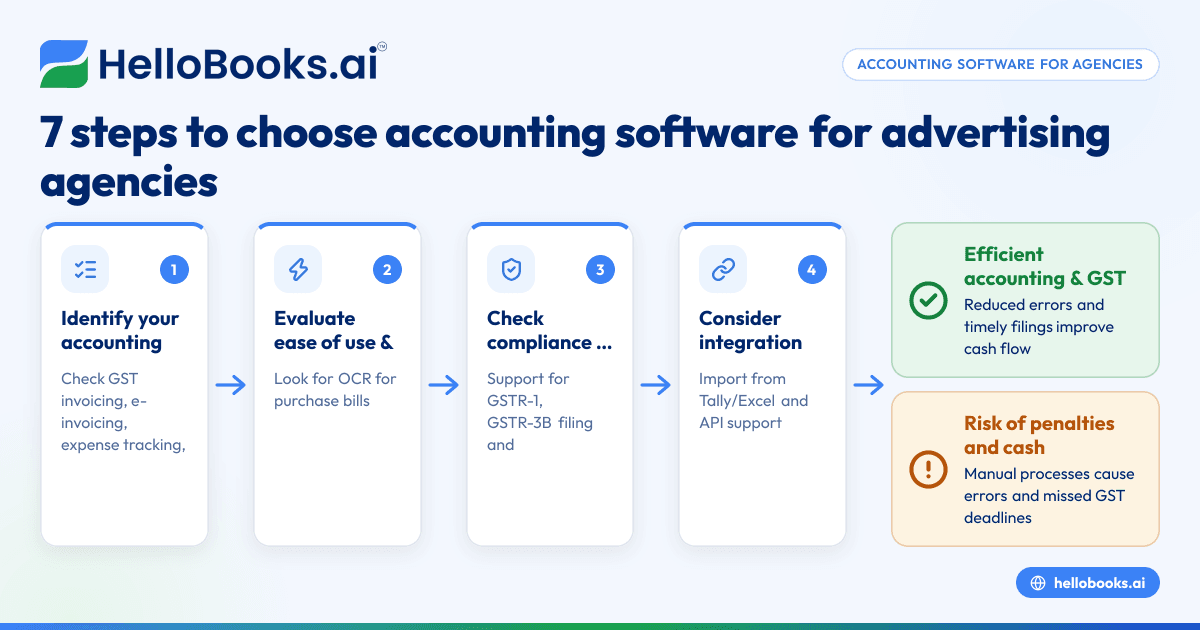
- Identify your agency’s accounting needs
- Determine if you require features like GST invoicing, e-invoicing, project-wise expense tracking, and inventory management.
- Check if the software supports multiple GSTINs if your agency operates in different states.
- Evaluate ease of use and automation
- Look for software that reduces manual data entry, such as OCR technology for purchase bills.
- Confirm it supports bank statement reconciliation and automatic transaction matching.
- Check compliance features
- Verify that the software assists with GSTR-1 and GSTR-3B filing deadlines.
- Ensure it supports GSTR-2B reconciliation to accurately claim Input Tax Credit (ITC).
- Consider integration capabilities
- If you currently use Tally or Excel, check if the software can import your existing data easily.
- Look for API support if you want to connect with other tools.
- Assess reporting and insights
- Ensure the software provides financial reports that help track profitability per client or project.
- Review support and updates
- Choose software that stays updated with GST rule changes and offers reliable customer support.
- Try before you buy
- Use free trials or free plans to test the software with your actual data.
For more on accounting software for small businesses, see accounting software for small business and for India-specific features, visit accounting software in India.
Example (fictional figures)
An advertising agency bills a client ₹2,00,000 on 15/04/2024 with GST at an assumed illustrative rate of 18% (CGST 9% + SGST 9%). The agency also receives purchase bills totaling ₹50,000 (excluding GST) for campaign expenses.
Sales invoice calculation:
₹2,00,000 × 9% = ₹18,000 (CGST)
₹2,00,000 × 9% = ₹18,000 (SGST)
Total GST = ₹18,000 + ₹18,000 = ₹36,000
Total invoice value = ₹2,00,000 + ₹36,000 = ₹2,36,000
Purchase bills GST (assumed 18%):
₹50,000 × 9% = ₹4,500 (CGST)
₹50,000 × 9% = ₹4,500 (SGST)
Total GST on purchases = ₹4,500 + ₹4,500 = ₹9,000
Input Tax Credit (ITC) claim:
ITC available = ₹9,000
GST payable after ITC:
GST on sales = ₹36,000
Less ITC = ₹9,000
Net GST payable = ₹36,000 - ₹9,000 = ₹27,000
This example illustrates the importance of accurate GST invoicing and purchase bill reconciliation.
Common mistakes
- Mixing personal and business expenses
- Prevent this by maintaining separate accounts and using software that tracks expenses by category.
- Ignoring timely GST filing
- Use reminders and software that supports GSTR-1 and GSTR-3B filing to avoid penalties.
- Manual data entry errors
- Reduce errors by using OCR for purchase bills and bank statement reconciliation.
- Not reconciling purchase bills with GSTR-2B
- Regularly match supplier invoices with GSTR-2B to claim correct ITC.
- Neglecting project-wise accounting
- Track income and expenses per client or project to understand profitability.
- Overlooking software updates
- Choose software that updates with GST rule changes to stay compliant.
For more on avoiding mistakes in Indian small business accounting, see accounting software for small business.
Doing this in HelloBooks
HelloBooks offers OCR for purchase bills, allowing advertising agencies to capture supplier bills from photos or PDFs without manual entry. This reduces data entry time and errors. Learn more about this feature at HelloBooks for India.
Frequently asked questions
What accounting software is best for marketing agencies?
Marketing agencies require software that handles GST invoicing, project tracking, and expense management. Features like OCR for bills and GST return filing support are important. HelloBooks offers these features tailored for Indian small businesses.
Can creative agencies use general accounting software?
Yes, but software designed for small businesses with GST compliance and expense tracking simplifies their accounting. Industry-specific features like project-wise billing help manage multiple clients better.
Is HelloBooks suitable for advertising agencies?
HelloBooks supports GST invoicing, e-invoicing, GSTR-1 and 3B filing, and OCR for purchase bills, making it a practical choice for advertising agencies managing compliance and bookkeeping.
How does OCR for purchase bills help advertising agencies?
OCR reads supplier bills from photos or PDFs and automatically matches line items to inventory or expense categories. This saves time and reduces manual entry errors.
Do I need separate software for GST filing?
Using accounting software with integrated GST filing like HelloBooks ensures timely and accurate submissions of GSTR-1 and GSTR-3B, reducing compliance risks.
For more on accounting software options in India, see accounting software in India.
Key takeaways
- Choose software that supports GST invoicing, e-invoicing, and filing (GSTR-1, 3B).
- Use OCR for purchase bills to reduce manual data entry.
- Track expenses and income per client or project for better profitability insights.
- Avoid mixing personal and business expenses to maintain clean records.
- Regularly reconcile purchase bills with GSTR-2B to claim correct ITC.
- Test software with free plans before committing.
Start managing your advertising agency’s accounts more efficiently with HelloBooks. Start on the Free plan (200 transactions a year, GSTR-1 and 3B filing for one GSTIN).


