
Key takeaways
What this article covers, in order:
- Why this comes up / what goes wrong
- Step-by-step
- Example (fictional figures)
- Common mistakes
- Frequently asked questions
- Key takeaways
Accounting in the fitness industry requires managing revenues from memberships, personal training, merchandise, and events, along with expenses such as rent, salaries, and equipment. Proper accounting ensures compliance with GST rules, accurate financial reporting, and helps business owners make informed decisions.
Why this comes up / what goes wrong
Fitness business owners and accountants in India often struggle with accounting because their revenue streams are varied and GST compliance can be complex. For example, gyms, yoga studios, and personal trainers may collect monthly or yearly membership fees, sell merchandise, or offer event-based services. Each of these may attract different GST rates or invoicing requirements. Additionally, many fitness businesses keep records manually or in Excel, leading to data entry errors and difficulties in reconciliation. Missing deadlines for GSTR-1 and GSTR-3B filing or incorrect invoice details can result in penalties. Understanding the specific accounting needs and GST rules for fitness services helps avoid these issues.
Step-by-step
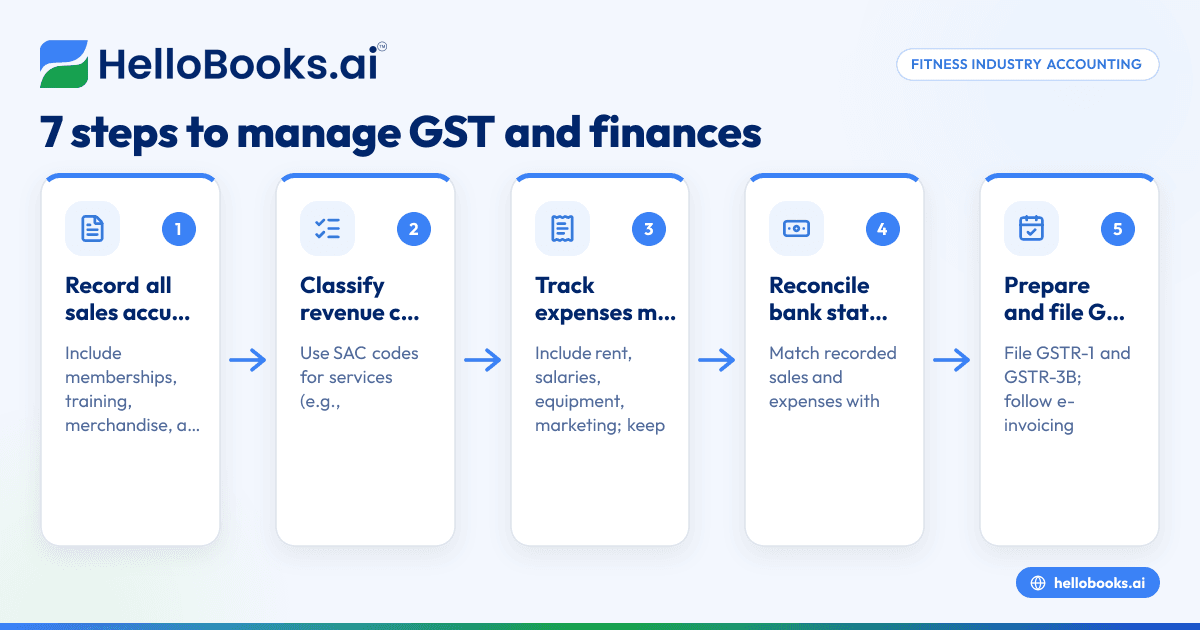
- Record all sales accurately: Include membership fees, personal training sessions, merchandise sales, and any event income. Ensure each sale has an invoice with the required details as per GST Rule 46, such as supplier and recipient GSTIN, HSN/SAC codes, and tax rates. See GST invoicing for detailed invoice requirements.
- Classify revenue correctly: Use SAC codes for services like gym training (e.g., SAC 9997 for fitness services) and HSN codes for goods like supplements or merchandise. This classification is essential for GST returns.
- Track expenses meticulously: Include rent, utilities, salaries, equipment purchases, and marketing costs. Keep bills and receipts for input tax credit (ITC) claims.
- Reconcile bank statements monthly: Match your recorded sales and expenses with bank deposits and withdrawals to catch discrepancies early.
- Prepare and file GST returns on time: File GSTR-1 with details of outward supplies and GSTR-3B for summary tax payments. For businesses with turnover over ₹5 crore, e-invoicing is mandatory for B2B sales from 1 August 2023, as per Notification No. 10/2023-Central Tax.[cgst-rule-46/rule46-particulars] Use the correct tax rates for CGST and SGST or IGST based on the location of supply.
- Maintain proper books of accounts: Whether using Excel, Tally, or manual ledgers, keep records updated for audit and tax purposes.
- Review financial reports regularly: Analyze profit and loss, cash flow, and GST liability to manage business health.
Example (fictional figures)
A gym in Bhopal collects ₹1,50,000 in membership fees and sells merchandise worth ₹50,000 in July 2023. Assume GST rate of 18% on services and 12% on merchandise.
- Membership fees GST = ₹1,50,000 × 18% = ₹27,000
- Merchandise GST = ₹50,000 × 12% = ₹6,000
- Total GST collected = ₹27,000 + ₹6,000 = ₹33,000
Expenses for the month include rent ₹40,000 (no GST), equipment purchase ₹30,000 + 18% GST, and salaries ₹50,000 (no GST).
- Equipment GST = ₹30,000 × 18% = ₹5,400
Input Tax Credit (ITC) = ₹5,400
Net GST payable = Total GST collected - ITC = ₹33,000 - ₹5,400 = ₹27,600
The gym files GSTR-1 with sales details and GSTR-3B declaring ₹27,600 GST liability.
Common mistakes
- Incorrect GST classification: Using wrong HSN/SAC codes leads to filing errors. Prevent by verifying codes against official lists.
- Missing invoice details: Invoices lacking supplier or recipient GSTIN or serial numbers cause compliance issues. Use a checklist based on Rule 46 requirements.
- Delayed GST filing: Late GSTR-1 or 3B filing results in penalties. Set reminders and prepare returns in advance.
- Ignoring e-invoicing rules: Businesses with turnover over ₹5 crore must issue e-invoices for B2B sales. Missing this requirement can cause rejection of invoices.[einvoice-threshold-5cr/einv-5cr-from-2023-08-01]
- Poor reconciliation: Not matching bank statements with records leads to errors. Reconcile monthly to catch discrepancies.
- Mixing personal and business expenses: Keep separate accounts to avoid confusion and audit issues.
Frequently asked questions
What GST rate applies to fitness services?
Fitness services like gym memberships generally attract 18% GST under SAC 9997. Merchandise sales have different rates depending on the product, such as 12% for supplements. Always check the latest GST notifications for accuracy.
Do I need to issue invoices for all fitness services?
Yes, GST Rule 46 mandates that all taxable supplies must have a tax invoice with specific details, including GSTINs, HSN/SAC codes, tax amounts, and serial numbers. For B2B supplies, e-invoicing is mandatory if turnover exceeds ₹5 crore.[cgst-rule-46/rule46-particulars]
How often should I file GST returns?
Most fitness businesses file monthly GSTR-1 and GSTR-3B returns. Small taxpayers under QRMP scheme may file quarterly. Filing on time avoids penalties.
Can I claim ITC on gym equipment?
Yes, input GST paid on equipment purchases used for business can be claimed as ITC, reducing your GST liability.
What are the common accounting software options for fitness businesses?
Many use Excel or Tally, but specialised software helps reduce errors and automate GST compliance. See Local service businesses for options.
Key takeaways
- Record all fitness-related sales and expenses with correct GST classification.
- Issue GST-compliant invoices including all mandatory details.
- Reconcile bank statements monthly to ensure accuracy.
- File GSTR-1 and GSTR-3B on time to avoid penalties.
- Follow e-invoicing rules if turnover exceeds ₹5 crore.
- Keep personal and business accounts separate.
Start your fitness business accounting with confidence. You can Start on the Free plan (200 transactions a year, GSTR-1 and 3B filing for one GSTIN) to manage your GST compliance and invoicing easily.
For more on managing service businesses, see Local service businesses and learn about HelloBooks for India.