


Key takeaways
What this article covers, in order:
- Why this comes up / what goes wrong
- Step-by-step
- Example (fictional figures)
- Common mistakes
- Doing this in HelloBooks
- Frequently asked questions
Accounting for a marketing agency means maintaining accurate records of all income from clients, expenses such as salaries and advertising spends, and GST filings. This helps the agency understand its profitability, manage cash flows, and comply with tax regulations.
Why this comes up / what goes wrong
Marketing agencies typically handle multiple clients and projects simultaneously, with varied expense types like digital ad spends, software subscriptions, freelancer payments, and employee salaries. Many agency owners or accountants use spreadsheets or Tally for bookkeeping, which can lead to time-consuming manual data entry and reconciliation errors. GST compliance adds complexity, especially when dealing with multiple GSTINs or interstate clients. Without a structured process, agencies risk missing input tax credits (ITC), filing delays, or inaccurate financial reports.
Step-by-step
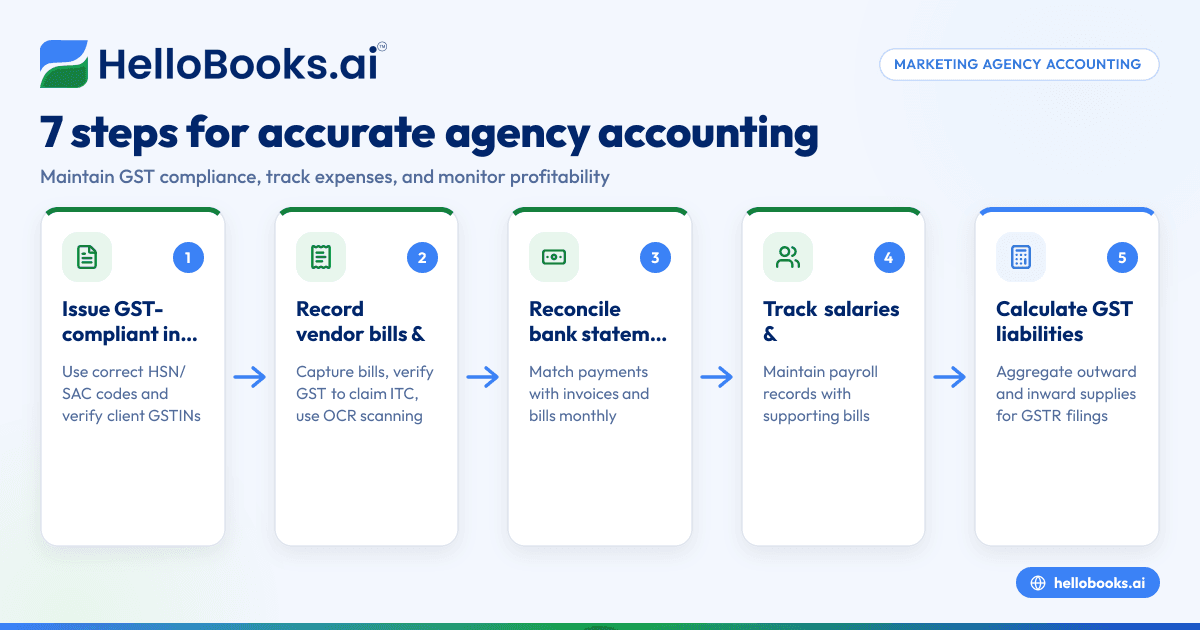
- Create and maintain client invoices: Issue GST-compliant invoices with correct HSN/SAC codes, GST rates, invoice numbers, and dates for every project or service delivered. Check that GSTINs of clients are accurate.
- Record all vendor bills and expenses: Capture bills for purchases such as ad spends, software, office supplies, and freelancer payments. Verify GST details on bills to claim ITC. Use OCR scanning to reduce manual entry errors.
- Reconcile bank statements: Regularly match payments received from clients and payments made to vendors against invoices and bills to identify discrepancies early.
- Track employee salaries and reimbursements: Maintain payroll records and document any reimbursements with supporting bills.
- Calculate GST liabilities: Aggregate outward supplies for GSTR-1 filing and inward supplies for GSTR-3B. Use GSTR-2B to verify ITC claims.
- Prepare financial reports: Generate monthly or quarterly profit and loss statements and balance sheets to assess agency performance.
- File GST returns on time: Ensure timely filing of GSTR-1 and GSTR-3B for each GSTIN to avoid penalties.
Regularly check for missing invoices or bills and verify GSTINs to prevent mismatches. For more details on software choices, see accounting software for small business.
Example (fictional figures)
A digital marketing agency in Pune issues an invoice on 10/05/2023 for ₹1,20,000 with an assumed GST rate of 18%. The agency also receives a purchase bill for a software subscription on 05/05/2023 for ₹24,000 at 18% GST.
- Invoice GST = ₹1,20,000 × 18% = ₹21,600
- Invoice total = ₹1,20,000 + ₹21,600 = ₹1,41,600
- Purchase bill GST = ₹24,000 × 18% = ₹4,320
- Purchase bill total = ₹24,000 + ₹4,320 = ₹28,320
The agency records the invoice and bill with GST details, reconciles payments received and made, and claims ₹4,320 as ITC in the GSTR-3B filing.
Common mistakes
- Missing or incorrect GST details on invoices or bills: Prevent by verifying GSTIN and tax amounts before recording transactions.
- Delayed reconciliation of payments: Schedule monthly reconciliation to catch errors early.
- Mixing personal and business expenses: Maintain separate records to ensure clarity and accurate tax reporting.
- Ignoring small expenses: Track all costs to get a true picture of profitability.
- Manual data entry errors: Use digital tools or OCR to reduce mistakes and save time.
Prevent these mistakes by following a disciplined accounting process and reviewing records regularly. Explore AI bookkeeping for automation benefits.
Doing this in HelloBooks
HelloBooks offers OCR for purchase bills, enabling marketing agencies to capture supplier bills directly from photos or PDFs instead of manual entry. This reduces data entry time and errors, helping agencies keep accurate expense records efficiently. Learn more about HelloBooks OCR scanning at /accounting-software-for-agencies.
Frequently asked questions
What is the best accounting software for a marketing agency?
The best software supports GST invoicing, expense tracking, bank reconciliation, and GST filing. HelloBooks provides these features along with OCR for purchase bills, making it suitable for small and growing agencies. For more options, see accounting software for small business.
How do I do bookkeeping for a marketing agency?
Bookkeeping involves regularly recording client invoices, vendor bills, payments, and expenses. Use a consistent system such as spreadsheets or accounting software to track all transactions and reconcile bank statements monthly.
What GST compliance is required for a digital marketing agency?
Marketing agencies must file GSTR-1 (outward supplies) and GSTR-3B (summary return) monthly or quarterly depending on turnover. Proper GST invoices must be maintained, and ITC claimed on eligible purchases.
Can I use Excel for agency accounting?
Excel may work for very small agencies but becomes inefficient as the business grows due to manual entry and reconciliation challenges. Switching to software like HelloBooks can save time and improve accuracy. Explore AI bookkeeping for automation benefits.
How does HelloBooks help with agency accounting?
HelloBooks automates purchase bill entry using OCR, supports GST invoicing, bank statement reconciliation, and GST return filing. This reduces manual work and compliance risks. Learn more about accounting software in India.
Key takeaways
- Issue accurate client invoices with correct GST details.
- Record all vendor bills and verify GST to claim ITC.
- Reconcile bank statements regularly to track payments.
- Use OCR-enabled tools like HelloBooks to reduce manual data entry.
- File GST returns on time to avoid penalties.
- Review financial reports monthly to monitor agency performance.
- Avoid common mistakes like missing GST info and mixing expenses.
Accounting for a marketing agency requires structured processes and the right tools. To start, consider HelloBooks which offers OCR for purchase bills and GST compliance features. You can Start on the Free plan (200 transactions a year, GSTR-1 and 3B filing for one GSTIN) and manage your agency’s accounting efficiently.


