
Key takeaways
What this article covers, in order:
- Why this comes up / what goes wrong
- Step-by-step
- Example (fictional figures)
- Common mistakes
- Doing this in HelloBooks
- Frequently asked questions
Accounting for dental groups means accurately managing multiple income streams such as dental treatments and lab diagnostics, tracking expenses including dental supplies and salaries, maintaining inventory, and ensuring GST compliance with proper SAC codes and timely filing. This guide explains these steps in detail, highlights common mistakes, provides a worked example using Indian figures, and shows how HelloBooks' OCR for purchase bills can help reduce manual work.
Why this comes up / what goes wrong
Dental group owners and accountants often face challenges because these businesses have diverse revenue sources and complex expense categories. Many still use spreadsheets, Tally, or bill books manually, which can cause errors in data entry and delays in GST filings. Misclassifying services under incorrect SAC codes or failing to claim proper input tax credit (ITC) creates compliance risks. Managing inventory of dental supplies and lab materials manually can lead to stock discrepancies and financial mismatches. Without automation, reconciling supplier bills and bank statements is time-consuming and prone to errors. These issues make accounting for dental groups complicated and error-prone.
Step-by-step
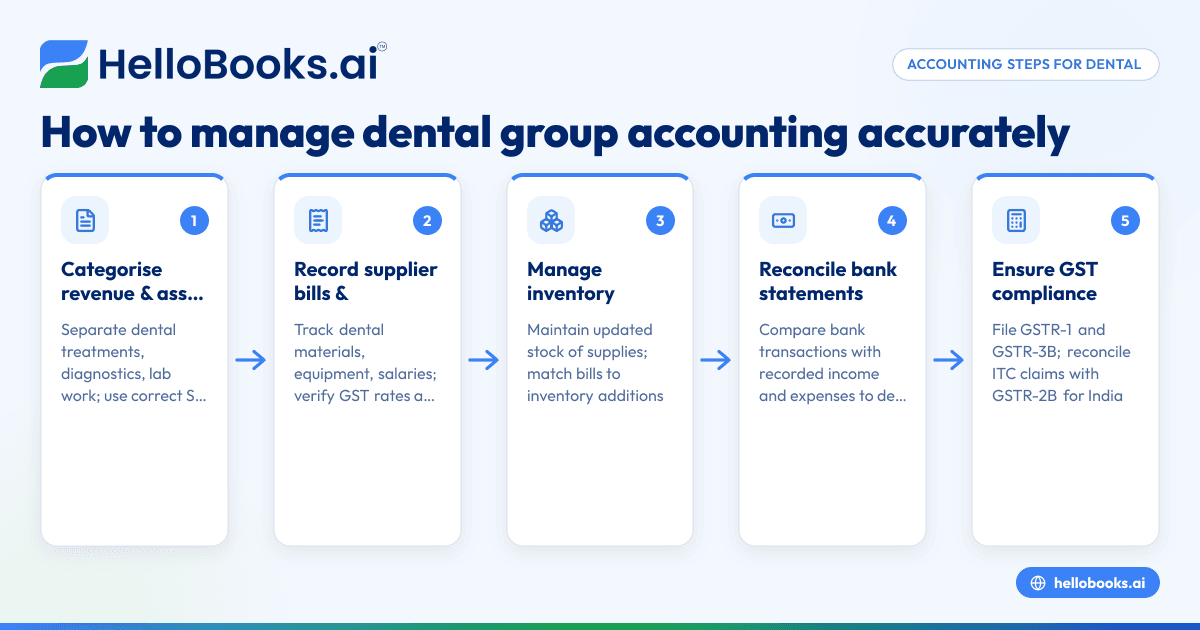
- Categorise Revenue and Assign SAC Codes: Separate income from dental treatments, diagnostics, and lab work. Use correct SAC codes on GST invoices. Verify that every invoice includes your GSTIN and meets e-invoicing requirements if applicable.
- Record Supplier Bills and Expenses: Track purchases of dental materials, equipment, rent, salaries, and other expenses. Check each bill for correct GST rates and supplier GSTIN. Keep digital or physical copies organised for audits.
- Manage Inventory: Maintain an updated inventory of dental supplies and lab materials. Match supplier bills with inventory additions to prevent stock discrepancies and ensure accurate expense reporting.
- Reconcile Bank Statements Regularly: Perform monthly reconciliation by comparing bank transactions with recorded income and expenses. This helps find missing entries or errors early.
- Ensure GST Compliance: Prepare and file GSTR-1 with accurate details of outward supplies. File GSTR-3B monthly or quarterly as per turnover. Reconcile ITC claims against GSTR-2B to claim eligible credits correctly.
- Generate Financial Reports: Create monthly profit and loss statements and balance sheets to monitor financial health. Review reports to identify unusual expenses or revenue drops.
- Prepare for Audits: Organise all books, invoices, bills, and reports systematically for easy retrieval during tax or GST audits.
For more on accounting in healthcare businesses, see Clinics, labs and healthcare.
Example (fictional figures)
A two-doctor dental clinic in Chennai recorded these figures for March 2024:
- Revenue from treatments: ₹4,00,000
- Revenue from lab diagnostics: ₹1,00,000
- Purchase of dental materials: ₹1,20,000 (including ₹21,600 CGST+SGST)
- Other expenses (rent, salaries): ₹1,50,000
Step 1: Calculate total revenue
₹4,00,000 + ₹1,00,000 = ₹5,00,000
Step 2: Calculate GST portion on purchases (assumed 18%)
₹1,20,000 × 18/118 = ₹18,305
Step 3: Calculate net purchase expense excluding GST
₹1,20,000 - ₹18,305 = ₹1,01,695
Step 4: Calculate total expenses excluding GST
₹1,01,695 + ₹1,50,000 = ₹2,51,695
Step 5: Calculate gross profit before GST
₹5,00,000 - ₹2,51,695 = ₹2,48,305
This example shows how to separate revenue streams, identify GST on purchases, calculate net expenses, and determine profit. Regular reconciliation ensures these figures match bank and supplier records.
Common mistakes
- Mixing personal and business expenses: Prevent this by maintaining separate bank accounts and clear expense categorisation.
- Incorrect SAC code usage: Always assign the correct SAC codes for dental treatments and lab services to avoid GST filing errors.
- Delaying bank reconciliation: Perform monthly reconciliation to catch mistakes early and maintain accurate books.
- Manual data entry errors: Use OCR or accounting software to reduce errors caused by manual typing.
- Ignoring inventory management: Regularly update stock records to prevent losses and incorrect expense reporting.
- Incomplete or incorrect supplier bills: Verify supplier GSTIN and invoice details before recording bills.
Learn more about GST invoicing best practices at GST invoicing.
Doing this in HelloBooks
HelloBooks offers OCR for purchase bills, allowing dental groups to capture supplier bills from photos or PDFs instead of manual entry. This feature auto-matches line items to existing inventory, reducing errors and saving time in bookkeeping. For more details, visit HelloBooks for India.
Frequently asked questions
How do dental groups manage GST compliance?
Dental groups must file GSTR-1 for outward supplies and GSTR-3B returns monthly or quarterly. Correct SAC code classification and reconciling ITC with GSTR-2B are essential for accurate GST compliance.
Can I use Excel or Tally for dental group accounting?
Yes, but these require manual data entry and reconciliation, which can lead to errors and consume time. Using software with OCR features can streamline accounting and improve accuracy.
What expenses are deductible for dental clinics?
Expenses such as dental materials, lab supplies, rent, salaries, and utilities are deductible. Keep proper bills and GST invoices to support deductions.
How often should bank statements be reconciled?
Monthly reconciliation is recommended to ensure all transactions are recorded and discrepancies are identified promptly.
Is inventory management necessary for dental groups?
Yes, tracking dental materials and lab supplies helps maintain stock levels, control costs, and avoid overstocking or shortages.
Key takeaways
- Separate dental services and lab revenue with correct SAC codes.
- Record and verify supplier bills with GST details.
- Reconcile bank statements monthly to avoid errors.
- Use OCR tools to reduce manual data entry.
- Maintain inventory records for dental materials and lab supplies.
- File GSTR-1 and GSTR-3B accurately for GST compliance.
Start managing your dental group accounts efficiently with HelloBooks. Start on the Free plan (200 transactions a year, GSTR-1 and 3B filing for one GSTIN).