
Key takeaways
What this article covers, in order:
- Key takeaways
- What is double entry bookkeeping?
- Why double entry bookkeeping matters for small businesses
- The basic rules behind double entry bookkeeping
- How double entry bookkeeping works with simple examples
- The accounting equation behind the system
Double entry bookkeeping is a method of recording every business transaction in at least two accounts. One side is a debit, and the other side is a credit, so the books stay balanced and your financial reports make sense.
For small businesses, double entry bookkeeping gives a clearer picture of cash, sales, expenses, assets, loans, and taxes. It reduces errors, makes bank reconciliation easier, and helps you produce reliable profit and loss statements and balance sheets.
Key takeaways
- Double entry bookkeeping records each transaction with equal debits and credits.
- It helps small businesses track profit, cash flow, assets, liabilities, and owner’s equity more accurately.
- The method supports better reporting, cleaner audits, and easier GST or tax compliance.
- Common transaction types include sales, purchases, expenses, loan payments, and owner contributions.
- A chart of accounts, basic accounting rules, and regular review are enough to get started.
- Software can automate posting, reconciliation, and reporting, especially as transaction volume grows.
What is double entry bookkeeping?
Double entry bookkeeping is the standard accounting system used by most businesses. In this system, every transaction affects at least two accounts. The total debits must equal the total credits.
This does not mean every transaction is complicated. It simply means money or value always comes from somewhere and goes somewhere.
For example, if you buy a laptop for your business using cash, your equipment account increases and your cash account decreases. If you make a sale on credit, your sales increase and your accounts receivable increase.
This method creates a complete record of what happened. It also gives you a way to check whether your books are internally consistent.
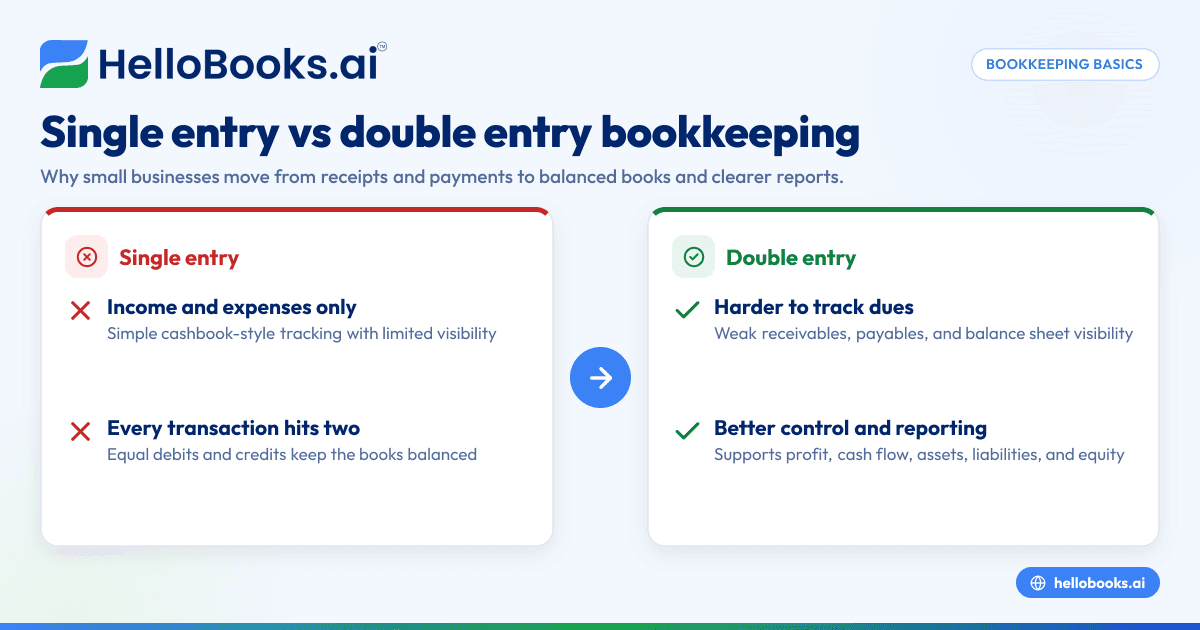
Single-entry bookkeeping is simpler, but it is limited. It usually tracks income and expenses only, much like a cashbook or spreadsheet ledger. That can work for very small operations for a short time. But as your business grows, you need more than a list of receipts and payments.
With double entry bookkeeping, you can answer questions like:
- How much do customers owe you?
- What do you owe vendors?
- How much is tied up in inventory or fixed assets?
- Are you profitable, or only collecting cash from old invoices?
- How much GST input credit or output tax is linked to your transactions?
That is why double entry bookkeeping is the foundation of proper accounting.
Why double entry bookkeeping matters for small businesses
Small businesses often start with spreadsheets, bank statements, and WhatsApp invoices. That may feel manageable in the beginning. But the cracks show quickly.
You may not know whether a payment was for a new sale or an old invoice. You may miss expenses paid from a personal card. You may struggle to match bank entries to invoices. You may file GST using incomplete records.
Double entry bookkeeping solves these problems by creating structure.
It gives you accurate financial reports
Your profit and loss statement shows income and expenses for a period. Your balance sheet shows assets, liabilities, and equity at a point in time. Both reports depend on correct double entry records.
Without that structure, reports can look right on the surface but still miss key items such as unpaid bills, outstanding invoices, loans, or depreciation.
It helps catch mistakes
Because debits and credits must balance, many errors become easier to spot. If your books do not balance, something is missing or recorded incorrectly.
This does not catch every mistake, but it improves control. It is one reason accountants rely on the method.
It supports tax and compliance work
In India, businesses often need clear records for GST, e-invoicing, vendor bills, and reconciliations. In the US, businesses need clean books for sales tax, income tax, payroll support, and contractor reporting.
Double entry bookkeeping makes it easier to separate revenue, tax, receivables, payables, and expenses correctly. This article is general information, not tax or legal advice.
It helps you make better decisions
If you only track cash in and cash out, you can misread the health of your business. A month with strong cash collections may still have weak current sales. A profitable month may still have poor cash flow if customers have not paid.
Double entry bookkeeping shows the full picture.
The basic rules behind double entry bookkeeping
To understand double entry bookkeeping, you need to know two things:
- The types of accounts.
- How debits and credits affect them.
The five main account types
Most business accounts fall into these categories:
- Assets: What the business owns. Examples: cash, bank balance, inventory, equipment, accounts receivable.
- Liabilities: What the business owes. Examples: loans, credit card dues, accounts payable, GST payable.
- Equity: The owner’s interest in the business. Examples: capital introduced, retained earnings, drawings.
- Income: Money earned from business activity. Examples: sales, service revenue, interest income.
- Expenses: Costs incurred to run the business. Examples: rent, salaries, software, travel, internet, advertising.
How debits and credits work
Debits and credits are accounting entries. They do not mean good or bad. They simply show which side of an account is affected.
A simple rule is:
- Assets and expenses increase with debits
- Liabilities, equity, and income increase with credits
The reverse also applies:
- Assets and expenses decrease with credits
- Liabilities, equity, and income decrease with debits
This sounds technical at first. It gets easier when you see examples.
How double entry bookkeeping works with simple examples
Here are common small business transactions and how double entry bookkeeping records them.
1. Owner puts money into the business
If the owner adds ₹1,00,000 to the business bank account:
- Debit: Bank ₹1,00,000
- Credit: Owner’s Capital ₹1,00,000
The business has more cash. It also has more owner equity.
2. Business buys a laptop in cash
If the business buys a laptop for ₹50,000 and pays immediately:
- Debit: Computer Equipment ₹50,000
- Credit: Bank or Cash ₹50,000
Equipment increases. Cash decreases.
3. Business makes a cash sale
If you sell goods for ₹20,000 and receive payment at once:
- Debit: Bank or Cash ₹20,000
- Credit: Sales ₹20,000
Cash increases. Income increases.
If GST applies in India, the entry may also include separate tax components depending on your setup and reporting method.
4. Business makes a credit sale
If you issue an invoice for ₹30,000 and the customer will pay later:
- Debit: Accounts Receivable ₹30,000
- Credit: Sales ₹30,000
You have earned income, but not yet received cash.
When the customer later pays:
- Debit: Bank ₹30,000
- Credit: Accounts Receivable ₹30,000
Cash increases. The customer’s outstanding balance reduces.
5. Business receives a vendor bill
If a supplier sends a bill for ₹10,000 for office supplies, payable later:
- Debit: Office Supplies Expense ₹10,000
- Credit: Accounts Payable ₹10,000
The expense is recorded now. The payment happens later.
When you pay the supplier:
- Debit: Accounts Payable ₹10,000
- Credit: Bank ₹10,000
6. Business repays a loan instalment
Suppose you pay ₹15,000 toward a business loan, including ₹13,000 principal and ₹2,000 interest:
- Debit: Loan Liability ₹13,000
- Debit: Interest Expense ₹2,000
- Credit: Bank ₹15,000
This is a good example of one transaction affecting more than two lines while still balancing.
The accounting equation behind the system
Double entry bookkeeping is built on one core equation:
Assets = Liabilities + Equity
Every transaction keeps this equation in balance.
If you borrow money from a bank, assets increase because cash comes in. Liabilities also increase because you now owe money.
If you earn a profit, equity increases over time. If you withdraw money for personal use, equity decreases.
This equation is why the balance sheet balances. It is also why double entry bookkeeping is not just data entry. It is a logic system for the business.
Double entry bookkeeping vs single entry bookkeeping
Many small businesses ask whether they really need double entry bookkeeping. The short answer is yes, once the business has regular invoices, expenses, bank transactions, tax filing needs, or more than one person handling finances.
Single entry bookkeeping
Single entry usually records one side of a transaction. For example, it may note that ₹5,000 was spent on fuel or ₹25,000 was received from a customer.
This can be enough for very small cash-based businesses. But it has limits:
- No proper receivables or payables tracking
- Weak balance sheet visibility
- Harder error detection
- Poor audit trail
- Limited reporting
Double entry bookkeeping
Double entry gives you:
- Better profit tracking
- Better control over dues and obligations
- Cleaner financial statements
- Easier correction of mistakes
- More confidence during tax filing or audits
If you are still using spreadsheets or legacy systems, moving to AI bookkeeping tools can reduce manual posting and make the transition easier.
The main books and records used in double entry bookkeeping
You do not need to memorise accounting jargon, but it helps to know the main parts of the system.
Chart of accounts
This is the list of all accounts your business uses. It usually includes bank accounts, sales accounts, expense heads, GST accounts, loans, assets, and equity accounts.
A clean chart of accounts matters. Too many accounts create confusion. Too few reduce visibility.
Journal entries
A journal entry is the first formal record of a transaction. It shows the date, accounts affected, debit amounts, credit amounts, and a brief narration.
Some systems post entries automatically from invoices, bills, and bank feeds.
Ledger
The ledger groups transactions account by account. For example, all entries for rent expense appear together. All entries for accounts receivable appear together.
This helps you review account balances and activity.
Trial balance
The trial balance is a list of all ledger balances. Total debits should equal total credits.
If they do not, there is an error that needs review.
Financial statements
From the trial balance, you prepare:
- Profit and loss statement
- Balance sheet
- Cash flow statement
These reports are what most owners use to understand business performance.
How to set up double entry bookkeeping in a small business
You do not need a large finance team to do this well. You need a simple process and consistency.
1. Create a sensible chart of accounts
Start with the basics:
- Bank and cash
- Sales
- Purchases or cost of goods sold
- Key expense categories
- Accounts receivable
- Accounts payable
- GST or tax accounts
- Loans
- Fixed assets
- Owner capital and drawings
Do not create a new account for every small variation.
2. Decide your bookkeeping basis
Choose whether your reports are mainly cash basis or accrual basis. Many businesses maintain books on an accrual basis because it better reflects invoices, bills, and dues.
Your accountant can guide you based on your business type and country.
3. Record source transactions properly
Capture these consistently:
- Sales invoices
- Customer receipts
- Vendor bills
- Expense claims
- Bank payments
- Cash transactions
- Loan entries
- Tax entries
- Owner withdrawals or contributions
4. Reconcile regularly
At least once a month, match your books with:
- Bank statements
- Credit card statements
- GST records, where relevant
- Vendor statements
- Customer outstanding balances
Using bank reconciliation software can save a lot of time here.
5. Review reports every month
Look at these reports together:
- Profit and loss
- Balance sheet
- Accounts receivable ageing
- Accounts payable ageing
- Cash flow view
This is where double entry bookkeeping becomes useful, not just correct.
Common mistakes small businesses make
Even with double entry bookkeeping, errors happen. The good news is most are preventable.
Posting to the wrong account
A loan repayment may be booked fully as expense. Asset purchases may be booked as routine expenses. Owner withdrawals may be booked as salary.
These errors distort profit and tax reporting.
Missing accruals and dues
If you ignore unpaid bills or unpaid customer invoices, your reports become incomplete. This is common in spreadsheet-based systems.
Mixing personal and business spending
This creates confusion and weakens the audit trail. Separate accounts are essential.
Ignoring reconciliations
If you do not reconcile the bank, receivables, and payables, mistakes can sit in the books for months.
Overcomplicating the setup
Some businesses create too many ledgers, tax buckets, and manual workarounds. Keep the structure simple and consistent.
Can software automate double entry bookkeeping?
Yes. Modern accounting systems handle much of the mechanics in the background. When you create an invoice, record a bill, or match a bank transaction, the software posts the debit and credit entries automatically.
That does not remove the need for review. But it reduces manual work and lowers the chance of basic posting errors.
For small businesses, useful features often include:
- Invoice creation and tracking
- Expense capture
- Bank reconciliation
- GST-ready records in India
- Financial reports
- Role-based workflows for teams and accountants
If you are comparing tools, accounting software for small business can help you move beyond spreadsheets without making the process harder.
Businesses in India may also want accounting software in India if GST, e-invoicing, and local workflows matter. If you are moving away from older desktop-ledger habits, a Tally alternative may also be worth considering.
When should a small business switch to double entry bookkeeping?
The best time is usually earlier than you think.
You should switch if any of these apply:
- You issue invoices and collect later
- You receive supplier bills and pay later
- You need a balance sheet
- You file GST or other business taxes
- You have inventory or fixed assets
- You have a business loan
- You want investor-ready or lender-ready reports
- More than one person touches the books
In practice, most growing small businesses should use double entry bookkeeping from the start. It creates cleaner records and avoids a painful cleanup later.
A simple monthly routine for staying on top of it
The method works best when it becomes part of a routine.
Weekly
- Record invoices and bills.
- Categorise expenses correctly.
- Match bank transactions.
- Follow up on missing receipts.
Monthly
- Reconcile bank and credit card accounts.
- Review customer and vendor balances.
- Check loan, tax, and asset accounts.
- Review profit and loss and balance sheet.
- Investigate unusual balances.
Quarterly or annually
- Review old receivables and write-offs if needed.
- Check depreciation and asset records.
- Prepare for tax filings and year-end closing.
- Clean up duplicate or inactive accounts.
A disciplined routine matters more than perfect accounting knowledge.
Double entry bookkeeping gives small businesses a reliable framework for recording transactions, staying organised, and understanding financial performance. If you want to spend less time on entries and reconciliation, you can book a demo with HelloBooks or compare options on the pricing page.
Frequently asked questions
Is double entry bookkeeping required for every small business?
Not every very small business starts with it, but most growing businesses should use it. If you have invoices, bills, GST, loans, or inventory, double entry bookkeeping becomes important quickly.