
Key takeaways
What this article covers, in order:
- The $225.25 that went missing (and didn't)
- Why the two records drift apart
- Which side do you adjust?
- What reconciliation actually protects you from
- Reconciliation vs. just "checking the bank app"
- A quick note on "auto-matching"
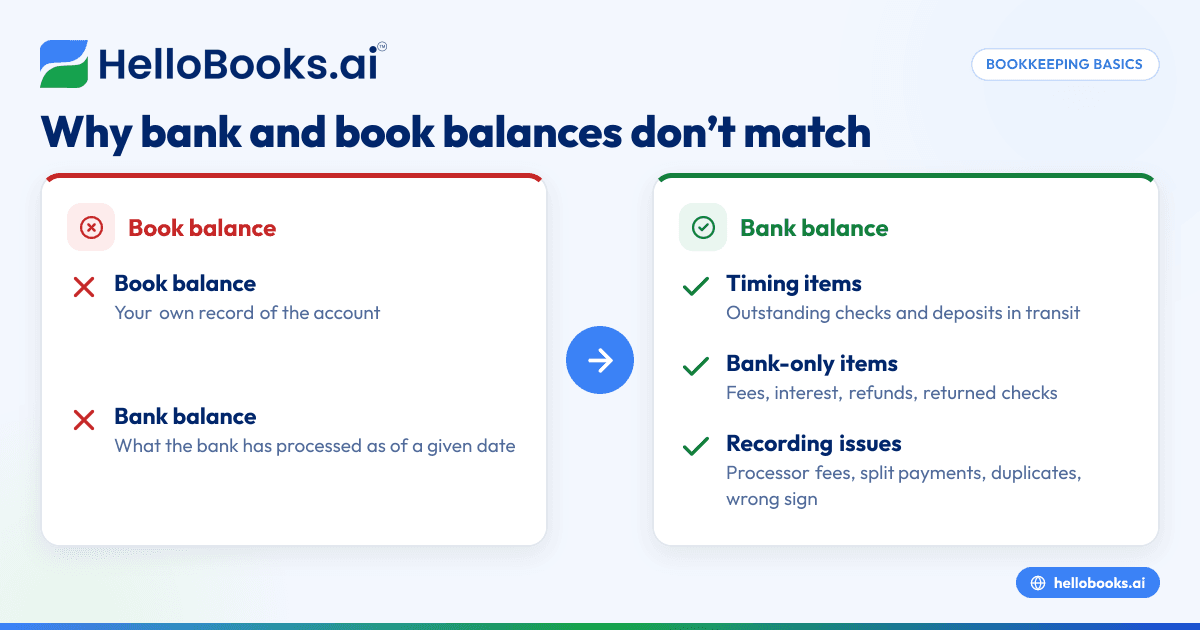
Bank reconciliation is the process of comparing your own record of a bank account with the bank's record, then explaining every difference until both sides agree. Your balances almost never match on their own because the bank and your books record the same transactions at different moments, and each side knows about a few things the other doesn't.
The $225.25 that went missing (and didn't)
It's the 3rd of the month. The bank says $14,212.40. Your books say $13,987.15. You have no idea where $225.25 went.
Here's the thing: it probably didn't go anywhere. Let's say you're Jamal, and you run a small print shop in Atlanta. (Jamal is made up, but his month is very typical.) When he lines up the statement against his books, he finds four items:
- A $310.00 check he wrote to a paper supplier on the 29th. Recorded in his books. Not cashed yet.
- A $95.00 deposit he dropped at the branch after closing on the 30th. Recorded in his books. Not on the statement.
- A $10.25 wire fee the bank charged. On the statement. Not in his books.
- A $20.50 refund a vendor sent back to his account. On the statement. Not in his books.
Put them together and the mystery disappears:
| Bank | Books | |
|---|---|---|
| Starting figure | $14,212.40 | $13,987.15 |
| Deposit in transit | +$95.00 | |
| Outstanding check | −$310.00 | |
| Wire fee | −$10.25 | |
| Vendor refund | +$20.50 | |
| Adjusted balance | $13,997.40 | $13,997.40 |
Both sides land on $13,997.40. That's his real cash. Neither of the starting numbers was it.
Why the two records drift apart
There are really only five reasons a bank balance and a book balance disagree. Almost every reconciliation problem is one of these, or two of them stacked.
1. Checks that haven't cleared
You record a check when you write it. The bank records it when it's cashed. In between, your books show less cash than the bank does. These are called outstanding checks.
2. Deposits the bank hasn't posted
The opposite situation. You deposit late on the last day of the month, record it, and the bank posts it on the 1st. Your books show more cash than the bank does. These are deposits in transit.
3. Things only the bank knew about
Service charges, wire fees, overdraft fees, interest earned, and returned customer checks all show up on the statement first. Until you enter them, your books are behind.
4. Things recorded differently
A card processor deposits $1,455 after keeping $45 in fees on $1,500 of sales. If you recorded the $1,500 sale but not the fee, you're $45 off. Batched deposits and split payments cause the same kind of mismatch.
5. Plain mistakes
A transposed number. A duplicate from importing the same statement twice. A deposit entered as a withdrawal. A transaction posted to the wrong bank account. These are the ones reconciliation exists to catch.
Which side do you adjust?
This is where people get turned around, so here's the short rule:
- If your books are already right and the bank just hasn't caught up, adjust the bank side. That's outstanding checks and deposits in transit. No journal entry needed.
- If the bank is right and your books are missing something, adjust the book side and record an entry. That's fees, interest, returned checks and your own errors.
Only book-side adjustments change your accounting records. Bank-side items fix themselves when they clear next month.
What reconciliation actually protects you from
It's easy to treat this as paperwork. It's more useful than that.
Spending money you don't have. If you look at the bank app and see $14,212.40, you might think you can cover a $14,000 equipment payment. You can't. Jamal's real number is $13,997.40, and that's before the rest of the month's bills.
Fraud and bank errors. A $49.99 charge from a vendor you've never heard of. A duplicate debit. A deposit credited to the wrong account. Banks generally expect you to report errors promptly, and the window for disputing some problems is limited, so you want to spot them within weeks, not at year-end.
Bad decisions from bad reports. Your P&L and Balance Sheet are only as good as the transactions under them. If fees and refunds aren't recorded, your expenses and your cash are both off, and the cash flow picture you're using to plan next quarter is off too.
Painful year-ends. Unreconciled books are the number one reason a CPA's year-end review takes longer than you expected. Clean books make tax time easier; your CPA handles the filing.
Reconciliation vs. just "checking the bank app"
Lots of owners glance at their bank balance daily and figure that's good enough. It's a fine habit, but it's not reconciliation. Here's the difference:
| Checking the bank app | Reconciling |
|---|---|
| Shows what's cleared right now | Ties a fixed statement date to your books |
| Ignores uncashed checks | Lists every outstanding check |
| Doesn't touch your books | Updates your books with fees, interest, corrections |
| Catches big surprises | Catches small errors before they pile up |
You want both. The glance tells you whether something's on fire. Reconciliation tells you your numbers are true.
A quick note on "auto-matching"
Accounting software with a bank feed will suggest matches between bank transactions and what's already in your books. That's a big time saver, but matching isn't the same as reconciling. Matching says "these two records are the same transaction." Reconciling says "the statement balance on Sep 30, 2026, minus the timing items, equals my book balance on Sep 30, 2026." You still want to do that final check, because a missing or duplicated transaction can match perfectly and still leave the totals wrong.
How HelloBooks helps
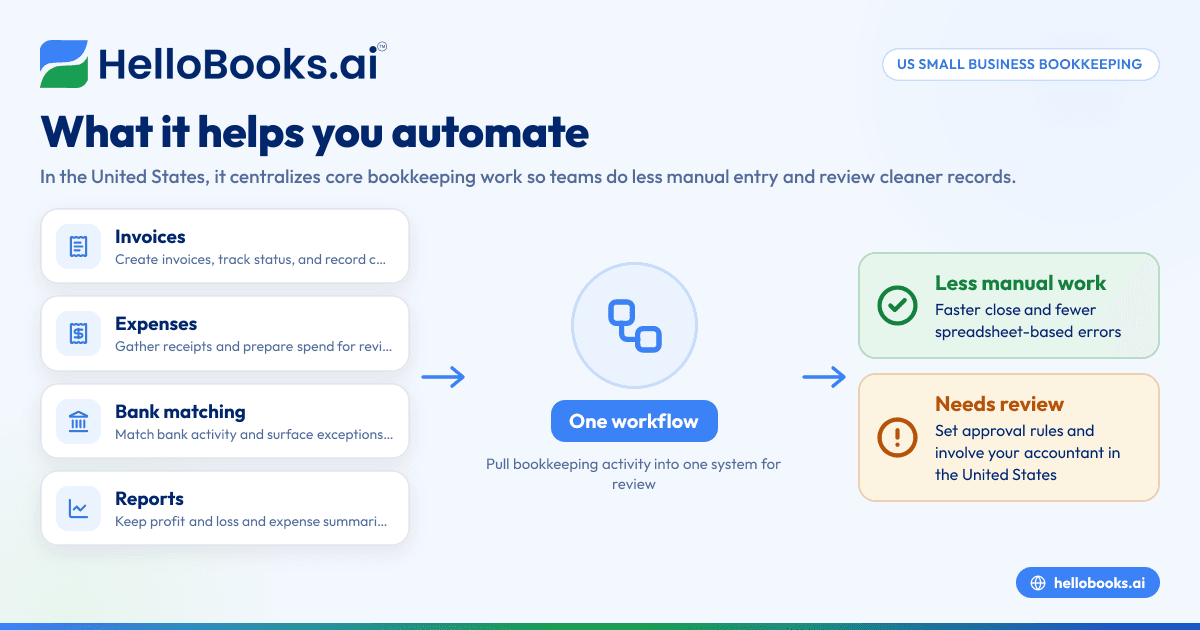
With HelloBooks you can connect most US banks and credit cards, so the bank's own transactions flow into your books instead of being typed from a PDF. If a bank won't connect, CSV statement import works as a fallback. On the reconcile screen, your statement sits next to your ledger, and each line gets an AI match suggestion with a confidence score and the reason behind it. That's the matching part. The reconciling part is the report it produces: opening balance, cleared items, outstanding items and closing balance, the same pieces as Jamal's table above, exportable as PDF or CSV. The Free plan includes 1 live bank feed, up to 200 transactions per year, and the core reports (P&L, Balance Sheet, Cash Flow). Paid plans add more bank connections: 3 on Starter ($14.99/month) and unlimited on Pro ($39.99/month). Starter also adds AI auto-categorization, so fees and refunds land in the right account faster. More detail is on our bank reconciliation software page.
FAQs
Is bank reconciliation required for small businesses?
There's no general rule forcing a sole proprietor to reconcile, but lenders, investors and CPAs all assume you do. Practically, it's the only way to know your books match reality.
What's the difference between the book balance and the bank balance?
The book balance is your own record of the account. The bank balance is what the bank has processed as of a given date. Timing items and unrecorded bank charges explain most of the gap.
Do I need a journal entry for outstanding checks?
No. An outstanding check is already in your books. You only list it on the reconciliation so the bank side can be adjusted. It clears on its own when the payee cashes it.
Why does my balance still not match after I add everything up?
Usually it's a duplicate, a transposed number, an entry with the wrong sign, or a changed opening balance. Check the opening balance first; it's the fastest one to rule out.
Can a bank make a mistake on my statement?
Yes, though it's uncommon. If you find a charge or deposit you can't explain and it isn't in your books, contact your bank promptly with the statement date and amount.
Once you've seen a real reconciliation close to the cent, the gap stops being scary and starts being a short to-do list.
Start free, no credit card. Try HelloBooks Free