
Key takeaways
What this article covers, in order:
- Key takeaways
- What is HelloBooks AI?
- What does HelloBooks AI help you automate?
- Who is HelloBooks AI a good fit for?
- How does HelloBooks AI compare with manual bookkeeping?
- What features matter most for US small businesses?
If you are searching for hellobooks ai, the short answer is this: it is AI-based accounting and bookkeeping software built to reduce manual finance work for small businesses. In the United States, it is most useful when your team spends too much time on invoicing, expense capture, bank reconciliation, and keeping books current for reporting and tax prep.
Key takeaways
- HelloBooks AI is designed to automate repetitive bookkeeping tasks that usually slow down small finance teams.
- It can help centralize invoices, expenses, reconciliations, and reporting in one workflow.
- The biggest value is speed, cleaner books, and fewer manual errors from spreadsheet-based processes.
- It is most relevant for US small businesses moving beyond spreadsheets, basic manual entry, or disconnected tools.
- You should still review outputs, set approval rules, and involve your accountant for tax treatment and filings.
- If you want a modern system for day-to-day finance operations, it fits the category of AI accounting software.
What is HelloBooks AI?
HelloBooks AI is bookkeeping and accounting software that uses automation to handle repetitive finance tasks. Instead of relying on someone to enter every transaction by hand, it helps organize records, match bank activity, track expenses, create invoices, and prepare reports with less manual work.
For a small business in Chicago, Houston, or Detroit, that matters because finance work often gets stuck in email inboxes, spreadsheets, and bank downloads. Owners approve expenses late. Accountants chase missing receipts. The books fall behind by two or three weeks. That creates problems for cash flow planning and month-end close.
The main appeal of hellobooks ai is not that it replaces judgment. It is that it reduces the boring work that keeps your team from focusing on review, decisions, and follow-up. If your current process depends on copying data from PDFs, matching payments manually, or hunting down transactions before tax season, automation can save meaningful time.
This is also where the phrase ai hellobooks ai makes sense in practice. People use that search when they want to know whether the product is actually useful, not just whether it includes AI in its marketing. The real test is simple: does it cut manual steps in bookkeeping and help you keep cleaner records every week?
What does HelloBooks AI help you automate?
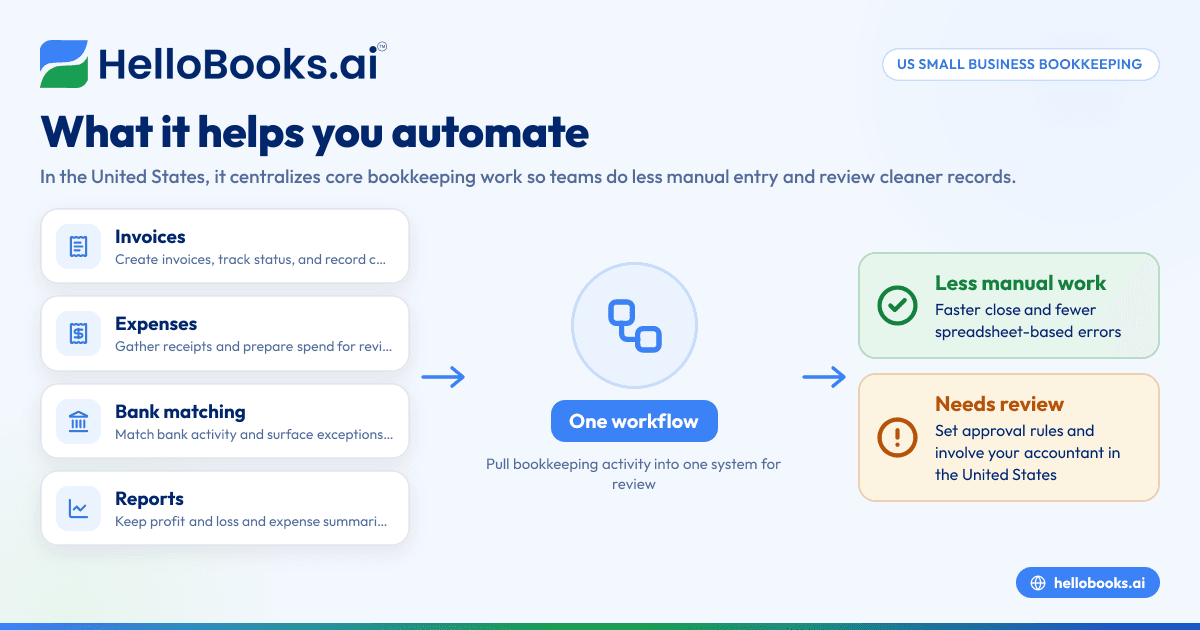
It helps automate core bookkeeping work like invoice creation, expense recording, bank matching, and financial reporting. For a small business, that means less data entry, faster monthly close, and better visibility into cash movement.
Under that simple answer, the value comes from how these tasks connect. Most small businesses do not struggle with one finance task in isolation. They struggle because billing, collections, expenses, and reconciliation happen in separate places.
1. Bookkeeping data entry
Manual bookkeeping often starts with collecting transaction data from different sources. That may include bank statements, card activity, receipts, supplier bills, and sales records. HelloBooks AI aims to reduce repeated entry by pulling bookkeeping activity into one system and organizing it for review.
That matters if your office manager is retyping transactions from one screen to another. It also matters if your accountant only gets usable records at month-end.
2. Invoicing
For service businesses and product sellers, invoicing delays create cash flow delays. A system that helps generate invoices quickly, track status, and record collections can shorten the gap between work completed and money received.
If your team sends invoices from Word documents or spreadsheets, moving to dedicated invoice software can make billing more consistent. It also reduces missed invoices and version confusion.
3. Expense capture and categorization
Expenses are one of the easiest places for records to get messy. Receipts sit in email. Card charges go uncategorized. Reimbursements get lost. An automated workflow helps gather those transactions in one place and prepare them for review.
For a growing US business, this can make month-end far less painful. It can also improve visibility into vendor spend and recurring costs before they drift upward.
4. Bank reconciliation
Reconciliation is one of the clearest places where automation creates value. If your team downloads statements and checks every line manually, the process is slow and error-prone. Matching bank activity against your books in a structured workflow can speed review and surface exceptions faster.
That is why businesses looking into hellobooks ai often compare it with dedicated bank reconciliation software. The question is not whether reconciliation matters. It is whether your current process wastes too many hours.
5. Financial reporting
Small business owners need current numbers, not reports that arrive weeks late. Automated bookkeeping systems help produce timely profit and loss, expense summaries, and other basic reports so you can see where the business stands.
That is especially useful when you are planning payroll, inventory purchases, contractor payments, or a new hire.
Who is HelloBooks AI a good fit for?
HelloBooks AI is a good fit for small businesses that have outgrown spreadsheets and want faster bookkeeping with fewer manual tasks. It is especially useful when one person handles too much of the finance process.
The best-fit users are usually in one of these situations:
Businesses still using spreadsheets for daily bookkeeping
Spreadsheets are flexible, but they break down fast when transaction volume increases. Version control gets messy. Manual formulas create risk. It becomes harder to tell whether books are truly current.
If that is your setup, moving to accounting software for small business can improve consistency and make finance work easier to review.
Teams using basic tools but still doing manual cleanup
Many companies have software already. The problem is that the real work still happens offline. People export files, edit them manually, and reupload them later. That creates lag and hidden errors.
HelloBooks AI is more useful in those cases than in businesses that already have a highly structured and well-staffed accounting operation.
Owners who need visibility without becoming bookkeepers
Many owners do not want to learn accounting workflows in depth. They want to know what they owe, what customers owe them, how much cash is left, and whether expenses are under control. Automation helps by turning scattered records into something reviewable.
Accounting firms supporting small business clients
Firms serving many small clients often lose time on cleanup work. Standardized bookkeeping workflows can make collaboration easier and reduce back-and-forth over missing records.
How does HelloBooks AI compare with manual bookkeeping?
It is faster and more consistent than manual bookkeeping for routine tasks. The main benefit is not perfection. The benefit is reducing repetitive work so your team can review exceptions instead of touching every transaction.
Manual bookkeeping often looks cheap at first. A founder does some entry work. An admin handles invoices. A part-time bookkeeper reconciles the bank account. But as transaction volume rises, the hidden cost becomes clear.
Here is what manual processes usually create:
- Delayed books.
- Duplicate entry.
- Missing receipts and bills.
- Reconciliation backlogs.
- Limited visibility into cash flow.
- Stress near month-end and tax deadlines.
HelloBooks AI can help reduce those issues by organizing work into one flow. That does not mean every transaction should post without review. It means fewer steps should require human effort.
For a business with weekly customer billing and frequent vendor payments, even a small reduction in manual touchpoints can save hours each month.
What features matter most for US small businesses?
For US small businesses, the most important features are invoice tracking, expense capture, bank reconciliation, and clear financial reports. Strong review controls matter too, because finance automation still needs human oversight.
Below are the practical areas to check before adopting any bookkeeping platform.
Clean invoice workflows
US businesses need reliable billing records. If you send many invoices each month, look for a system that makes invoice creation, tracking, and status review simple. That matters for service firms, agencies, consultants, and B2B sellers.
Expense organization
You need a clean way to collect receipts, review spend, and keep records attached to transactions. That helps during audits, year-end review, and internal cost control.
A dedicated expense management software workflow is useful when employee and card spending starts to grow.
Reconciliation speed
This is often the biggest operational bottleneck. Ask how quickly the system helps your team identify matched items, open items, and exceptions that need investigation.
Reporting that owners can actually use
Reports should help with decisions, not just compliance. You should be able to understand revenue trends, major expenses, and cash position without exporting everything into another spreadsheet.
Fit with your current stack
Many US small businesses already rely on tools like QuickBooks and Stripe in their finance process. If you are reviewing options because your current setup feels too manual, you may also want to look at a QuickBooks alternative.
Can HelloBooks AI replace your bookkeeper?
No. It can reduce your bookkeeper’s manual workload, but you still need human review for coding decisions, exceptions, and tax treatment.
That short answer matters because automation is often misunderstood. Software can speed up capture, classification, and matching. It can organize records and make daily bookkeeping easier. But it does not remove the need for accounting judgment.
A bookkeeper or accountant still matters for:
- Reviewing unusual transactions
- Fixing historical errors
- Applying consistent categorization
- Preparing for tax filings
- Handling year-end adjustments
- Supporting lender, investor, or audit requests
This is general information, not tax or legal advice. If you need help with filing positions, state sales tax treatment, 1099 reporting, or year-end cleanup, work with a qualified accountant. If you do not have one, you can find an accountant.
In practice, the strongest use case for HelloBooks AI is not replacement. It is leverage. One finance person can manage a cleaner process with less chasing and less rework.
What does the implementation actually look like?
Implementation usually means setting up your workflows, importing or organizing core finance data, and creating a review process. The goal is to get current books faster, not just move old chaos into new software.
For a small business, setup should be approached in phases.
Step 1: Map your current finance process
Write down where transactions start and who touches them. Include invoices, expenses, bank activity, reimbursements, and approvals. This shows where your bottlenecks are.
Step 2: Clean up your chart of accounts and categories
Automation works better when your categories are structured. If you have duplicate or vague account names, fix that first.
Step 3: Set rules for review and approval
Do not automate blindly. Decide which items can flow through quickly and which ones require a human check.
Step 4: Reconcile one period carefully
Before scaling the process, make sure one full period closes correctly. That helps you catch mapping problems and missing records early.
Step 5: Train the people who actually use it
A finance system succeeds when the owner, bookkeeper, and operations staff know their roles. Keep workflows simple. Assign responsibility for receipts, approvals, and exception review.
What are the limits of HelloBooks AI?
HelloBooks AI is helpful for routine bookkeeping, but it is not a shortcut around finance discipline. If your business has weak processes, poor records, or inconsistent approvals, software alone will not fix everything.
Here are the common limits to keep in mind.
It depends on clean inputs
If expenses are undocumented or bank accounts are mixed with personal spending, automation has less to work with. The software can organize activity, but it cannot create missing evidence.
It still needs review
AI can help classify and match transactions, but unusual items need attention. Refunds, chargebacks, owner draws, loan activity, and one-off purchases should be reviewed carefully.
It is not your tax advisor
Bookkeeping software helps maintain records. It does not replace professional advice on deductions, sales tax obligations, contractor classification, or filing strategy.
It works best with a repeatable process
The more standardized your invoice, expense, and reconciliation workflows are, the more value you get. Random processes create random results.
Is HelloBooks AI worth it for a small business?
Yes, if manual bookkeeping is slowing your team down and your books are often behind. It is most worth it when automation saves real staff time and helps you close the books with fewer errors.
To judge value, look beyond software features. Ask these questions:
- How many hours each month go into manual entry?
- How long does bank reconciliation take?
- How often are invoices delayed?
- How many transactions sit uncategorized at month-end?
- How often does your accountant have to clean up your books?
If those pain points are growing, the return is usually operational before it is purely financial. Better books help you make faster decisions, chase receivables earlier, and reduce cleanup work.
If you are exploring tools in this category, you may also want to compare solutions labeled as AI bookkeeping or broader accounting software in the USA.
If you want to see whether HelloBooks fits your workflow, book a demo at /book-a-demo or compare options at /pricing.
Frequently asked questions
Is HelloBooks AI only for accountants?
No. It can also fit owners, operations managers, and finance leads who need simpler bookkeeping workflows. Accountants still benefit because cleaner records reduce cleanup work and speed review.
Does HelloBooks AI work for service businesses and product businesses?
Yes. Both types of businesses deal with invoices, expenses, bank activity, and reporting. The exact workflow differs, but the core bookkeeping automation is useful in either model.
Can HelloBooks AI help if my books are behind?
It can help organize current bookkeeping and reduce future backlog. If your books are far behind or inaccurate, you may still need a bookkeeper or accountant to clean up prior periods first.
Should I switch if I already use QuickBooks?
Maybe. If QuickBooks meets your needs and your process is efficient, a switch may not be necessary. If your team still does too much manual work around it, it may be worth comparing alternatives.
Does HelloBooks AI handle tax filing for my business?
Bookkeeping software can support tax readiness by keeping records organized, but tax filing requirements depend on your business and state rules. Review filing obligations with your accountant before relying on any workflow for compliance.
Read next
This article covers one part of a bigger topic. For the complete picture, read our guide to hellobooks ai.