
Key takeaways
What this article covers, in order:
- Key takeaways
- Why monthly close and cleanup matter
- What does the right CPA or bookkeeper actually do?
- How do I find an accountant for monthly close and cleanup?
- What should I ask before hiring?
- CPA vs. bookkeeper: which one do you need?
Finding the right CPA or bookkeeper in the United States starts with matching the person to the job you actually need done. If your problem is a late monthly close, messy books, and cleanup after months of spreadsheet errors, you need someone with cleanup experience, a clear close process, and comfort working inside your current systems.
Key takeaways
- To find an accountant for monthly close and cleanup, define the work first, then screen for process, communication, and tool fit.
- A good fit is not just about credentials. It is also about responsiveness, documentation, and the ability to clean up old periods without making new errors.
- Ask how they handle reconciliations, prior-period adjustments, 1099 tracking, sales tax workflows, and owner review each month.
- Request a sample monthly close checklist, reporting package, and cleanup plan before you hire.
- If you use spreadsheets, QuickBooks, or a mix of disconnected tools, choose a professional who can simplify your workflow, not just work around it.
- The best relationship often combines a human accountant with strong automation, such as AI bookkeeping and bank reconciliation software.
Why monthly close and cleanup matter
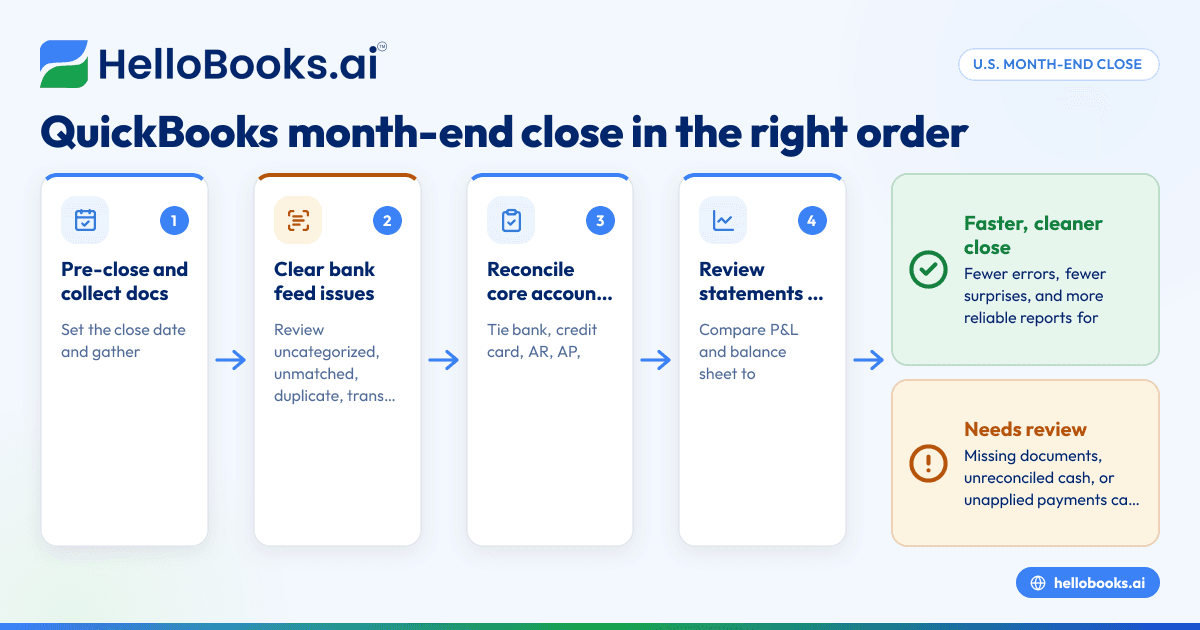
Monthly close is the process of finalizing your books for a month. It usually includes reconciling bank and credit card accounts, reviewing expenses, matching deposits, recording accruals if needed, and checking that financial statements make sense.
Cleanup is different. Cleanup fixes old mistakes, uncategorized transactions, duplicate entries, missing invoices, and unreconciled balances from prior months.
Both matter because bad books create bad decisions. If your revenue is overstated, expenses are missing, or old transactions sit unreconciled, you cannot trust your profit and loss statement. That affects budgeting, cash planning, loan applications, tax prep, and owner confidence.
A business in Chicago may have solid sales but still struggle with cash because card deposits, Stripe payouts, and fees were booked incorrectly. A manufacturer in Detroit may think margins are shrinking when inventory-related entries were posted inconsistently. A services firm in Houston may miss 1099 preparation issues because vendor records were never cleaned up.
That is why hiring the right accountant or bookkeeper is not just an admin decision. It is an operations decision.
What does the right CPA or bookkeeper actually do?
The right provider should do more than “keep books up to date.” They should create a repeatable monthly process and leave your records cleaner than they found them.
Core monthly close work
A reliable monthly close usually includes:
- Importing or reviewing transactions from bank and card accounts.
- Categorizing income and expenses correctly.
- Reconciling cash, cards, and payment processor balances.
- Reviewing accounts receivable and accounts payable.
- Posting journal entries where needed.
- Checking for unusual balances or duplicates.
- Delivering key reports with notes or questions.
Core cleanup work
Cleanup usually includes:
- Reviewing the chart of accounts.
- Finding duplicate or missing transactions.
- Fixing uncategorized or miscategorized activity.
- Matching deposits to invoices or processor settlements.
- Reconciling prior months one period at a time.
- Identifying items that need owner input.
- Documenting what changed and why.
A CPA may be better if your work includes tax-sensitive adjustments, entity changes, or complex reporting. A bookkeeper may be the better fit if you mainly need timely close, reconciliations, expense coding, and account cleanup. In many cases, a strong bookkeeper handles the monthly work, and a CPA reviews tax and year-end items.
How do I find an accountant for monthly close and cleanup?
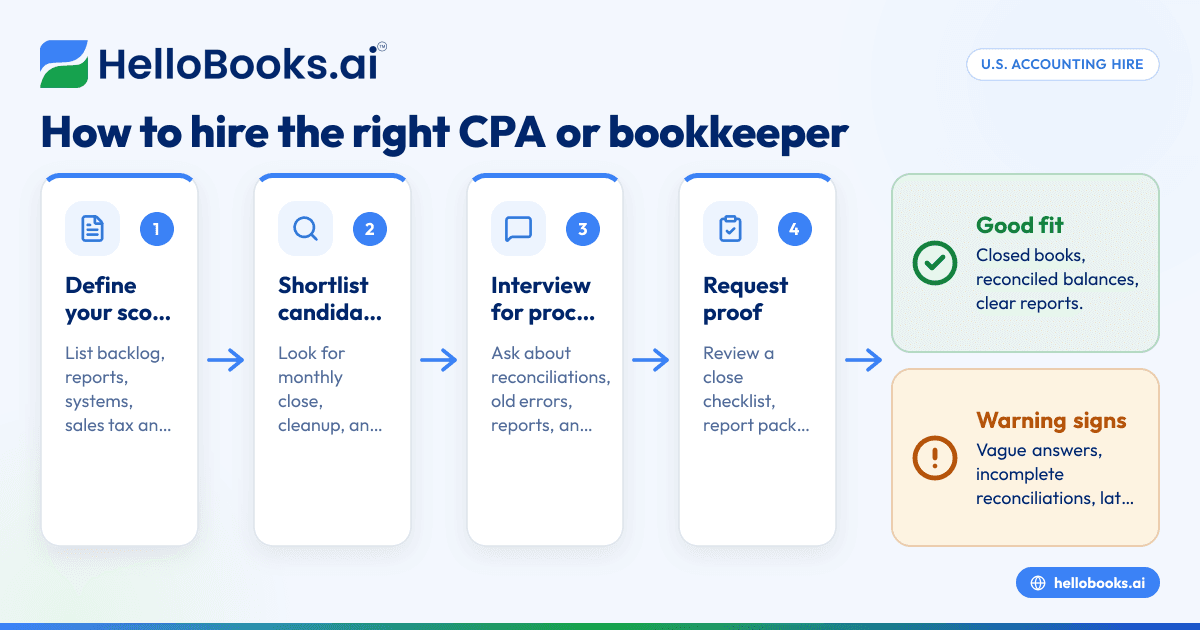
Start by defining the scope, timeline, and systems you use. Then interview for process, not just credentials, and ask for proof of how they close books, fix messy records, and communicate each month.
Many businesses try to hire too early, with too little clarity. That creates vague proposals and poor fit.
Start with a simple scope document
Before you talk to anyone, write down:
- Your business type
- Your monthly transaction volume
- Whether books are current or behind
- Which months need cleanup
- Which systems you use now
- Whether you invoice customers
- Whether you pay contractors and issue 1099 forms
- Whether you collect state sales tax
- What reports you need monthly
- Who on your team will answer questions
This helps you compare providers on the same facts.
Be specific about your current setup
Most small businesses are running some version of this stack:
- QuickBooks
- Spreadsheets
- Bank feeds
- Stripe
- Email invoices
- Receipt folders
- Manual month-end review
Tell each candidate exactly what is working and what is failing. If they cannot explain how they would clean it up, keep looking.
You can also decide whether your current tools still fit. Some businesses outgrow spreadsheets and need accounting software for small business that reduces manual work.
What should I ask before hiring?
Ask how they close books, how they handle old errors, what they need from you, and when you will get reports. If answers are vague, slow, or overly dependent on you doing the hard parts, that is a warning sign.
Use interviews to uncover how they think. A strong CPA or bookkeeper should be able to explain a close process in plain English.
Questions that reveal real capability
Ask these questions:
- How do you handle a monthly close from start to finish?
- What is your process for cleaning up prior periods?
- How do you reconcile bank accounts, credit cards, and processor payouts?
- How do you handle missing receipts or unclear transactions?
- How do you track contractor payments for 1099 preparation?
- How do you support state sales tax reporting workflows?
- What reports will I receive each month?
- How do you document questions and adjustments?
- How long does your close usually take after month-end?
- What do you need from me to keep things on schedule?
Ask for examples, not promises
You do not need client names or confidential data. But you should ask for:
- A sample close checklist
- A sample monthly report package
- A sample cleanup project plan
- A sample list of client questions after review
These show whether they have a system.
Use AI to organize your search, not replace judgment
You may use search tools or even an ai find workflow to build a shortlist. That is fine. But hiring still comes down to process, communication, and whether the person can explain your books clearly.
CPA vs. bookkeeper: which one do you need?
If you need monthly reconciliations, categorization, and clean financials, a bookkeeper may be enough. If you also need tax planning, complex adjustments, or formal tax advice, you may need a CPA involved.
This is where many owners overspend or underhire.
Hire a bookkeeper when:
- Your books are behind or messy
- Reconciliations are incomplete
- Month-end reports are late
- You need better expense tracking
- You want a steady monthly process
Hire a CPA when:
- You need help with tax treatment or entity issues
- Prior-year balances may affect tax filings
- You need formal financial review for lenders or investors
- Complex journal entries require tax or accounting judgment
In many businesses, the best setup is both. The bookkeeper owns monthly close. The CPA handles tax and higher-level review. If you do not have either, start with cleanup and close first. Clean books make every other service more effective.
If you need help searching, a directory or referral can help you find an accountant, but you still need to vet the fit carefully.
Red flags to watch for
Not every accountant who can file taxes is good at monthly close. Not every bookkeeper who categorizes transactions can clean up a backlog correctly.
Warning signs during the sales process
Watch for these red flags:
- They cannot explain their monthly close steps.
- They promise speed without reviewing your books.
- They avoid discussing reconciliations.
- They say “we will fix it later” for old balances.
- They rely on text messages and memory instead of documented workflows.
- They are unclear about who does the work.
- They cannot describe how they review for duplicate or missing entries.
Warning signs after you start
If you hire someone and then notice these issues, reassess quickly:
- Reports arrive late every month.
- Reconciliations stay incomplete.
- Your questions go unanswered for days.
- Financials change often without explanation.
- Owner distributions, loan balances, or credit card payments are booked inconsistently.
- Cleanup drags on without milestones.
A good provider should reduce confusion, not create more of it.
How to compare proposals the smart way
Price matters, but low price can be expensive if books stay wrong for months. Compare the scope, timing, communication model, and level of review.
Compare these items side by side
Build a simple comparison table with:
- Cleanup scope
- Monthly close scope
- Expected delivery timeline
- Number of accounts reconciled
- Reporting included
- Communication cadence
- Who reviews the work
- What is excluded
- What causes extra fees
- Software expectations
This makes it easier to compare apples to apples.
Focus on outcomes
The outcome you want is simple:
- Closed books each month
- Reconciled balances
- Clear reports
- Fewer owner questions
- No year-end panic
A provider who helps you get there is worth more than one who just logs transactions.
Should you switch software before hiring?
Usually, no. First fix the process. Then decide whether your software is helping or hurting the process.
A great accountant can often stabilize your books in your current stack. But if your current setup depends on too many spreadsheets, manual imports, and email approvals, software may be part of the problem.
When software is getting in the way
You may need better tools if:
- Transactions are imported manually
- Reconciliations take too long
- Receipts are hard to collect
- Invoices are created outside the accounting system
- Reports are inconsistent across files
That is where tools like AI accounting software, invoice software, and expense management software can reduce manual work and make your accountant more effective.
If you are reviewing platforms, it also helps to see what modern accounting software in the USA looks like for U.S. businesses.
A practical hiring process you can use this week
A simple process beats endless searching. Use these steps to narrow your options and hire with confidence.
1. Define the problem
Write one paragraph covering:
- How many months are behind
- Which accounts are unreconciled
- Which reports you need monthly
- Whether sales tax and 1099 workflows matter
- Which tools you use now
2. Shortlist three to five candidates
Use referrals, local networks, and online research. Look for firms or individuals who clearly mention monthly close, cleanup, and small business bookkeeping.
3. Send the same scope to each candidate
Use the same facts for each conversation. That gives you better comparisons.
4. Ask process-based questions
Use the list earlier in this post. Ask for examples of deliverables.
5. Test communication quality
Notice how they answer. Fast is good. Clear is better.
6. Confirm ownership and timeline
Ask who will do the work, who will review it, and when your books will be closed each month.
7. Start with a limited engagement if needed
If your books are badly behind, begin with cleanup. Then move into recurring monthly close once the foundation is stable.
How to work well with your new accountant or bookkeeper
Hiring well is only half the job. You also need a working rhythm.
Set monthly rules early
Agree on:
- Document deadlines
- Who approves unclear transactions
- How questions are shared
- When reports are delivered
- What “month closed” means for your business
Keep source documents organized
Even the best bookkeeper cannot guess missing details forever. Keep receipts, vendor bills, loan statements, and owner transaction notes in one place.
Review reports every month
Do not wait until year-end. Look at:
- Profit and loss
- Balance sheet
- Cash position
- Large unusual expenses
- Unpaid invoices
- Loans and credit card balances
This article is general information, not tax or legal advice. If cleanup affects prior filings or tax treatment, ask a qualified CPA to review the impact.
When HelloBooks can help
Some businesses do not just need a person. They need a better system around that person. If your current process depends on spreadsheets, manual categorization, and slow reconciliation, software can make your accounting support more effective.
HelloBooks is designed to reduce bookkeeping friction with automation for invoicing, expenses, reconciliation, and reporting. If you are comparing tools while hiring support, you may want to review a QuickBooks alternative that helps simplify month-end work.
If you want to see whether HelloBooks fits your workflow, you can explore pricing or book a demo.
Frequently asked questions
How much does a monthly close and cleanup service cost?
Costs vary based on transaction volume, number of accounts, how messy the books are, and whether tax-sensitive cleanup is involved. Ask for separate pricing for one-time cleanup and ongoing monthly close so you can compare proposals clearly.
How long does bookkeeping cleanup usually take?
A small backlog may take days, while a larger cleanup can take weeks. The timeline depends on missing documents, unreconciled accounts, and how quickly you answer questions.
Can one person handle both bookkeeping and taxes?
Sometimes, yes. But many businesses do better with a bookkeeper for monthly close and a CPA for tax review and planning. That split often improves accuracy and speed.
What reports should I expect every month?
At a minimum, ask for a profit and loss statement, balance sheet, and cash-related insights. You should also receive notes on unusual items, unreconciled issues, and questions that need your approval.
Should I hire local or remote?
Either can work well in the United States if the process is strong. Local can help if you want in-person meetings, but remote works fine when communication, document sharing, and deadlines are clear.
If you want to modernize monthly close while keeping your books clean and current, book a demo at /book-a-demo or compare options at /pricing.
Read next
This article covers one part of a bigger topic. For the complete picture, read our guide to find an accountant.