
Key takeaways
What this article covers, in order:
- State code 22 in GST means Chhattisgarh, not Tamil Nadu
- Where the code appears in real GST work
- Why Tamil Nadu businesses should care about a Chhattisgarh code
- How the code affects CGST, SGST, and IGST in practice
- An illustrative invented scenario for a Tamil Nadu wholesaler
- What to check when you see code 22 in a GSTIN or return
India GST state code 22 does not mean Tamil Nadu. It identifies Chhattisgarh in the GST system, so if your business is in Tamil Nadu and you see code 22 in a GSTIN, invoice, e-invoice, or return, you should treat it as a sign to re-check the customer state, supplier GSTIN, place of supply, and whether the tax should be CGST+SGST or IGST. This matters because the code flows into data reported on the GST Portal run by GSTN under the CGST Act, 2017 and related GST law. NEEDS EXPERT REVIEW
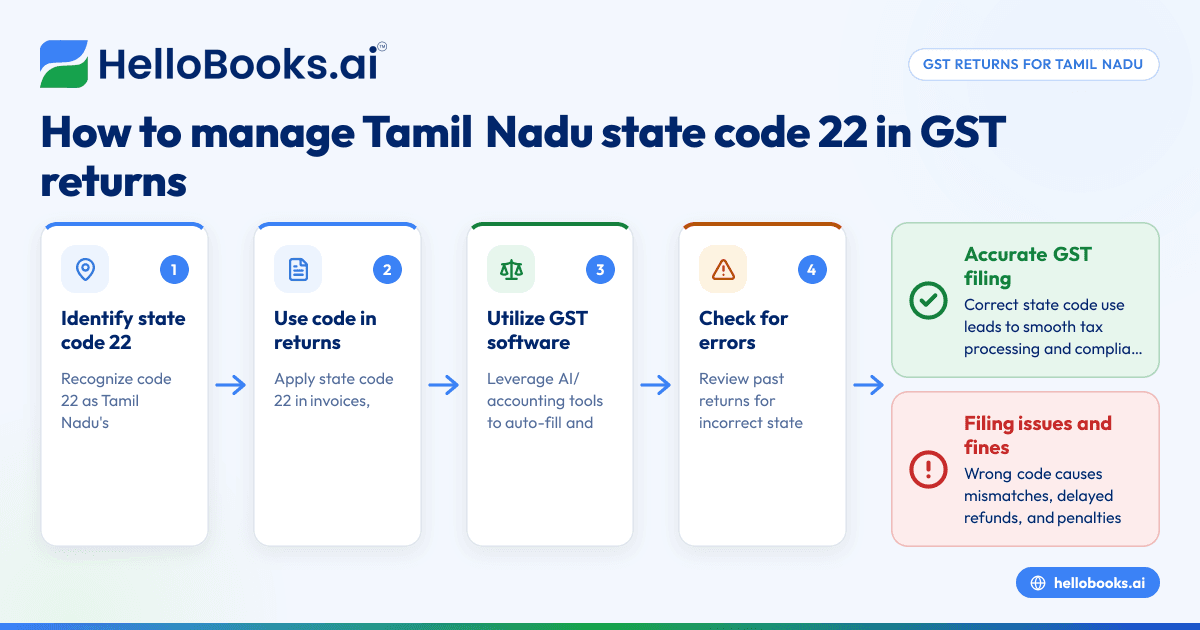
State code 22 in GST means Chhattisgarh, not Tamil Nadu
The short answer is simple: in the GST state-code structure used across India, 22 refers to Chhattisgarh. Tamil Nadu has a different state code in the GSTIN master published through official GST resources. If you are a small business in Chennai, Coimbatore, Madurai, Tiruppur, Salem, or elsewhere in Tamil Nadu, seeing 22 in a GST context usually means one of three things:
- the counterparty is registered in Chhattisgarh,
- the GSTIN was entered wrongly,
- or the invoice and return data have been mapped to the wrong state.
You should verify the current state-code mapping from the GST Portal and GSTIN structure references maintained through GSTN and administered under the GST framework by CBIC. If a consultant, staff member, or software setup has treated 22 as Tamil Nadu, the error can affect invoice tax heads, return tables, and reconciliation.
Where the code appears in real GST work
For small businesses, the state code is not just a theory item. It appears in daily records and compliance workflows such as:
- the first two digits of a GSTIN,
- customer and supplier masters,
- tax invoices,
- e-invoice data used to generate an IRN and signed QR where applicable,
- e-way bill details,
- GSTR-1 reporting,
- GSTR-3B summary preparation,
- and purchase reconciliation against GSTR-2A or GSTR-2B.
That is why a wrong code can spread quietly. A clerk may copy a GSTIN from an old spreadsheet, a Tally import may carry an old state mapping, or a marketplace order may have the billing state right but the place of supply wrong. Once that happens, your books may still “look balanced” in rupee terms, but the GST classification can be wrong.
If you use software that derives the state from the GSTIN and then applies the right place-of-supply logic, it becomes much harder to accidentally charge Tamil Nadu SGST on a transaction that should have been treated as IGST. HelloBooks does this directly in invoicing and return prep, which is exactly where this issue usually begins.
Why Tamil Nadu businesses should care about a Chhattisgarh code
A trader in Tamil Nadu might think: “If 22 is another state, why does it matter to me?” It matters because GST is built around state identity.
Under the GST framework administered by CBIC and implemented through the GSTN platform, state coding influences whether a supply is treated as intra-state or inter-state. That, in turn, affects whether your invoice uses CGST + SGST or IGST. The underlying legal rules come from the CGST Act, 2017 and the IGST Act, 2017, and the latest operational guidance is published on the official GST Portal and CBIC notifications.
For a Tamil Nadu business, mistakes involving code 22 often show up in these situations:
- a buyer GSTIN starts with 22, but the team assumes it is Tamil Nadu and raises a local-tax invoice,
- a purchase bill is booked to the wrong state, affecting input tax credit tracking,
- the place of supply is keyed incorrectly for dispatches outside Tamil Nadu,
- an e-invoice payload picks up the wrong state code and may fail validation or create downstream mismatch,
- or a return gets filed with B2B entries that do not align with the customer’s GSTIN details.
This is especially common in businesses that sell pan-India through phone orders, distributors, field sales teams, transport bookings, and mixed payment modes such as UPI, NEFT, RTGS, or IMPS, where back-office staff may complete invoices after the movement has already started.
How the code affects CGST, SGST, and IGST in practice
The state code does not itself create the tax liability, but it strongly influences how the transaction is classified in your systems.
If your business is registered in Tamil Nadu and you sell to another registered person in Chhattisgarh, the GST treatment normally depends on the place of supply and the nature of the transaction under the IGST Act, 2017, as interpreted through official guidance published by CBIC and on the GST Portal. If your records wrongly read code 22 as Tamil Nadu, your invoice may wrongly split tax into CGST and SGST instead of IGST. NEEDS EXPERT REVIEW
That misclassification can lead to:
- wrong invoice values by tax head,
- mismatch in customer books,
- issues in GSTR-1 auto-population logic,
- difficulty during GSTR-3B preparation,
- and extra work during reconciliation.
For small businesses, the biggest pain is often not the first mistake but the cleanup. A corrected invoice may need to be re-issued or amended, stock movement records may need review, and payment follow-up becomes messy if the customer’s accounts team refuses the invoice.
HelloBooks helps here by reading the GSTIN state and applying the tax-head split inside the invoice itself, so the sale is less likely to be posted with the wrong cgst/sgst/igst combination. If the business also needs an IRN, the same state data flows into e-invoicing rather than being typed again.
An illustrative invented scenario for a Tamil Nadu wholesaler
Take an illustrative and invented case, not legal advice: a textile wholesaler in Tiruppur issues an invoice for ₹1,18,000 to a buyer whose GSTIN begins with 22. The accounts team assumes the buyer is in Tamil Nadu and raises the bill with local tax heads. Later, the buyer says its registration is actually in Chhattisgarh and asks for a corrected invoice.
This invented figure is only to show the workflow; it leaves out freight, valuation disputes, any exemption questions, transport-document requirements, and whether the place of supply has any special rule. In that invented case, the seller may have to cancel or amend the invoice record, regenerate the tax treatment, update the e-way bill if movement details were tied to the original invoice, and ensure the corrected values flow into GSTR-1 and then the summary used for GSTR-3B. The exact legal handling depends on the facts and current official instructions on the GST Portal and CBIC releases.
Where businesses struggle is speed. If the original data is spread across Excel, Tally exports, transporter notes, and a bank receipt from UPI or NEFT, the fix is slow. In HelloBooks, the invoice, inventory movement, return data, and uploaded bank statement matching sit closer together, so one correction is easier to trace through receivables and tax reporting.
What to check when you see code 22 in a GSTIN or return
If you are based in Tamil Nadu and code 22 shows up anywhere in your GST records, review these points before filing:
Check the GSTIN itself
The first two digits matter. Use an official GSTIN validation source on the GST system, or a checking tool such as the GSTIN validator to catch obvious errors before filing.
Check the customer or supplier master
Many businesses carry forward old ledgers from Tally or manually created masters. One wrong state in the ledger can keep repeating across every invoice.
Check place of supply separately
The registered state and the place of supply are related but not always identical in the way beginners assume. The legal position should be checked from the IGST Act, 2017 and the latest CBIC/GST Portal guidance for your transaction type.
Check the invoice tax head split
If the state data is wrong, the invoice may show CGST/SGST when IGST should apply, or the reverse.
Check downstream documents
If goods moved, the e-way bill may also need review. If your business is under e-invoicing, the IRN data should match the corrected invoice details.
Check return reconciliation
Look at whether your outward supplies in GSTR-1 and your books still agree after corrections. For purchases, review whether supplier invoices and ITC tracking are still in line with GSTR-2A/2B.
This is where software matters more than generic bookkeeping. In HelloBooks, OCR can pull supplier bill data from a photo or PDF, GSTR-2A/2B reconciliation helps spot purchase-side mismatches, and GSTR-1 plus GSTR-3B can be filed from the records already maintained instead of being rebuilt manually at month-end.
Does state code 22 change filing obligations for Tamil Nadu businesses?
By itself, no. State code 22 does not create a new filing obligation for a Tamil Nadu business just because the number appears on a customer or supplier record. Your compliance obligations still depend on your registration, transaction type, turnover category where relevant, and the current rules under the GST laws administered by CBIC through the GSTN platform.
But the code can change how a transaction is reported.
For instance, a B2B outward supply to a GSTIN beginning with 22 may need to be classified differently from a sale within Tamil Nadu, depending on the place-of-supply rules and facts of the transaction. The current return tables, filing process, and validation logic are published on the official GST Portal. If you are unsure whether a particular invoice belongs in a particular table or tax-head treatment, that is exactly the point to involve your CA or GST practitioner.
You can reduce errors by generating invoices from a system that uses GSTIN-based state logic, using smart invoicing, checking whether e-invoice generation is needed through e-invoicing software, and filing from the same books via GST return filing software instead of retyping values into separate sheets.
The risks of treating GST state codes as a memorisation exercise
A lot of small businesses try to “remember the code” rather than verify the transaction. That is risky.
GST compliance in India is not just about recognising that a number maps to a state. You also need the surrounding facts right:
- the seller GSTIN,
- the buyer GSTIN,
- the dispatch location,
- the ship-to location,
- the place of supply,
- inventory movement,
- transport document alignment,
- and the eventual receipt in bank or cash records.
If those do not line up, the state code becomes the first visible symptom, not the whole problem.
That is why a disciplined workflow matters more than memory. A business that creates invoices, stock entries, and transport details in one place is less likely to create GST mismatches than a business that invoices in one app, tracks stock in another, raises the e-way bill elsewhere, and reconciles bank receipts from screenshots.
HelloBooks is useful here because it connects invoicing, inventory, e-way bill creation, uploaded bank reconciliation software workflows, and financial reports in one record trail. If you are moving from Tally-led processes, the tally-alternative path is often less about replacing habits overnight and more about reducing repetitive data entry and state-code errors.
What a Tamil Nadu small business should do next
If your article search started with “What does state code 22 mean in GST returns for small businesses in Tamil Nadu?”, the practical answer is: it means you should not treat 22 as Tamil Nadu.
Do these checks now:
- verify the GSTIN on the GST system,
- confirm whether the party is actually registered in Chhattisgarh,
- re-check place of supply,
- review whether igst or cgst+sgst was used correctly,
- inspect any linked e-invoice, IRN, or e-way bill data,
- and make sure your GSTR-1 and GSTR-3B are based on corrected books.
If you are still setting up your process, use the official GST Portal and CBIC publications for the latest legal position, and have your CA review any transaction where the state, place of supply, or tax head is unclear. For businesses that want fewer manual mistakes, HelloBooks can handle GST invoicing, e-invoicing where applicable, direct GSTR-1 and GSTR-3B filing, reconciliation, uploaded bank matching, and multi-GSTIN operations from one workflow. You can explore the India edition at HelloBooks India, see pricing, or book a demo.