
Key takeaways
What this article covers, in order:
- Why this comes up / what goes wrong
- Step-by-step
- Example (fictional figures)
- Common mistakes
- Doing this in HelloBooks
- Frequently asked questions
A VAT/GST registration number, known as the GSTIN (Goods and Services Tax Identification Number), is a unique 15-digit number assigned to every business registered under GST in India. It serves as the official tax identification for the business and is required to legally collect and remit GST on sales. This number also enables businesses to file GST returns and claim input tax credit (ITC) on purchases.
Why this comes up / what goes wrong
Small business owners often search for "vat/gst registration number" when they start or expand their business and need to comply with GST rules. They may be unsure whether they need to register, how to apply for the number, or how to use it correctly on invoices and GST returns. Without a valid GSTIN, a business cannot charge GST legally, cannot claim ITC, and risks penalties or losing credibility with customers and tax authorities.
Step-by-step
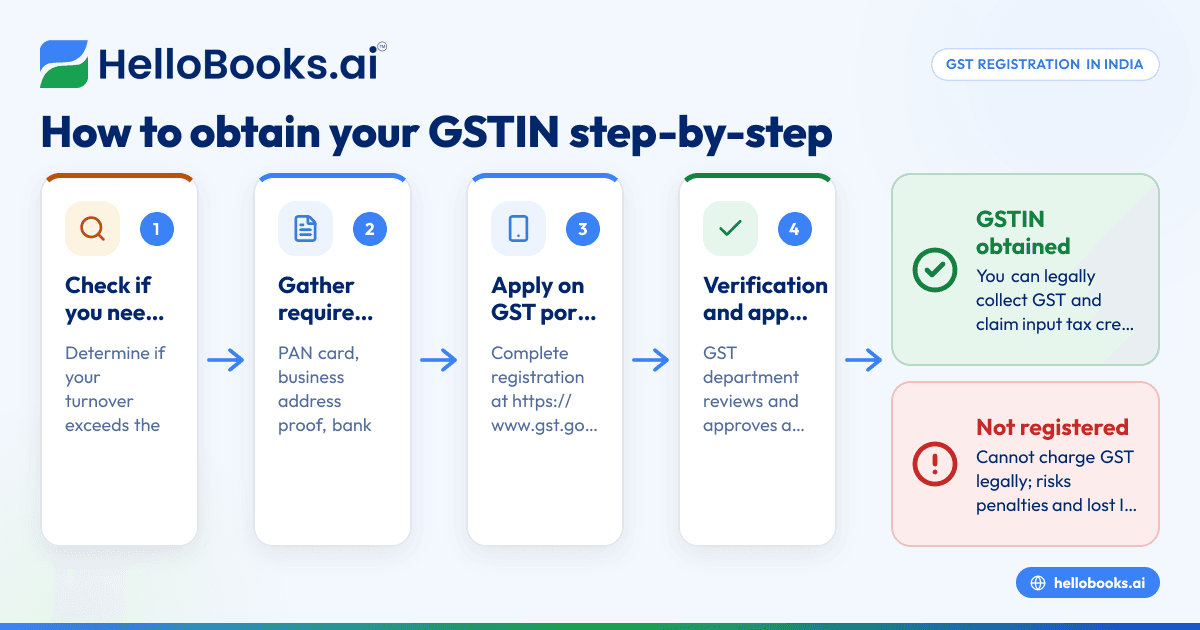
- Check if you need GST registration: Determine if your business turnover exceeds the GST registration threshold (NEEDS EXPERT REVIEW). If yes, you must register.
- Gather required documents: Prepare your PAN card, proof of business address, bank account details, and identity and address proofs of promoters.
- Apply on the GST portal: Visit the official GST portal at https://www.gst.gov.in/ and complete the registration application with your business details.
- Verification and approval: The GST department reviews your application and may request additional documents. Once approved, you receive your GSTIN.
- Use your GSTIN on invoices: Include your GSTIN on all tax invoices along with other mandatory details such as supplier and recipient names, addresses, HSN/SAC codes, tax amounts, and invoice number as required by Rule 46 [cgst-rule-46/rule46-particulars].
- File GST returns: Use your GSTIN to file monthly or quarterly returns like GSTR-1 and GSTR-3B by their due dates (11th and 20th of the following month respectively) or as per the QRMP scheme [gstr1-due-date/gstr1-monthly-11th], [gstr3b-due-date/gstr3b-monthly-20th], [qrmp-scheme/qrmp-dates].
For more on creating compliant invoices, see GST invoicing.
Example (fictional figures)
Assume a small business registered under GST sells goods worth ₹1,00,000 on 15/04/2024. The assumed GST rate is 18% (CGST 9% + SGST 9%). The invoice must show:
Taxable value = ₹1,00,000
CGST = ₹1,00,000 × 9% = ₹9,000
SGST = ₹1,00,000 × 9% = ₹9,000
Total invoice value = ₹1,00,000 + ₹9,000 + ₹9,000 = ₹1,18,000
The invoice must also include the supplier's and recipient's GSTIN, HSN code, invoice number, date, and other details as per Rule 46 [cgst-rule-46/rule46-particulars].
Common mistakes
- Not registering when required: This leads to penalties and inability to legally collect GST. Prevent this by monitoring your turnover and registering promptly.
- Incorrect or missing GSTIN on invoices: This can cause your customers to lose ITC eligibility. Always verify and include the correct GSTIN for both supplier and recipient.
- Delaying GST return filing: Late filing attracts interest and penalties. Use reminders and plan to file GSTR-1 by the 11th and GSTR-3B by the 20th of the following month [gstr1-due-date/gstr1-monthly-11th], [gstr3b-due-date/gstr3b-monthly-20th].
- Mismatch between invoices and returns: Ensure the invoices you issue match the data filed in returns to avoid GST notices.
- Not updating registration for new states: If your business expands to new states, obtain a separate GSTIN for each state.
For help with filing returns, see GSTR-1 and GSTR-3B direct filing.
Doing this in HelloBooks
HelloBooks creates GST-compliant tax invoices with the correct CGST/SGST or IGST split and automatically fills HSN/SAC codes from your customer's GSTIN, ensuring all Rule 46 fields are completed correctly. It also supports direct filing of GSTR-1 and GSTR-3B returns built from your recorded invoices, so your returns match your sales data, reducing manual work and errors. Learn more about HelloBooks for India.
Frequently asked questions
What is the difference between VAT and GST registration number?
VAT was a tax system applied at the state level before GST was introduced nationwide in 2017. The GST registration number (GSTIN) replaced VAT numbers and is valid across all states in India.
How can I find my GST registration number?
You can find your GSTIN on the GST portal by logging in with your credentials, on your GST registration certificate, or on any GST-compliant invoice you have issued.
Do I need a separate registration number for each state?
Yes, if your business operates in multiple states, you must get a separate GSTIN for each state.
Can I register for GST if my turnover is below the threshold?
Yes, voluntary registration is allowed and can help you claim input tax credit and improve your business credibility. NEEDS EXPERT REVIEW
What happens if I don't include my GSTIN on invoices?
Invoices without your GSTIN may be considered invalid for GST purposes, and your customers may not be able to claim input tax credit on those purchases.
What are the deadlines for filing GSTR-1 and GSTR-3B?
Monthly GSTR-1 must be filed by the 11th day of the month following the tax period, and GSTR-3B by the 20th day of that month. Under the QRMP scheme, these deadlines differ slightly [gstr1-due-date/gstr1-monthly-11th], [gstr3b-due-date/gstr3b-monthly-20th], [qrmp-scheme/qrmp-dates].
Key takeaways
- A VAT/GST registration number (GSTIN) is mandatory for businesses exceeding the turnover threshold.
- GSTIN is a 15-digit unique identifier used for tax compliance and filing.
- Include GSTIN and other mandatory details on all tax invoices as per Rule 46.
- File GSTR-1 and GSTR-3B returns on time using your GSTIN to avoid penalties.
- HelloBooks helps create compliant GST invoices and file returns directly from your recorded data.
Start managing your GST compliance easily. Start on the Free plan (200 transactions a year, GSTR-1 and 3B filing for one GSTIN).
This article is general information, not tax or legal advice. Rules change; confirm the current position on gst.gov.in or with your chartered accountant before acting.