
Key takeaways
What this article covers, in order:
- Before you start
- What is “state code 18” and why does it matter in GST filing?
- Where exactly is state code 18 used in GST filings?
- How do I make sure I’m entering state code 18 correctly?
- Why does state code 18 appear in my e-invoicing and how does it affect GST returns?
- How do I correct mistakes involving state code 18 in my GST filings?
Understanding State Code 18 in GST Filing for Maharashtra Businesses
This guide is for business owners, finance leads, and accountants in Maharashtra who need to correctly apply the GST state code 18 in their filings. By the end, you will understand what state code 18 means, where to use it in GST returns and e-invoicing, and avoid common errors that can delay your compliance.
Before you start
- Have your GSTIN ready, prominently showing Maharashtra as your principal place of business.
- Keep your latest GST return filing documents accessible.
- Understand the basics of GST return formats and the e-invoicing process in India.
- Have your accounting or invoicing software configured for Indian GST rules.
What is “state code 18” and why does it matter in GST filing?
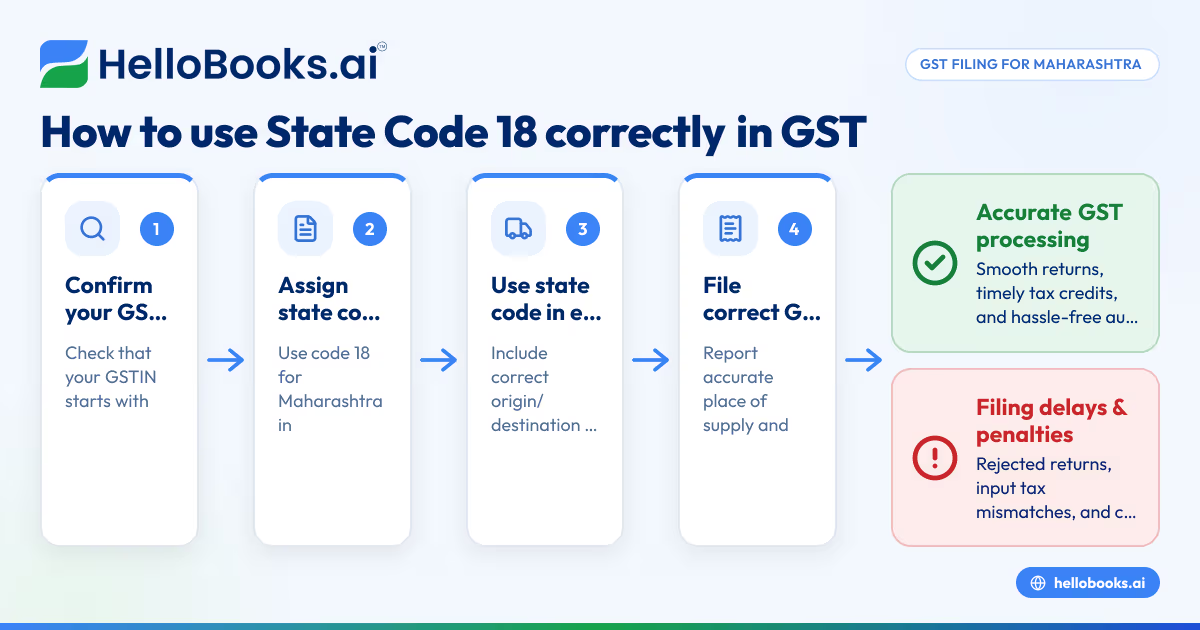
The GST system assigns each Indian state and union territory a unique two-digit state code for tax and compliance purposes. Maharashtra's state code is 18. This numeric code is used throughout GST forms, invoices, and e-way bills to identify the state associated with the supplier or recipient.
Using the correct state code ensures that your GST returns are accurately processed and your interstate transactions are correctly recorded. Errors with the state code can cause filing rejections, delays in input tax credit claims, and complications in audits.
Many businesses use automated tools now to handle this. For instance, having an ai state code recognition feature in your accounting software can auto-fill the correct code based on the GSTIN or location you enter, reducing manual errors.
Where exactly is state code 18 used in GST filings?
State code 18 appears in multiple places:
- GSTIN: The first two digits in your GSTIN identify Maharashtra. For example, a GSTIN starting with “27” or “18” (check your GSTN portal) indicates your registered state.
- Invoice Details: When preparing GST-compliant invoices, the state code 18 must be correctly set to represent Maharashtra in the invoice JSON or the relevant application field.
- E-way Bills: Transporters or consignors generating e-way bills must mention the correct state code for the origin and destination.
- GST Returns: Return forms such as GSTR-1 (outward supplies), GSTR-2 (inward supplies), and GSTR-3B use state codes in different tables to reflect the place of supply and receipt.
How do I make sure I’m entering state code 18 correctly?
Use the numeric state code 18 exactly where Maharashtra’s location is required — never substitute the number with the state name. When entering location details in software, confirm that the GSTIN you provide corresponds to Maharashtra, and check that the software is not auto-defaulting to another state.
A common mistake is mixing the state code with nearby numbers or confusing Maharashtra’s code with the codes of adjacent states such as Gujarat (24) or Karnataka (29). Double-check especially in interstate sales records, where the place of supply differs from the supplier’s state.
You can also cross-check your filings using available GST portal reports that break down supplies by state code.
Why does state code 18 appear in my e-invoicing and how does it affect GST returns?
E-invoicing mandates sellers with turnover above ₹20 crore to generate electronic invoices that include mandatory fields like GSTIN and state code. The state code 18 is crucial to verify that the invoice belongs to Maharashtra’s tax ecosystem.
If the state code is not accurately included or mismatches the GSTIN location, your e-invoice can be rejected by the Invoice Registration Portal (IRP). This rejection causes waits and repeated attempts, delaying your ability to issue invoices to customers.
Your GST returns, especially the GSTR-1 capturing outward supplies, also rely on e-invoice data. Wrong state codes can distort inter-state transaction records, affecting Integrated GST (IGST) reporting and payment reconciliation.
Many e-invoicing software solutions incorporate validation features for proper state codes, helping reduce errors.
How do I correct mistakes involving state code 18 in my GST filings?
If you discover an error in previously submitted GST returns or invoices regarding state code 18, you must act promptly:
- Rectification in Returns: Amend the GSTR-1 or relevant form in the next filing if mistakes relate to incorrect state codes. Use the amendment functionality in the GST portal.
- Invoice Corrections: If the invoice was generated electronically with a mistake, issue a credit note and re-issue the invoice with correct details. Maintain audit trails.
- Communicate with Customers: For inter-state sales, alert your customers about the correction as it affects their filings and input tax credit claims.
- Keep Records: Maintain a detailed record of errors and corrections for GST audits.
Errors relating to state codes can cause misclassification of sales and tax payment mismatches; timely correction avoids penalties and compliance issues.
Can I automate entry of state code 18 to avoid mistakes?
Yes, automation reduces errors dramatically. Modern accounting software in India with AI capabilities can recognise your Maharashtra GSTIN and auto-assign state code 18 in invoices and returns.
For example, a platform with AI bookkeeping features will detect “18” as your state code and use it consistently across all documents, saving time on manual entry and cross-checking.
If you are still manually filing or using Tally or spreadsheets, exploring automation could cut your data entry time and compliance risk.
Worked example: Filing GST for a Pune-based supplier
Rajesh runs an electrical supplies distribution business in Pune, Maharashtra. His GSTIN starts with 27 (Pune’s code is 27 under Maharashtra’s state code umbrella). He makes three sales in March 2024:
- ₹1.5 lakh sale to a Mumbai customer (within Maharashtra)
- ₹2 lakh sale to a Bengaluru customer (Karnataka)
- ₹3 lakh sale to a Pune customer (within Maharashtra)
Step 1: Rajesh confirms his GSTIN starts with 27, linking him to state code 18 for Maharashtra.
Step 2: When creating invoices for Mumbai and Pune customers, Rajesh’s software must assign state code 18 as the place of supply.
Step 3: For the Bengaluru sale, the place of supply state code becomes 29 (Karnataka), so the invoice has Maharashtra as supplier and Karnataka as recipient state.
Step 4: In filing GSTR-1, Rajesh’s e-invoices include accurate state codes: 18 for Mumbai and Pune sales, 29 for Bengaluru.
Step 5: Rajesh reviews the e-way bills to include proper origin (18 for Maharashtra) and destination state codes (29 Karnataka for Bengaluru shipment).
By following this method, Rajesh’s GST filings are accurate. If he had wrongly entered a state code for Mumbai as 29, his filing would be rejected or delayed, impacting tax credit claims.
What are the consequences of mixing up state codes when filing GST for Maharashtra?
Incorrect state code use can lead to
- Return filing rejections or errors on the GSTN portal.
- Problems in matching input tax credits and tax payments.
- Delays in e-way bill approvals and goods movement.
- Risk of penalties for incorrect GST filings.
- Difficulties in GST audits or compliance checks.
Always double-check state codes, especially if you operate across multiple states or sell to customers outside Maharashtra. If manual entry causes confusion, using a QuickBooks alternative or a Tally alternative designed for Indian GST can prevent these costly mistakes.
What is the best way to stay updated on GST codes and compliance?
GST rules and state codes rarely change, but it’s prudent to regularly check the official GST portal updates and your state tax department notices. Subscribe to newsletters or use software offering automated compliance alerts.
By adopting smart tools like bank reconciliation software and expense management software alongside AI-powered GST return filing software, you stay ahead in compliance without extra workload.
If you want to reduce errors linked to state code 18 and simplify your GST filings, consider automated accounting software tailored for Maharashtra businesses. You can book a demo or compare plans at HelloBooks.ai to see how our AI accounting software can help streamline your GST compliance.
Getting your GST state code right is a small step with major benefits. Start today and avoid surprises at filing time.
Related reading
- GST return filing software
- Understanding GST Return Filing for Small Businesses
- Understanding Quarterly Estimated Tax Payments for Small Businesses in the United States
Read next
This article covers one part of a bigger topic. For the complete picture, read our guide to state code 18.