


Key takeaways
What this article covers, in order:
- Why this comes up / what goes wrong
- Step-by-step
- Example (fictional figures)
- Common mistakes
- Doing this in HelloBooks
- Frequently asked questions
A GST return is a statement that businesses registered under the Goods and Services Tax (GST) system must file periodically to report their outward supplies (sales), inward supplies (purchases), tax collected, and tax paid. Filing returns such as GSTR-1 (details of outward supplies) and GSTR-3B (summary return with payment) is essential for compliance and to claim input tax credit correctly.
Why this comes up / what goes wrong
Small business owners often find GST return filing confusing because it involves multiple forms, deadlines, and detailed invoice data. Many keep their books in spreadsheets, Tally, or bill books but spend excessive time reconciling data and ensuring that invoices match return details. Common issues include missing deadlines, mismatched invoice details, incorrect tax calculations, and incomplete information on invoices. These mistakes can lead to penalties, interest, or delayed input tax credit claims, affecting cash flow and compliance.
Step-by-step
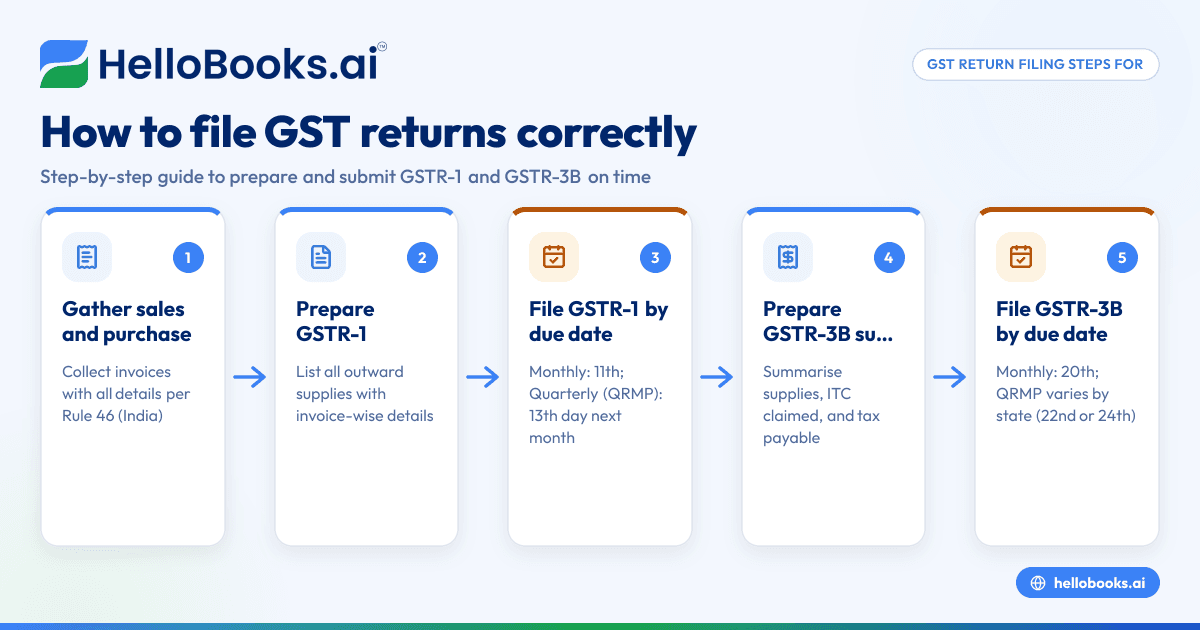
- Gather your sales and purchase data: Collect all invoices issued and received during the tax period. Ensure invoices include required details as per Rule 46 such as supplier and recipient GSTIN, HSN/SAC codes, tax rates, amounts, and other particulars [cgst-rule-46/rule46-particulars].
- Prepare GSTR-1 (Outward Supplies): List all taxable sales and exports with invoice-wise details. Check that the invoice data exactly matches your books.
- File GSTR-1 by the due date: For monthly filers, this is the 11th day of the month following the tax period [gstr1-due-date/gstr1-monthly-11th]. Quarterly filers under QRMP file by the 13th day [qrmp-scheme/qrmp-dates].
- Prepare GSTR-3B (Summary Return): Summarise total outward supplies, inward supplies liable to reverse charge, ITC claimed, and tax payable.
- File GSTR-3B by the due date: Monthly filers must file by the 20th day of the following month [gstr3b-due-date/gstr3b-monthly-20th]. QRMP filers have later deadlines (22nd or 24th) depending on state [qrmp-scheme/qrmp-dates].
- Verify and reconcile: Cross-check your GSTR-1 and GSTR-3B with your books and supplier GST returns (GSTR-2A/2B) to ensure accuracy.
Example (fictional figures)
Assume a small business has the following sales in March 2024:
- Taxable sales value (excluding GST): ₹1,00,000
- GST rate assumed: 18% (CGST 9% + SGST 9%)
Calculate GST:
₹1,00,000 × 9% = ₹9,000 CGST
₹1,00,000 × 9% = ₹9,000 SGST
Total GST = ₹9,000 + ₹9,000 = ₹18,000
Total invoice value including GST:
₹1,00,000 + ₹18,000 = ₹1,18,000
The business files GSTR-1 listing these sales and tax details by 11/04/2024. Then it files GSTR-3B by 20/04/2024, declaring ₹18,000 as output tax payable.
Common mistakes
- Missing deadlines: Set reminders for GSTR-1 and GSTR-3B due dates to avoid late fees and penalties.
- Incorrect invoice details: Ensure GSTIN, HSN/SAC codes, tax rates, and amounts are accurate on invoices to prevent mismatches.
- Not reconciling returns with books: Regularly reconcile invoices with returns and supplier data to catch errors early and avoid discrepancies.
- Ignoring reverse charge supplies: Include reverse charge transactions correctly in returns to comply with GST rules.
- Filing GSTR-1 and GSTR-3B separately without coordination: Since GSTR-3B is a summary, it must align with GSTR-1 figures for consistency.
- Incomplete invoice particulars: Missing details like place of supply or delivery address can cause compliance issues. Verify all required fields per Rule 46.
For detailed guidance, see GST return filing (GSTR-1, GSTR-3B).
Doing this in HelloBooks
HelloBooks simplifies GST return filing by building GSTR-1 and GSTR-3B directly from the invoices you record, ensuring the figures match perfectly. It supports GST invoicing with compliant tax invoices that include CGST/SGST or IGST splits and HSN/SAC codes from your customer's GSTIN, meeting Rule 46 requirements consistently. You can file GSTR-1 and GSTR-3B directly to the GSTN without manual JSON export or upload, saving time and reducing errors.
Learn more about GST invoicing and GST return filing (GSTR-1, GSTR-3B) with HelloBooks.
Frequently asked questions
What is a GST return?
A GST return is a form filed by GST-registered businesses to report sales, purchases, output GST, and input tax credit. Filing returns like GSTR-1 and GSTR-3B is mandatory for compliance and tax payment.
When is the GST return due?
Monthly GSTR-1 must be filed by the 11th day of the following month, and GSTR-3B by the 20th day [gstr1-due-date/gstr1-monthly-11th][gstr3b-due-date/gstr3b-monthly-20th]. Quarterly filers under QRMP have later deadlines (13th for GSTR-1; 22nd or 24th for GSTR-3B) depending on the state [qrmp-scheme/qrmp-dates].
What happens if I miss the GST return filing date?
Late filing can lead to penalties and interest on tax dues. It may also delay your input tax credit claims. It's important to file on time or seek extensions if available.
Can I file GSTR-1 and GSTR-3B together?
No, GSTR-1 and GSTR-3B are separate returns. GSTR-1 details outward supplies, while GSTR-3B is a summary return including tax payment.
How can I ensure my GST invoices meet compliance?
Invoices must include specific details like supplier and recipient GSTIN, HSN/SAC codes, tax rates, and amounts as per Rule 46 [cgst-rule-46/rule46-particulars]. Using GST invoicing software helps maintain accuracy and consistency.
Is it necessary to reconcile GSTR-1 and GSTR-3B before filing?
Yes, reconciling helps avoid mismatches between detailed sales data in GSTR-1 and the summary figures in GSTR-3B, preventing notices or penalties.
Key takeaways
- GST returns report sales, purchases, and tax details for compliance.
- GSTR-1 lists outward supplies; GSTR-3B is a summary return with tax payment.
- File GSTR-1 by the 11th and GSTR-3B by the 20th of the following month (or later under QRMP).
- Ensure invoices meet Rule 46 requirements for GST compliance.
- Reconcile your books with returns to avoid mistakes and penalties.
- HelloBooks automates GST invoicing and direct filing of GSTR-1 and GSTR-3B.
Start managing your GST returns easily with HelloBooks. Start on the Free plan (200 transactions a year, GSTR-1 and 3B filing for one GSTIN).
This article is general information, not tax or legal advice. Rules change; confirm the current position on gst.gov.in or with your chartered accountant before acting.


