


Key takeaways
What this article covers, in order:
- Why this comes up / what goes wrong
- Step-by-step
- Example (fictional figures)
- Common mistakes
- Doing this in HelloBooks
- Frequently asked questions
The turnover limit for GST registration in India is a crucial factor for small and growing businesses. If your aggregate turnover crosses the prescribed threshold, you must register for GST and comply with invoicing and return filing requirements. This article covers why this rule matters, who it applies to, the steps to comply, a worked example with realistic figures, common mistakes, and how HelloBooks can help streamline GST compliance.
Why this comes up / what goes wrong
Many small business owners in India keep their books in spreadsheets, Tally, or manual bill books. They often struggle to know when they must register for GST based on their turnover. Missing the registration deadline or failing to register when required can lead to penalties and compliance issues. Understanding the turnover limit and the registration process helps avoid legal trouble and ensures smooth business operations.
Step-by-step
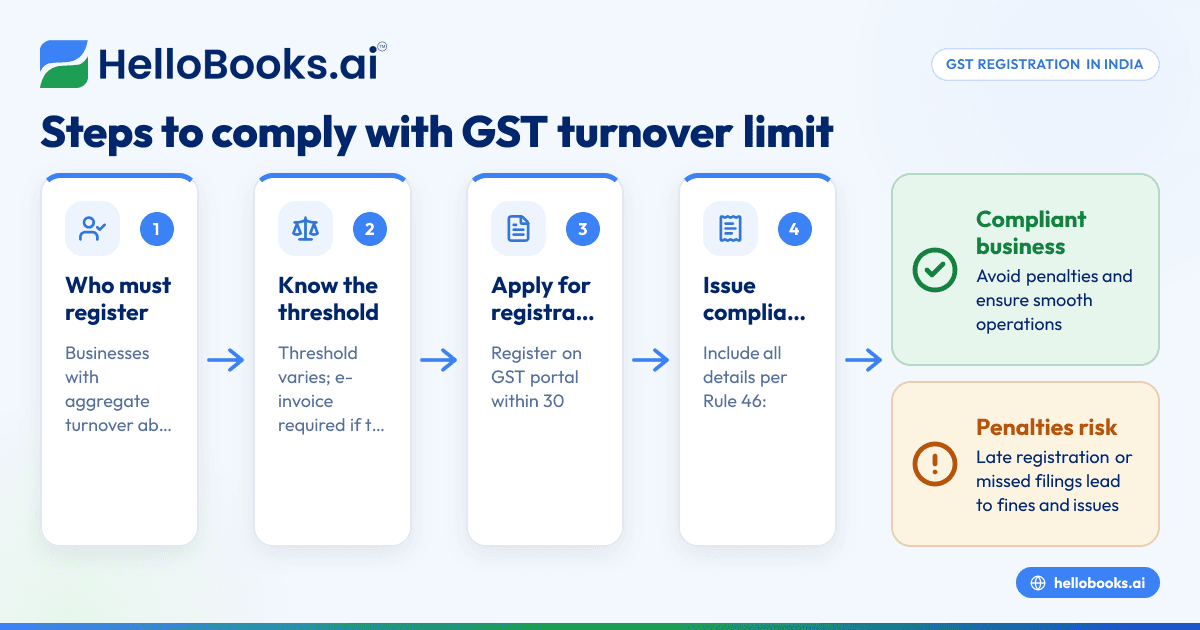
- Who it applies to: Any person or business whose aggregate turnover (sum of turnover from all GSTINs under a PAN) exceeds the prescribed threshold must register for GST.
- Threshold/Condition: While commonly cited thresholds are ₹40 lakh for goods and ₹20 lakh for services (lower in some special category States), this article does not state these as verified facts. However, a registered person whose aggregate turnover exceeded ₹5 crore in any financial year from 2017-18 onwards must issue e-invoices for B2B supplies from 1 August 2023 (Notification No. 10/2023-Central Tax).
- What must be done: Upon crossing the threshold, the business must apply for GST registration on the GST portal, obtain a GSTIN, and start issuing GST-compliant tax invoices containing all particulars as per Rule 46, including supplier and recipient GSTIN, HSN/SAC codes, tax rates, and invoice serial numbers.
- When: Registration must be done within 30 days from the date on which the threshold is crossed. Once registered, the business must file GSTR-1 and GSTR-3B returns monthly or quarterly as applicable.
- Return filing deadlines: Monthly GSTR-1 is due by the 11th of the following month, and GSTR-3B by the 20th. Under the QRMP scheme, quarterly GSTR-1 is due by the 13th and GSTR-3B by the 22nd or 24th day, depending on the State.
For more on invoicing and return filing, see GST invoicing and HelloBooks for India.
Example (fictional figures)
A Delhi-based goods supplier crosses the turnover limit in the financial year 2023-24 and needs to register for GST by 30 November 2023.
- Aggregate turnover as on 31 October 2023: ₹42,00,000 (exceeds ₹40 lakh threshold assumed for goods)
- Date turnover crossed ₹40 lakh: 15 October 2023
- Deadline for GST registration: 15 October 2023 + 30 days = 14 November 2023
- Registration applied on 10 November 2023 (within time)
- GSTIN obtained on 20 November 2023
- First GSTR-1 filing due for October 2023 by 11 November 2023 (missed as registration was not active yet)
- First GSTR-1 filing after registration due for November 2023 by 11 December 2023
This example shows the importance of timely registration and compliance with return deadlines.
Common mistakes
- Delaying registration after crossing the threshold: Register promptly within 30 days to avoid penalties. Keep track of turnover regularly.
- Ignoring turnover from all GSTINs under the same PAN: Aggregate turnover includes all GST registrations under your PAN.
- Incorrect or incomplete tax invoices: Ensure invoices contain all details as per Rule 46, including GSTIN, HSN/SAC codes, tax rates, and invoice serial numbers to avoid rejection.
- Missing return filing deadlines: Note the monthly or quarterly due dates for GSTR-1 and GSTR-3B to avoid late fees.
- Not issuing e-invoices when required: Businesses with turnover exceeding ₹5 crore must issue e-invoices for B2B sales from 1 August 2023.
Use GST invoicing features to create compliant invoices automatically.
Doing this in HelloBooks
HelloBooks helps small businesses with GST compliance by offering:
- GST invoicing: Creates GST-compliant tax invoices with the correct CGST/SGST or IGST split and HSN/SAC codes from the customer's GSTIN, fulfilling Rule 46 requirements consistently.
- GSTR-1 and GSTR-3B direct filing: Returns are built from the invoices already recorded, ensuring GSTR-1 figures match issued invoices, and files them directly to the GSTN.
- OCR for purchase bills: Supplier bills can be captured from photos or PDFs, reducing manual data entry.
Learn more at HelloBooks for India.
Frequently asked questions
What is the turnover limit for GST registration in India?
The commonly cited turnover limits are ₹40 lakh for goods and ₹20 lakh for services, with lower limits in some special category States. However, this article does not state these as verified facts. Businesses must register once their aggregate turnover exceeds the prescribed threshold.
When must I register for GST after crossing the turnover limit?
You must apply for GST registration within 30 days from the date your aggregate turnover crosses the threshold.
What are the key details required on a GST tax invoice?
As per Rule 46, a tax invoice must contain supplier and recipient names, addresses, GSTINs, invoice serial number and date, HSN or SAC codes, description, quantity, value, tax rates and amounts, place of supply, and signature.
What are the GSTR-1 and GSTR-3B filing deadlines?
Monthly GSTR-1 is due by the 11th of the following month, and GSTR-3B by the 20th. Under the QRMP scheme, quarterly GSTR-1 is due by the 13th and GSTR-3B by the 22nd or 24th day depending on the State.
Do I need to issue e-invoices for all sales?
From 1 August 2023, businesses with aggregate turnover exceeding ₹5 crore must issue e-invoices for B2B supplies.
For detailed invoicing and filing, see GST invoicing and e-invoicing (IRN and QR).
Key takeaways
- Aggregate turnover across all GSTINs under a PAN determines GST registration requirement.
- Registration must be done within 30 days of crossing the turnover threshold.
- Tax invoices must comply with Rule 46, including GSTIN, HSN/SAC, and tax details.
- Monthly or quarterly GSTR-1 and GSTR-3B returns must be filed by specified deadlines.
- Businesses with turnover over ₹5 crore must issue e-invoices for B2B sales from 1 August 2023.
- Using software like HelloBooks can simplify GST invoicing and filing.
Start your GST compliance journey with HelloBooks. Start on the Free plan (200 transactions a year, GSTR-1 and 3B filing for one GSTIN).
This article is general information, not tax or legal advice. Rules change; confirm the current position on gst.gov.in or with your chartered accountant before acting.


