
Key takeaways
What this article covers, in order:
- What reverse charge means in Indian books
- The accounts you usually need for RCM
- The journal flow most small businesses follow
- How to book the purchase or expense when RCM applies
- A plain-English worked entry with invented numbers
- When input tax credit is available and when caution is needed
India businesses record reverse charge mechanism (RCM) by booking the expense or purchase first, then recognising GST payable under reverse charge in the books, paying that tax through the GST portal, and claiming input tax credit only if the Central Goods and Services Tax Act, 2017 and the Central Goods and Services Tax Rules, 2017 allow it. The exact categories, rates, return fields and current compliance figures are published by the CBIC, GSTN and the GST portal, so treat any software setup or journal design as secondary to the law.
What reverse charge means in Indian books
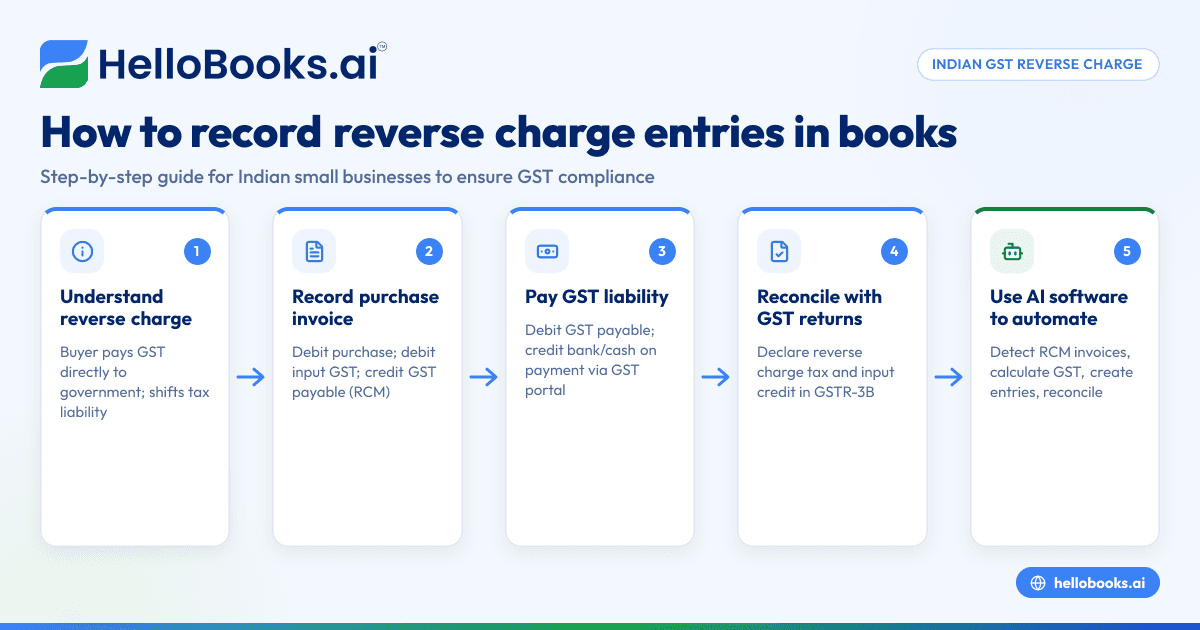
Under GST in India, reverse charge shifts the tax payment responsibility from the supplier to the recipient for notified supplies and situations specified under the Central Goods and Services Tax Act, 2017, related rules, and official notifications issued by the Central Board of Indirect Taxes and Customs (CBIC). In practice, that means your vendor may issue a bill without charging GST, but your business still has to account for the tax liability.
For bookkeeping, the core point is simple: RCM is not the same as ordinary output GST on your sales. It is also not just a note on the purchase voucher. It creates a tax payable in your books, usually followed by a separate payment entry from your bank, and then an input tax credit position if the credit is legally available.
That distinction matters for small businesses using rupee-based ledgers, Excel, Tally, or cloud accounting. If you post an RCM bill as a normal purchase and stop there, your expense may be right but your GST payable will be understated. If you book only the liability and forget the underlying expense or inventory movement, your profit and stock records will be wrong.
The accounts you usually need for RCM
Most Indian businesses keep RCM cleaner when they create separate ledgers instead of dumping everything into one GST payable account. The exact chart of accounts is a design choice, but these buckets are commonly useful:
- Purchase, expense, or inventory account
- Vendor payable or creditor account
- GST payable under reverse charge
- Input CGST, Input SGST, and Input IGST, where relevant
- Bank account for the tax payment
Whether you split tax into CGST and SGST or use IGST depends on the nature of the supply, place of supply, and whether the transaction is intra-state or inter-state under GST law. Those rules sit under the IGST Act and the GST framework, and the current legal position should always be checked on CBIC notifications and the GST portal.
This is where software helps if it understands Indian place-of-supply rules. A system that automatically applies the right tax head split from the supplier GSTIN, state, and transaction type reduces one of the most common errors: posting CGST and SGST where IGST belongs, or the reverse. If you raise tax invoices and purchase entries in the same system, that consistency also carries into GST return filing software.
The journal flow most small businesses follow
RCM entries are easier when you stop thinking of them as one journal and see them as a sequence.
First, record the underlying transaction: rent, legal fee, transport, goods purchase, or another notified inward supply. That part goes to the normal expense, asset, or inventory ledger exactly as the business event happened.
Second, recognise the GST liability under reverse charge. Some accountants do this through the purchase voucher itself; others use a separate journal. Either is acceptable if the books clearly show the liability.
Third, record the payment of that GST to the government through the GST portal from your bank account, whether funded through NEFT, RTGS, IMPS or another banking route your bank supports for tax payments. The banking rail does not change the accounting treatment.
Fourth, track eligible ITC carefully. Eligibility depends on the nature of the inward supply, your business use, blocked credit rules, and other conditions in the GST law. Do not assume every RCM payment automatically becomes claimable credit.
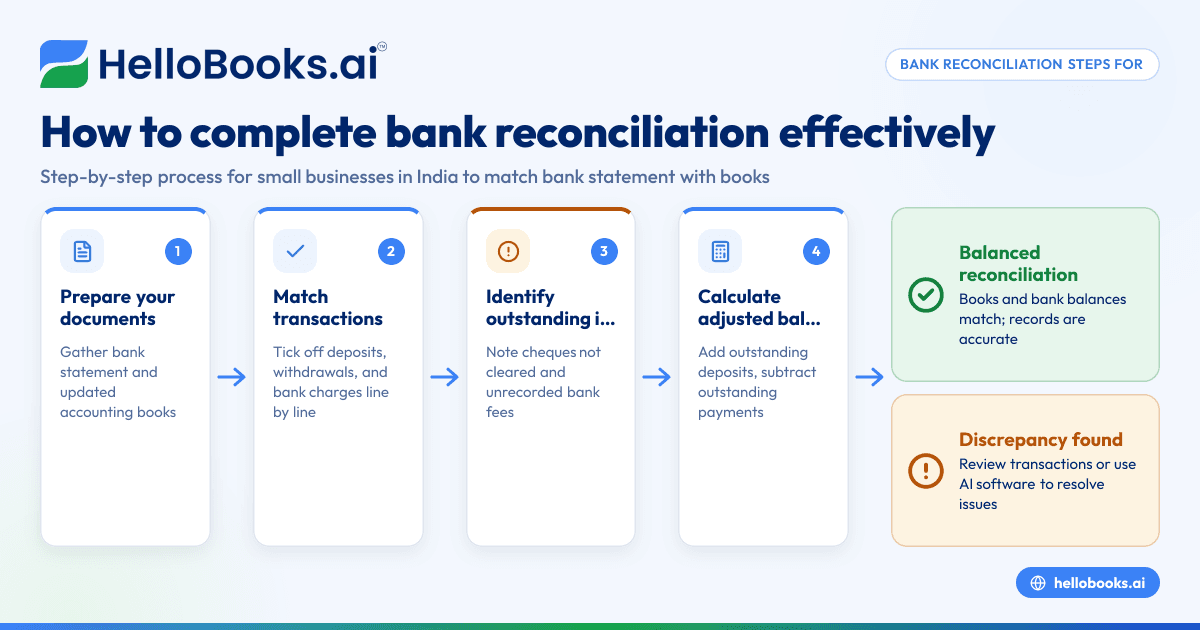
A practical setup in software is useful here. If purchase bills are captured with OCR from PDFs or phone scans, and the product can flag reverse charge treatment at bill level, you reduce manual retyping. When the same books also reconcile the uploaded bank statement against tax payments, you can trace the RCM cycle from invoice to bank debit to GSTR-3B without keeping a side spreadsheet. HelloBooks supports OCR for purchase bills, bank statement upload with AI reconciliation in India, and direct filing for GSTR-1 and GSTR-3B, so the accounting trail and the return numbers stay closer together.
How to book the purchase or expense when RCM applies
The first entry is the commercial transaction itself.
If the supplier has not charged GST because reverse charge applies, you generally record the base value to the relevant expense, asset, or inventory account. Whether you credit the supplier ledger, cash, or bank depends on how you will settle that commercial amount.
A typical pattern is:
- Debit the relevant expense or purchase or inventory account
- Credit the supplier payable, bank, or cash account
That entry does not complete the GST treatment. It only records what you owe the vendor or what you have already paid them.
You then need the tax recognition entry for RCM. Depending on the transaction, that may involve Input IGST and GST payable under reverse charge, or Input CGST plus Input SGST and corresponding payable amounts. The law, rate notifications, and current classifications must be checked on official CBIC and GST portal publications; do not rely on an old chart pinned in the office.
If your team handles many such transactions, it helps when the accounting system lets you mark the bill as reverse charge and keeps the tax ledgers separate from normal output GST. That avoids the classic Tally-era confusion where output tax, input tax, and RCM all sit in one control account until year-end cleanup.
A plain-English worked entry with invented numbers
Here is an illustrative and invented scenario, not legal advice, and it leaves out classification disputes, blocked credits, exempt supplies, composition issues, and any special notification-specific conditions.
Assume a Delhi business receives a professional service bill for ₹50,000 from a supplier transaction that the business has determined falls under reverse charge after checking the Central Goods and Services Tax Act, 2017, the relevant notification, and CBIC guidance. Assume further, purely for illustration, that the applicable GST published in the official notification leads to an RCM amount of ₹9,000.
The business might book:
- Debit Professional Fees ₹50,000
- Credit Vendor Payable ₹50,000
Then recognise the reverse charge tax:
- Debit Input CGST ₹4,500
- Debit Input SGST ₹4,500
- Credit GST Payable under RCM - CGST ₹4,500
- Credit GST Payable under RCM - SGST ₹4,500
When the tax is paid through the GST portal, the payment entry might be:
- Debit GST Payable under RCM - CGST ₹4,500
- Debit GST Payable under RCM - SGST ₹4,500
- Credit Bank ₹9,000
This example is only to show ledger mechanics in rupees. The tax amount used here is invented for illustration. Your actual tax head split, valuation, and ITC position depend on the notified category, place of supply, state, and current law as published by CBIC and shown on the GST portal. NEEDS EXPERT REVIEW
When input tax credit is available and when caution is needed
The bookkeeping entry can make it look as if ITC automatically arises the moment you recognise RCM. That is dangerous.
Under the GST framework, availability of ITC still depends on legal conditions, including business use, documentation, and blocked credit rules under the Central Goods and Services Tax Act, 2017. The current position is published in the Act, rules, notifications, circulars and guidance available through CBIC and the GST portal.
For many businesses, the better habit is to separate three questions:
- Was this inward supply actually under reverse charge?
- Has the GST under reverse charge been paid?
- Is the ITC legally eligible and supported by records?
If your accountant treats all three as one yes-or-no decision, errors creep into GSTR-3B. Reconciliation helps. Software that tracks GSTR-2A/2B and ITC separately from the purchase ledger makes it easier to see where an entry is booked in accounts but still under review for return treatment. That is particularly useful when you run more than one GSTIN across states and need a clean audit trail for each registration.
How RCM should show up in GST returns and reconciliations
Your books and your return should tell the same story. In India, that means the RCM liability recognised in the ledger, the bank payment made through the GST portal, and the ITC position should line up with your GSTR-3B workings. The exact return tables, labels, validations and current filing instructions are published by GSTN on the GST portal.
Do not rely on memory for field mapping, especially if your team handles normal GST, e-invoice data, e-way bill details, and TDS all in the same month. Return design and validations can change.
A sound monthly check usually includes:
- RCM ledger balance versus tax paid
- Purchase or expense ledgers for inward supplies likely to attract reverse charge
- Bank statement entries that prove the tax payment
- ITC ledgers versus what is being considered in GSTR-3B
- Supplier master and GSTIN details
If the bank statement is uploaded and matched inside the accounting system, this check becomes faster than manually hunting for one challan-linked payment among dozens of UPI collections, IMPS receipts, NEFT vendor payments, and cash expenses. HelloBooks can reconcile uploaded Indian bank statements and connect those reconciled entries back to the books, which is useful when RCM tax payments are made from the same account used for day-to-day operations.
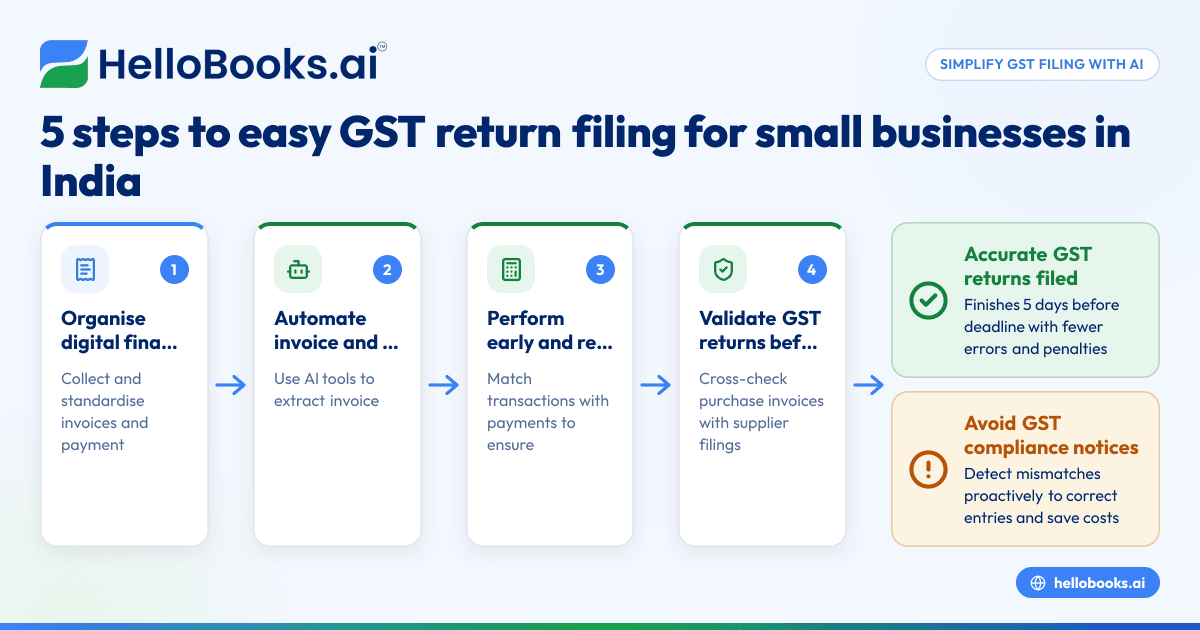
You can also use free checks before filing. A GSTIN validator helps confirm the party details you are posting against, and a GST reconciliation checker can help spot mismatches before they become a return problem.
Practical situations where small Indian businesses get RCM wrong
A few patterns come up repeatedly in India:
Posting the supplier bill correctly but skipping the RCM tax journal.
This leaves the purchase right and the GST wrong.
Claiming ITC without separately confirming legal eligibility.
The books may balance, but the tax position may not.
Using the wrong tax heads.
CGST and SGST versus IGST depends on the supply facts and the law, not on habit.
Mixing RCM with output GST collections.
RCM is not sales tax collected from your customer.
Recording the bank payment unclearly.
If the bank narration is vague and the ledger is not reconciled, month-end review becomes painful.
Forgetting multi-state separation.
If you operate under more than one GSTIN, each registration needs its own compliant treatment and return trail.
These are exactly the kinds of errors that reduce when bookkeeping, GST invoicing, and return preparation live in one place. If you are moving off Tally-heavy workflows or duplicate Excel trackers, a Tally alternative or accounting software India setup that handles reverse charge, tax heads, and return data together can save cleanup time later.
How to set up your books so RCM is not a month-end scramble
The best RCM process is boring. It should not depend on one person remembering a special journal at month-end.
A workable Indian setup usually includes:
- A vendor master with GSTIN and state details
- A clear flag for transactions that may attract reverse charge
- Separate ledgers for RCM payable and normal output GST
- Monthly bank statement upload and reconciliation
- Review of purchase bills captured by OCR rather than from paper piles
- Return preparation from the same books used for accounting
If you manage inventory, it also matters whether the inward supply should hit stock, consumables, or expense, because the commercial entry drives margin reports and closing stock. For traders and manufacturers, inventory and accounting cannot be kept apart from GST forever; they meet during return filing and assessment.
HelloBooks is useful here because it handles GST invoicing with the right tax-head split, records purchase bills with OCR, supports reverse charge handling, and files GSTR-1 and GSTR-3B directly from the books. If your team works partly on mobile and partly on desktop, entries and document capture can happen without waiting to return to the office. And if an owner wants a quick clarification in Hindi, English or Hinglish, Noor on WhatsApp can help them navigate the books workflow without turning every doubt into a CA phone call.
The safest way to use software without outsourcing judgment to it
No accounting product should be treated as the law. In India, the law is the statute, the rules, and the notifications and guidance published by CBIC, GSTN and the GST portal. Software helps with consistency, not legal interpretation.
So the safest pattern is:
- Check whether RCM applies under the current notification and law
- Post the commercial transaction accurately
- Record the reverse charge tax in separate ledgers
- Pay through the GST portal and reconcile the bank debit
- Claim ITC only after confirming eligibility
- File from books that already reflect those entries
If you want to see how this looks in a real Indian workflow, you can explore smart invoicing, bank reconciliation software, and GST return filing software, or book a demo. For pricing, use /in/pricing.
RCM is one of those areas where clean bookkeeping prevents tax stress. The journal itself is not difficult. The discipline is in separating the purchase, the GST liability, the bank payment, and the ITC decision so your books, GST returns, and financial reports all agree.