
Key takeaways
What this article covers, in order:
- Key takeaways
- Why startup expense tracking matters in India
- What usually goes wrong in startup expense tracking India?
- How do you control spend without slowing approvals?
- What should a startup expense policy include?
- How to set up a practical expense workflow for an Indian startup
Startup expense tracking in India means recording, approving and reviewing every business expense in one consistent system. The goal is simple: give teams enough freedom to spend when needed, while keeping founders and finance teams in control of budgets, proofs and GST-ready records.
Key takeaways
- Good expense tracking is not only about reimbursement. It is also about visibility, policy control and faster month-end closing.
- Startups in India often lose time on WhatsApp bills, Excel sheets, missing invoices and delayed approvals.
- A clear approval flow, spend policy and digital audit trail help control team spend without slowing down work.
- The best setup connects expenses, invoices, bank entries and reporting in one place, not across five tools.
- If your team grows across cities like Mumbai, Bengaluru and Pune, standardisation matters more than manual checking.
- This article is general information, not tax or legal advice.
Why startup expense tracking matters in India
In early-stage startups, spending moves quickly. Sales teams travel. Founders pay for software. Operations teams book couriers. Marketers buy ad credits. Small purchases happen every day. If expense tracking is weak, finance only discovers the problem at month-end.
That creates three risks.
First, cash flow becomes harder to predict. You may think the business spent ₹3 lakh this month. The real number could be ₹4.2 lakh once late claims arrive.
Second, approvals become messy. Teams wait for someone to respond on WhatsApp. Managers approve without checking budget. Finance receives screenshots instead of proper bills.
Third, accounting and GST records become incomplete. Missing vendor details, duplicate claims and unclear business purpose make bookkeeping harder. This becomes a bigger problem during audits, investor due diligence or tax review.
For Indian startups, the challenge is often not lack of effort. It is lack of structure. Many teams still use a mix of spreadsheets, email, UPI screenshots and Tally entries done after the fact. That may work for a 5-person team. It starts breaking at 20 people. At 50 people, it becomes expensive.
A proper startup expense tracking India process helps you answer basic questions quickly:
- Who spent the money?
- Why was it spent?
- Was it within policy?
- Was it approved by the right person?
- Is the bill available?
- Has it been reimbursed or already paid directly?
- Is the entry recorded correctly in the books?
When these answers are easy to find, approvals become faster, not slower.
What usually goes wrong in startup expense tracking India?
Most startups do not have a fraud problem in the beginning. They have a process problem.
1. Expenses come from too many channels
A founder pays from a personal card. A team member uses UPI. Another vendor is paid via bank transfer. Receipts come on email, SMS and WhatsApp. Finance then has to collect documents manually.
2. Policies are vague
Teams may not know daily travel limits, meal limits, approval levels or what counts as a valid invoice. When policy is not written, every claim becomes a debate.
3. Approvals depend on one person
If one founder or finance manager approves every expense, work slows down. Claims pile up. Teams stop submitting on time. Then reimbursements and books get delayed together.
4. Accounting happens after reimbursement
Many startups reimburse first and classify later. This creates confusion. The same expense may be booked twice, or to the wrong ledger, especially if you rely on spreadsheets and Tally entries at month-end.
5. No single source of truth
A receipt may sit in a WhatsApp chat, approval in email, payment proof in the bank statement and accounting entry in another file. Finance spends hours connecting the dots.
This is why many fast-growing teams now look at expense management software and AI bookkeeping instead of extending spreadsheets further.
How do you control spend without slowing approvals?
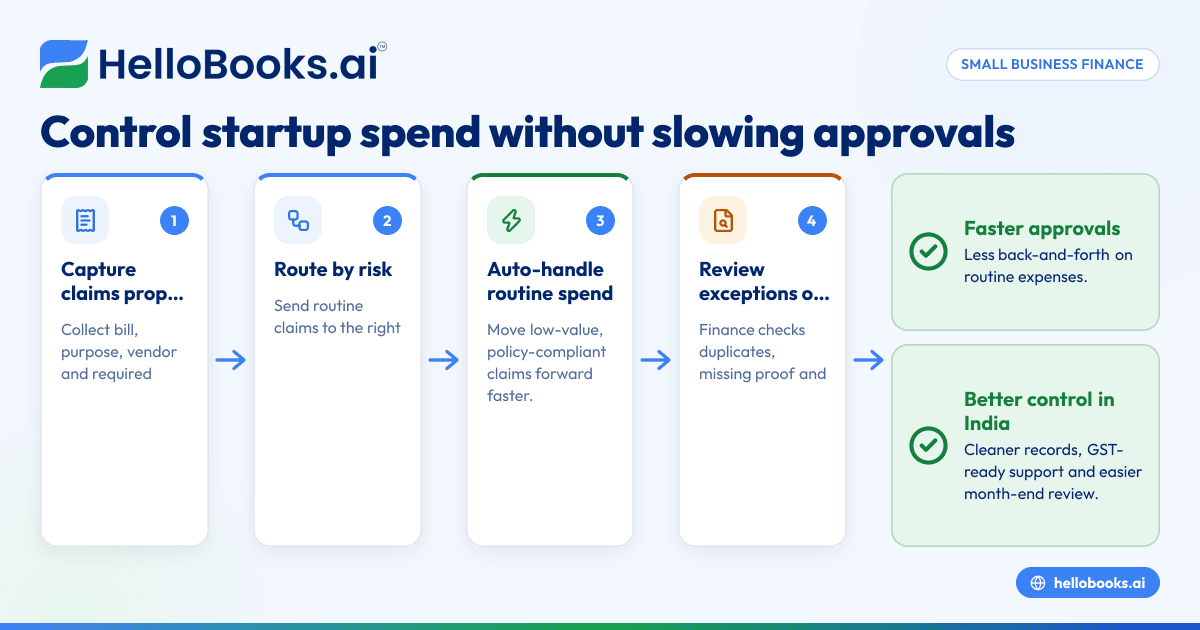
Set simple rules, route low-risk expenses automatically, and make proofs mandatory at submission. Finance should only review exceptions, duplicates and policy breaches, not every routine taxi fare.
The phrase “control” often makes teams think of extra forms and longer wait times. That is the wrong approach. Good control removes unnecessary back-and-forth. It pushes routine decisions to the right level and highlights only the exceptions.
Here is the principle: standardise the small things so you can spend time on the big things.
Build your process around three expense types
Most startup expenses fit into three buckets:
- Employee reimbursement The employee pays first and claims later. Example: local travel, client lunch, small emergency purchases.
- Company-paid expense The business pays the vendor directly. Example: rent, software subscriptions, agency retainers.
- Advance or float settlement An employee receives money in advance for travel or an event and later submits bills against it.
Each type needs a slightly different workflow. Problems start when all three are handled in the same spreadsheet.
Use approval levels based on risk, not hierarchy
A ₹450 cab claim should not need founder approval. A ₹48,000 unplanned software purchase probably should.
A practical approval matrix could be based on:
- amount
- department
- budget owner
- vendor type
- planned vs unplanned spend
This speeds up routine approvals. It also creates accountability where it matters.
Make supporting documents compulsory at the start
Do not let claims move forward without the required proof. That can include:
- invoice or bill
- payment proof, where needed
- business purpose
- client or project tag
- travel dates or location, if relevant
The earlier you collect data, the less work finance does later.
What should a startup expense policy include?
Your policy should define who can spend, what needs approval, what proof is required and how reimbursements are timed. Keep it short, practical and easy to follow on mobile.
A long policy nobody reads is not useful. Start with one or two pages. Keep language simple. Review it every quarter as the company grows.
Core sections to include
Eligible and non-eligible expenses
List what is usually reimbursable and what is not. Examples help. Teams should not guess whether a meal, data recharge or client gift is allowed.
Spending limits
Set limits by category where useful. For example:
- local travel
- outstation travel
- meals
- accommodation
- small office purchases
Do not overcomplicate limits on day one. Start with the categories where confusion happens most.
Approval rules
State who approves what. Mention what happens if the approver is unavailable. A backup approver prevents bottlenecks.
Submission timelines
Set a clear time limit. For example, employees must submit claims within a fixed number of days after the expense or trip. This improves month-end accuracy.
Required documents
Be specific. “Send bill” is too vague. Clarify what counts as acceptable proof and when a tax invoice is needed.
Reimbursement timelines
Tell employees when approved claims will be paid. Predictability reduces follow-ups and frustration.
GST treatment and accounting notes
You do not need to explain full tax law in the policy. But finance should define what documents are needed for proper recording and possible input tax credit review where applicable.
How to set up a practical expense workflow for an Indian startup
You do not need a complex enterprise process. You need a process that your team will actually use.
1. Map your current expense paths
List all ways expenses happen today:
- employee pays personally
- founder pays
- vendor invoices company
- UPI transfer from office account
- petty cash
- travel advance
This simple exercise shows where records are getting lost.
2. Create standard categories
Use a short, stable category list. For example:
- travel
- meals
- software
- marketing
- office supplies
- courier
- utilities
- professional services
Too many categories create confusion. Too few make reporting useless.
3. Define minimum claim fields
Every claim should capture:
- employee name
- date
- amount
- vendor name
- category
- business purpose
- project, client or cost centre if relevant
- receipt or invoice
This creates clean accounting data from day one.
4. Set approval thresholds
Keep the logic simple. Smaller claims can go to line managers. Larger or unusual claims can go to finance or a founder.
5. Decide payment and reimbursement cycles
For example, you may process approved reimbursements twice a week. Teams know when to expect payment. Finance gets a regular rhythm.
6. Match claims to books and bank records
This is the step many startups miss. Approval alone is not enough. Finance must ensure the expense is recorded correctly and matched to the bank or reimbursement payment.
This is where bank reconciliation software and good bookkeeping discipline reduce month-end stress.
Can AI help with startup expense tracking in India?
Yes. AI can extract bill details, detect duplicate submissions, suggest categories and flag policy exceptions. It helps finance teams review faster, especially when expenses arrive from email, uploads or mobile photos.
That short answer matters because founders often assume AI is only useful for very large teams. In practice, even a 15-person startup can save hours if receipts are messy and finance is small.
Where AI helps most
AI helps most when expenses are frequent, low-value and messy. It reduces manual data entry, catches duplicates, suggests categories and flags exceptions early. An ai startup expense workflow is most useful when finance teams spend too much time chasing bills and cleaning data.
Receipt data capture
A team member uploads a photo of a fuel bill or restaurant receipt. AI can extract vendor name, date and amount. Finance does not need to type every field manually.
Category suggestions
Software can suggest likely categories based on prior entries. A recurring Zoom or courier bill should not need fresh manual classification each month.
Duplicate checks
If the same invoice is uploaded twice, or an employee submits a claim after the vendor has already been paid directly, the system can flag it for review.
Policy alerts
An ai startup expense workflow can highlight claims above policy limits or outside approved categories before reimbursement is processed.
Faster bookkeeping
Once expense data is structured, it is easier to post to accounts, match with payments and prepare reports. That is one reason many teams move to AI accounting software or accounting software in India as they scale.
Which expenses should be auto-approved and which should be checked?
Low-value, routine and policy-compliant claims can often be auto-approved. High-value, unusual, out-of-policy or poorly documented expenses should be checked manually.
This distinction is what keeps approvals fast. Not every claim deserves the same level of review.
Good candidates for quicker approval
- regular local travel within limit
- approved subscriptions already in budget
- repeat vendor costs with complete invoices
- standard team meals within policy
- claims with full proof and clear business purpose
Claims that need extra attention
- duplicate-looking invoices
- missing bill or handwritten proof
- large one-time software or equipment buys
- claims submitted long after the spend date
- personal and business expenses mixed together
- cross-border vendor payments or unusual tax treatment
Finance should focus on exception handling. That is where control adds value.
How should founders and finance divide responsibility?
Founders should set budgets and approve exceptions. Finance should own process, records and month-end accuracy. Managers should approve team expenses within policy.
This split prevents two common problems. One, founders becoming approval bottlenecks. Two, finance being blamed for spending decisions it did not make.
A simple responsibility model
Founders or leadership
- set overall budgets
- approve non-routine or high-value spend
- review monthly spend trends
Department heads
- approve team expenses within budget
- ensure business purpose is valid
- challenge unnecessary or late claims
Finance team
- maintain the expense policy
- check documents and accounting treatment
- monitor duplicates, policy breaches and reimbursement status
- reconcile expenses to payments and books
When each role is clear, the process feels lighter to everyone.
What should founders review every month?
Review category-wise spend, pending approvals, late claims, exceptions and budget vs actuals. These five checks show whether your process is healthy and whether any team is overspending before it becomes a cash flow problem.
Expense tracking is not complete when claims are paid. The real control comes from reviewing trends and acting early.
Review these five things every month
- Top spend categories Are travel, marketing or software costs rising faster than expected?
- Pending approvals Which manager is causing delays? Do claims get stuck at one level?
- Late submissions If employees submit old claims, your monthly numbers are less reliable.
- Duplicate and exception counts These show whether process discipline is improving or slipping.
- Budget vs actual by team This helps founders make decisions before overspending turns into a cash problem.
A clean monthly review is much easier when your expenses sit inside the same system as invoicing, bookkeeping and reports. If your team is outgrowing manual processes or looking for a Tally alternative, this is often the first pain point to fix.
Common mistakes Indian startups should avoid
Relying on WhatsApp as the record
WhatsApp is useful for speed. It is not a reliable ledger. Messages get buried. Files get lost. Approvals become hard to prove later.
Reimbursing without checking document quality
A blurry image or partial screenshot may not be enough for proper records. Finance then chases employees weeks later.
Keeping policy only in the founder’s head
If rules are verbal, enforcement becomes inconsistent. Teams need written guidance.
Ignoring small repeated costs
One unused software subscription may not matter. Ten of them may cost ₹1 lakh or more over a year.
Treating expense tracking as separate from accounting
Expense tracking is part of bookkeeping, not a side task. If your system cannot flow into reports, you still have manual work left.
That is why many startups eventually move from standalone sheets to accounting software for small business, where expenses, approvals and books stay connected.
When should you move from spreadsheets to software?
Move when expense volume rises, claims are delayed, records are incomplete or founders lack visibility. If finance spends hours chasing receipts and matching payments, spreadsheets are already costing you time.
Here are common signs:
- more than 20 to 30 expense claims a month
- multiple approvers across teams or cities
- reimbursements delayed because proofs are missing
- month-end takes too long
- founders cannot see spend by team quickly
- duplicate claims or coding errors keep appearing
The right software should make life easier for employees and finance together. If only finance likes it, adoption will fail. If only employees like it, controls will stay weak.
A good setup should support receipt capture, approval routing, reimbursement tracking, bank matching and reporting. It should also fit naturally into your bookkeeping process, not create a second source of truth.
HelloBooks is built for small businesses and firms that want practical automation across expenses, books, invoicing and reconciliation. If you want to explore a cleaner workflow, compare options on pricing or book a demo.