
Key takeaways
What this article covers, in order:
- Key takeaways
- What is a startup expense reimbursement policy in United States?
- Why does a startup need this policy?
- What should be included in the policy?
- How should approvals work?
- What records do you need to keep?
A startup expense reimbursement policy in United States is a written set of rules for how employees spend company money, submit expenses, get approvals, and receive repayment. A good policy reduces fraud, speeds up close, supports clean tax records, and helps your team know what is allowed before they swipe a card.
Key takeaways
- A reimbursement policy should define allowed expenses, spending limits, required receipts, approval steps, and payment timing.
- The best policies are short, specific, and easy to follow across travel, meals, software, home office, and client-related spending.
- Clean records matter as much as the policy itself. You need receipts, business purpose, approver names, dates, and accounting categories.
- Founders should avoid verbal exceptions. Written rules and consistent enforcement prevent confusion and weak controls.
- Fast reimbursements improve employee trust, but speed should not replace review. Approval workflows and documentation still matter.
- Using expense management software and bank reconciliation software can reduce manual work and missing records.
What is a startup expense reimbursement policy in United States?
It is a company policy that tells employees when they can spend their own money for business purposes and how the company will pay them back. It usually covers travel, meals, mileage, office supplies, software, training, and client expenses.
For a startup in the United States, this policy also helps with tax records, payroll coordination, month-end close, and audits. It creates one source of truth for founders, managers, finance staff, and employees.
A startup does not need a 20-page legal document to get this right. It needs a clear and practical policy that matches how the business actually operates. If your team uses email, spreadsheets, and scattered receipts, your policy should also explain where expense reports are submitted, who approves them, and how long records must be kept.
Many startups wait until spending gets messy before writing a policy. That is usually too late. By then, the company already has duplicate claims, late submissions, unsupported expenses, and hard conversations about who approved what.
Why does a startup need this policy?
A startup expense reimbursement policy in United States gives your business control without slowing people down. It sets expectations before spending happens, not after.
It also protects employees. If someone pays for a flight, a customer dinner, or emergency supplies, they should know whether the company will reimburse the cost and how soon. That trust matters when cash flow is tight and teams move fast.
From a finance standpoint, a reimbursement policy helps you:
- Reduce out-of-policy spending.
- Prevent duplicate or inflated claims.
- Capture complete records for bookkeeping.
- Code expenses to the right accounts.
- Support tax deductions with proper documentation.
- Make month-end close faster and cleaner.
This is also where an ai startup expense workflow can help. Instead of chasing employees for missing receipts and business purpose, software can collect documents, extract data, and route approvals with less manual back-and-forth.
What should be included in the policy?
A short answer: include rules people can follow on day one. The policy should answer what is reimbursable, what is not, who approves, what proof is needed, and when repayment happens.
Core policy sections
Start with the basics:
- Purpose of the policy Explain that the company reimburses reasonable and necessary business expenses.
- Who the policy covers Include employees and, if relevant, contractors or advisors. If contractors follow different rules, say so clearly.
- Types of reimbursable expenses List common categories such as:
- Airfare and lodging for approved travel
- Local transportation, parking, and tolls
- Meals during business travel or client meetings
- Office supplies
- Software and subscriptions approved for work
- Training or conference fees
- Mileage for business driving, if your company reimburses it
- Shipping and postage
- Non-reimbursable expenses Spell these out. Common examples include:
- Personal purchases
- Alcohol, if not approved as part of a client event
- Upgrades like premium seats or luxury hotels without approval
- Late fees caused by the employee
- Expenses without documentation, unless a manager approves an exception
- Commuting costs between home and a regular office
- Spending limits Set practical limits for hotels, meals, flights, and recurring software tools. If limits vary by role or city, say so.
- Approval requirements Clarify which expenses need pre-approval. Travel usually should. Small office purchases may not.
- Submission deadline State how quickly employees must submit claims after the expense date or end of a trip.
- Required documentation Require receipts, the date, amount, vendor, business purpose, attendees for meals, and any client name if relevant.
- Reimbursement timing Explain how often the company pays reimbursements, such as weekly or with the next payroll cycle.
- Policy exceptions Explain who can approve exceptions and that exceptions must be documented in writing.
Keep it simple enough to use
A policy that nobody reads does not help. Avoid vague lines like “reasonable expenses may be reimbursed at management discretion.” That creates confusion and inconsistent decisions.
Instead, write specific rules. For example, “Manager approval is required before booking airfare” is clear. “Employees should use good judgment” is not enough on its own.
How should approvals work?
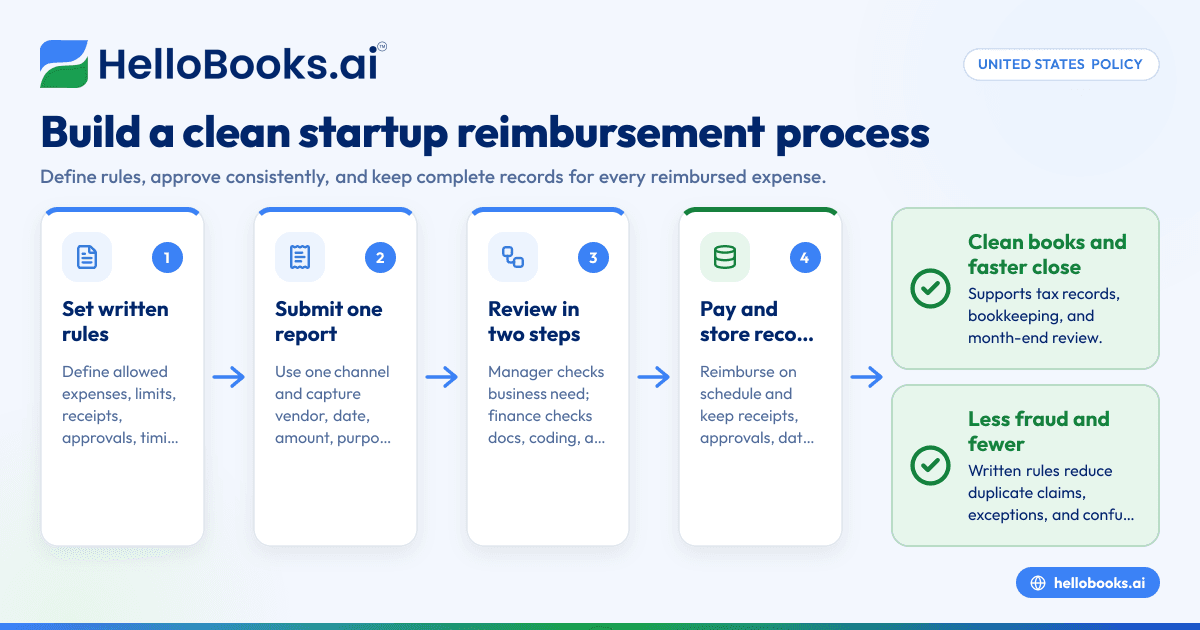
Use a simple approval chain: employee submits, manager reviews business need, finance checks documentation, and reimbursement is paid. The best workflow is fast, documented, and consistent.
For most startups, a two-step review works well. The direct manager approves the business purpose. Finance reviews receipts, categories, and policy compliance. High-value items or founder expenses should have an added reviewer.
A practical approval flow
Here is a common structure for a small or growing team:
- Employee spends or requests pre-approval Travel, events, and larger purchases should be approved before money is spent.
- Employee submits the expense report Include receipts, date, amount, vendor, and a short business purpose.
- Manager reviews The manager confirms the expense was necessary and within policy.
- Finance reviews Finance checks documentation, duplicates, category coding, and any sales tax details relevant to the books.
- Reimbursement is processed Payment is made on the stated schedule.
- Records are stored Keep the report, receipts, and approvals together in one system.
Special approval cases
Some expenses need tighter controls:
- Founder and executive expenses should be approved by another executive, board designee, or finance lead.
- Related-party purchases should be disclosed and reviewed carefully.
- Client entertainment should include who attended and the business purpose.
- Emergency purchases can be reimbursed later, but the policy should define what counts as an emergency.
If your team is growing fast, this is where AI bookkeeping can help organize the back office. It is easier to review expenses when receipts and categories are already structured.
What records do you need to keep?
Keep the receipt, amount, date, vendor, business purpose, approver, and accounting category for every reimbursed expense. Good records support clean books, tax deductions, and faster audits or due diligence.
The minimum record set
For each expense, keep:
- Employee name
- Expense date
- Submission date
- Vendor name
- Amount in USD ($)
- Receipt or invoice image
- Business purpose
- Names of attendees for meals or events, when relevant
- Approval record
- General ledger category
- Payment date and method
This record set matters for tax and accounting support. This post is general information, not tax or legal advice. If you have questions about deductibility or documentation standards, ask your tax advisor or CPA.
How long should records be stored?
Your policy should say where records are stored and who can access them. Most startups want digital storage with searchable reports, not inboxes full of PDFs and phone photos.
Retention periods can depend on tax, accounting, legal, and company requirements. Many businesses keep expense records for several years as part of their general accounting documentation. Your CPA or attorney can help set a retention schedule that fits your situation.
Why clean records matter during growth
Startups often think reimbursements are too small to matter. But small records problems turn into bigger control problems. Missing receipts, vague meal notes, and approvals buried in Slack can create issues during fundraising, lender reviews, financial statement prep, or an acquisition process.
If your team already struggles with coding and close, AI accounting software or accounting software in the USA can make expense data easier to track inside your books.
Which expenses should startups reimburse?
Start with ordinary, necessary, and clearly business-related expenses that employees reasonably paid out of pocket. Then define category-specific rules so employees know what counts.
Common reimbursable categories
Travel
Cover approved airfare, hotels, rideshare, parking, and baggage fees tied to business travel. State whether employees must book economy flights and standard hotels.
Meals
Allow meals during approved travel or business meetings. Require names of attendees and the business purpose.
Mileage
If employees drive a personal car for business, your policy should explain whether the company reimburses mileage, parking, and tolls. It should also say how mileage is logged.
Software and subscriptions
These are common in startups. Require pre-approval for recurring tools. Otherwise, you end up with duplicate subscriptions across teams.
Office and remote work supplies
List what is covered, such as a headset, keyboard, shipping supplies, or approved home office basics. Be careful with broad “work from home” language. Specific limits help.
Customer and event expenses
Trade show supplies, client lunches, and event materials should include the event or customer name and purpose.
Common non-reimbursable categories
- Personal travel add-ons
- Family member expenses
- Personal phone upgrades
- Traffic tickets or fines
- Clothing not required for specific business use
- Entertainment without business purpose
- Purchases made after a denied pre-approval request
How do you handle startup expense reimbursements without chaos?
Set one submission method, one approval chain, one deadline, and one record standard. Chaos usually starts when teams use different tools and managers make one-off exceptions.
Under that short rule, build a process your team can repeat every month.
A simple monthly reimbursement routine
- Pick one submission channel Use one app, one form, or one finance inbox. Do not allow receipts to arrive by text, chat, and email all at once.
- Use a standard expense form Every report should capture vendor, date, amount, category, business purpose, and approval.
- Set a submission deadline For example, require employees to submit by a set day after month-end or after a trip.
- Review exceptions separately Do not bury policy exceptions inside normal reports. Log and approve them in writing.
- Reconcile reimbursements to the books Match approved reports to payments and ledger entries.
- Audit a sample every month Spot-check for missing receipts, duplicate claims, and vague descriptions.
For many startups, the biggest issue is not policy writing. It is follow-through. That is where accounting software for small business becomes useful. It helps keep expense data, reports, and approvals closer to the accounting records instead of split across spreadsheets and email.
How detailed should the policy be?
Be detailed enough to remove doubt, but short enough that employees will actually use it. Most startups can cover the essentials in three to five pages plus a simple expense form.
What to avoid
Do not try to cover every rare scenario in the first draft. That makes the policy bloated. It is better to cover the most common expense types clearly and add a short exceptions section.
Avoid these mistakes:
- No spending limits
- No pre-approval rules
- No submission deadline
- No guidance for receipts
- No separate review for founder expenses
- No statement on non-reimbursable items
- No link between reimbursement records and bookkeeping
What a strong policy sounds like
A strong policy uses direct language:
- “Receipts are required for all reimbursable expenses except approved mileage.”
- “Travel must be pre-approved by the employee’s manager.”
- “Expense reports must be submitted within 15 days after the trip ends.”
- “Meals must include attendees and business purpose.”
- “Recurring software purchases require department head approval.”
That kind of language reduces debate and keeps finance from rewriting the same emails every month.
What happens if employees do not follow the policy?
Claims can be delayed, reduced, or denied if they are late, unsupported, or outside policy. The policy should say this clearly so enforcement feels consistent, not personal.
Create consequences without creating fear
The point is not to punish employees. The point is to protect the business and set fair expectations. Most employees want to comply if the rules are clear and the process is simple.
Use a graduated approach:
- Return incomplete reports for correction.
- Require manager explanation for repeat issues.
- Deny clearly personal or unapproved spending.
- Escalate repeated violations to HR or leadership if needed.
Train managers too. Many reimbursement problems happen because managers approve expenses casually and finance has to clean up the mess later.
How can software help keep records clean?
Software can capture receipts, route approvals, reduce duplicate entries, and sync expense data into bookkeeping. The best setup gives finance one place to review reports, payments, and supporting documents.
If you are still stitching together spreadsheets, email threads, and exported bank data, cleanup takes too long. A cleaner workflow helps founders and finance teams spend less time chasing documentation.
HelloBooks can help startups centralize bookkeeping tasks and reduce manual work around expense records, categorization, and close. If you are reviewing options, see how invoice software and QuickBooks alternative workflows compare to the process you use today.
Sample policy outline for a U.S. startup
You do not need to copy a template word for word. But this outline is a practical starting point:
1. Policy purpose
The company reimburses employees for approved, necessary, and documented business expenses.
2. Scope
Applies to all employees. Contractors follow contract terms unless stated otherwise.
3. Reimbursable expenses
Travel, meals, mileage, office supplies, approved software, training, customer meetings, shipping.
4. Non-reimbursable expenses
Personal items, commuting, fines, unsupported expenses, luxury upgrades without approval.
5. Pre-approval rules
Required for travel, events, recurring software, and any single purchase above your set threshold.
6. Submission rules
Expense reports must include receipts, business purpose, category, and manager approval.
7. Deadlines
Claims must be submitted within your stated window after purchase or travel.
8. Reimbursement timing
Approved claims are reimbursed on the company’s regular reimbursement schedule.
9. Exceptions
Exceptions must be approved in writing by the designated authority.
10. Recordkeeping
All reports, receipts, and approvals are stored digitally and linked to accounting records.
A policy like this is simple, but it covers the points that usually cause problems.
If your team needs cleaner back-office workflows, you can book a walkthrough at book a demo or review options on the pricing page.
Frequently asked questions
Does every startup in the United States need a written expense reimbursement policy?
Not every startup is legally required to have a formal standalone policy, but it is a smart control. A written policy reduces confusion, helps managers approve consistently, and supports cleaner bookkeeping.