
Key takeaways
What this article covers, in order:
- Key takeaways
- What is accounts receivable follow up?
- Why do small businesses in India struggle with overdue invoices?
- What is the best overdue invoice reminder sequence in India?
- When should you send invoice reminders?
- WhatsApp reminder scripts for overdue invoices
Late payment follow-up works best when you use a clear sequence, not random reminders. For Indian small businesses, the right mix is usually a polite WhatsApp message, a short email, and a firm phone call, all sent on a simple schedule tied to the invoice due date.
If your team handles accounts receivable follow up in spreadsheets or from memory, delays will pile up fast. A standard reminder process helps you collect faster, protect customer relationships, and give your finance team fewer awkward escalations.
Key takeaways
- Accounts receivable follow up should follow a fixed sequence by days overdue, not ad hoc reminders.
- In India, WhatsApp often gets the fastest response, but email gives you a clear written record.
- Reminder messages should be polite first, firm later, and always mention invoice number, amount and due date.
- Call scripts work better when the caller asks for a payment date, not a vague promise.
- A clear escalation path helps your sales, finance and founders stay aligned on overdue collections.
- Using invoice software, bank reconciliation software or AI bookkeeping can reduce manual follow-ups and missed invoices.
What is accounts receivable follow up?
Accounts receivable follow up means contacting customers after you raise an invoice so that payment happens on time. It includes reminders before the due date, messages after the due date, calls for delayed bills, and escalation when payment keeps slipping.
For many Indian SMEs, this process is informal. One person in accounts sends a reminder on WhatsApp. The founder calls if the amount is large. Sales steps in when the customer goes silent. That works for a while, but once you have 50, 100 or 500 invoices a month, inconsistency becomes expensive.
Poor follow-up creates three problems:
- Cash flow becomes unpredictable.
- Team time gets wasted on repeated manual chasing.
- Customer communication becomes messy and emotional.
A better system makes collections feel routine, not personal. That matters if you run a service business in Mumbai, a distributor in Pune, or a manufacturing unit serving dealers in tier-2 cities.
Why do small businesses in India struggle with overdue invoices?
The common issue is not that customers never want to pay. It is that no one owns the process end to end. Sales assumes accounts will follow up. Accounts assumes the relationship owner will push. The founder steps in only when the delay becomes serious.
There are also local realities:
- Customers ask for "one more week" on WhatsApp.
- Payment happens after internal approval cycles.
- Buyers wait for vendor details, revised invoices, or GST corrections.
- Part payments come through UPI, bank transfer, or payment links at different times.
- Teams track invoices in Tally, Excel, email and chats, with no single view.
This is where structured accounts receivable follow up matters. You do not need aggressive language. You need consistency, proof, and a next step.
What is the best overdue invoice reminder sequence in India?
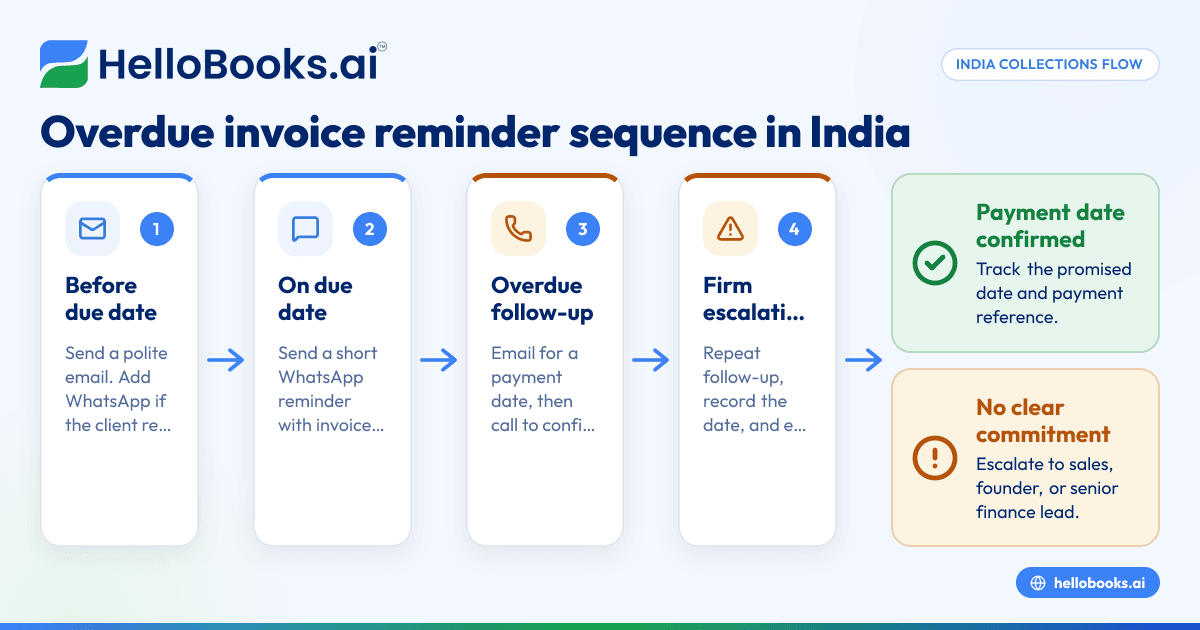
Use WhatsApp for quick visibility, email for documentation, and calls for commitment. Start before the due date, follow up within 1-3 days after due date, and escalate firmly after 7-15 days if there is no confirmed payment date.
A reminder sequence should be simple enough that any accounts executive can run it. It should also be clear enough that management can review it every week.
A practical 15-day reminder sequence
Here is a simple sequence for small businesses in India. Adjust the timing based on your industry and customer relationship.
- 3 days before due date Send a polite reminder by email. If the client usually responds on WhatsApp, send a short WhatsApp too.
- On due date Send a gentle payment due reminder on WhatsApp. Keep it short and easy to act on.
- 3 days overdue Send a stronger email with invoice details. Ask for a payment date, not just confirmation.
- 5 days overdue Make a call to the accounts contact or approver. Confirm whether there is a dispute, approval issue, or cash flow delay.
- 7 days overdue Send a follow-up email summarising prior reminders. Copy the relationship owner if needed.
- 10 days overdue Send a firm WhatsApp and make a second call. Ask for a specific date and payment reference.
- 15 days overdue Escalate internally to sales head, founder, or senior finance lead. If appropriate, pause fresh work or supplies until payment is cleared.
This kind of sequence works especially well when every reminder uses the same standard format. It also becomes easier to automate in AI accounting software or accounting software in India if your volume grows.
When should you send invoice reminders?
Send one reminder before the due date, one on the due date, and follow-ups at fixed overdue intervals such as 3, 7 and 15 days. The exact schedule depends on your sales cycle, customer size, and whether delayed payment is common in your sector.
Match the reminder style to the delay stage
Before due date
Your tone should be helpful. Assume the customer intends to pay.
Use this for:
- Large invoices
- New customers
- Clients with strict internal approval cycles
- Invoices sent near weekends or month end
1 to 7 days overdue
Your tone should be polite but direct. Ask for the payment date.
Use this for:
- Most routine overdue invoices
- Cases where the customer has seen the invoice but not acted
- Situations where accounts says "processing"
8 to 15 days overdue
Your tone should become firm. Mention prior reminders and ask for closure.
Use this for:
- Repeat delays
- High-value invoices
- Customers asking for repeated extensions
Beyond 15 days overdue
Escalate carefully. Bring in a senior stakeholder and review commercial exposure.
Use this for:
- Customers with no clear payment commitment
- Disputed invoices not getting resolved
- Clients with multiple overdue bills
WhatsApp reminder scripts for overdue invoices
WhatsApp works well in India because it is often the fastest channel. But keep the message professional. Do not send long paragraphs or emotional texts. One short message with all key details is enough.
Script 1: Before due date
Hi [Name], sharing a quick reminder that Invoice [Invoice Number] for ₹[Amount] is due on [DD/MM/YYYY]. Please let us know if you need the invoice copy or any details for processing. Thank you.
Script 2: On due date
Hi [Name], this is a reminder that Invoice [Invoice Number] for ₹[Amount] is due today, [DD/MM/YYYY]. Request you to please share the payment update. Thank you.
Script 3: 3 days overdue
Hi [Name], Invoice [Invoice Number] for ₹[Amount], due on [DD/MM/YYYY], is still pending at our end. Please share the expected payment date today so we can update our records.
Script 4: 7 days overdue
Hi [Name], this is a follow-up on Invoice [Invoice Number] for ₹[Amount], now overdue by 7 days. We have not yet received a payment date. Please confirm by today so we can close the follow-up.
Script 5: Firm escalation
Hi [Name], despite earlier reminders, Invoice [Invoice Number] for ₹[Amount] remains unpaid. Please confirm the payment date and status today. If there is any issue with the invoice, kindly let us know immediately.
Tips for WhatsApp follow-up
- Send during working hours.
- Avoid voice notes unless the customer prefers them.
- Do not send repeated "?" messages.
- Keep one payment thread per customer where possible.
- Save screenshots if your process needs evidence of follow-up.
If your business collects many payments each week, combining reminder logs with expense management software and collections tracking can reduce confusion across finance and operations teams.
Email reminder templates for accounts receivable follow up
Email gives you a better audit trail than chat. It also works well when the payer is different from your day-to-day contact, which is common in larger businesses.
Email template 1: Gentle reminder before due date
Subject: Reminder: Invoice [Invoice Number] due on [DD/MM/YYYY]
Dear [Name],
This is a gentle reminder that Invoice [Invoice Number] for ₹[Amount] is due on [DD/MM/YYYY].
Please let us know if you need the invoice copy, PO details, or any supporting document for payment processing.
Regards,
[Your Name]
[Company Name]
Email template 2: Due date reminder
Subject: Payment due today: Invoice [Invoice Number]
Dear [Name],
This is to remind you that Invoice [Invoice Number] for ₹[Amount] is due today, [DD/MM/YYYY].
Kindly confirm the payment status or expected transfer date.
Regards,
[Your Name]
Email template 3: 3 days overdue
Subject: Follow-up: Overdue invoice [Invoice Number] for ₹[Amount]
Dear [Name],
We wish to follow up on Invoice [Invoice Number] for ₹[Amount], which was due on [DD/MM/YYYY] and remains unpaid.
Please share the expected payment date. If there is any issue with the invoice or documentation, please let us know so we can resolve it quickly.
Regards,
[Your Name]
Email template 4: 7 to 15 days overdue
Subject: Urgent follow-up: Invoice [Invoice Number] overdue
Dear [Name],
This is a further reminder regarding Invoice [Invoice Number] for ₹[Amount], overdue since [DD/MM/YYYY]. We have followed up earlier but have not yet received a confirmed payment date.
Request you to please update us today. If required, we can coordinate directly with your accounts team to help close this.
Regards,
[Your Name]
Email template 5: Escalation email
Subject: Escalation: Long overdue payment for Invoice [Invoice Number]
Dear [Name],
Despite earlier reminders, Invoice [Invoice Number] for ₹[Amount] remains unpaid. We request your urgent attention to this matter.
Please confirm the payment date today. If there is a dispute or internal approval issue, kindly share the details so we can address it immediately.
Regards,
[Your Name]
What should you say on a collection call?
Ask whether the invoice is approved, whether any issue is blocking payment, and the exact date payment will be made. Keep the call calm and specific. The goal is not to argue. The goal is to get a real commitment you can record and follow up on.
Call script 1: First overdue call
"Hello [Name], I am calling regarding Invoice [Invoice Number] for ₹[Amount], due on [DD/MM/YYYY]. I wanted to check whether the invoice is approved and when we can expect payment."
Then pause and listen.
If they say it is being processed, ask:
"Thank you. Could you please share the expected payment date so I can update our records?"
Call script 2: If they say they did not receive the invoice
"No problem. I will resend it right away on email and WhatsApp. May I confirm the correct email ID and contact person for payment processing?"
Call script 3: If they mention a dispute
"Understood. Please help me with the exact issue on the invoice so we can resolve it today. Once corrected, what would be the expected payment timeline?"
Call script 4: If they keep delaying
"I understand there may be internal timelines. We need a clear payment date from your side so we can plan our collections. Can you please confirm a specific date?"
Call script 5: Firm escalation call
"We have followed up several times on this invoice and have not received payment or a confirmed date. Please help us close this today, or let us know who the right escalation contact is."
Good call habits
- Call with invoice details open in front of you.
- Record the promised payment date immediately.
- Send a confirmation email after the call.
- Never rely on memory.
- Keep the relationship owner informed for large accounts.
How do you handle customers who keep saying “next week”?
A repeated “next week” usually means there is no real payment plan yet. Stop accepting vague assurances. Ask for a date, amount, approver name, or transaction reference. If they cannot give one, escalate internally and decide whether to pause future work or supplies.
Turn vague promises into trackable commitments
When a customer says "next week", respond with one of these:
- "Please confirm the exact date."
- "Will the full amount be paid, or part payment?"
- "Who is approving this on your side?"
- "Can you share the UTR once the transfer is made?"
- "If there is a billing issue, please tell us today."
This changes the conversation from soft follow-up to accountable follow-up.
Build an internal collections policy your team can follow
Many businesses fail at collections because the process lives inside one person's head. A written policy fixes that. It also stops awkward confusion between finance, sales and founders.
Include these rules in your policy
1. Who owns follow-up?
Assign a primary owner. Usually this is accounts or finance. For large accounts, sales may support.
2. When does follow-up start?
Define the exact schedule. For example, 3 days before due date, on due date, 3 days overdue, 7 days overdue, and 15 days overdue.
3. Which channel is used first?
Set the standard. Example: email first, WhatsApp second, call after 5 days overdue.
4. When is a customer escalated?
Define triggers such as:
- Overdue above 15 days
- Outstanding above ₹1,00,000
- More than two unpaid invoices
- No response after two written reminders and one call
5. What gets recorded?
At minimum, record:
- Invoice number
- Amount
- Due date
- Contact person
- Reminder dates
- Call notes
- Promised payment date
- Actual payment date
This is where ai accounts receivable workflows can help. They can surface overdue invoices, prompt next actions, and reduce the chance that a busy team misses follow-up on a large outstanding amount.
Use automation without losing the human touch
Automation should handle timing, reminders and record-keeping. Humans should handle disputes, relationships and escalations.
For example, your system can:
- send due-date reminders,
- flag overdue invoices,
- match incoming payments,
- update ageing reports,
- and show who needs a call today.
That is especially useful if your team is moving away from manual Tally exports or spreadsheet trackers and wants an accounting software for small business setup that supports collections better. If you are evaluating a Tally alternative, look closely at invoicing, payment reminders and reconciliation, not just bookkeeping.
If the discussion involves tax treatment, GST adjustments, or legal recovery steps, please take advice from your accountant or counsel. This article is general information, not tax or legal advice.
Common mistakes in accounts receivable follow up
Waiting too long to start
If you remind the customer only after 15 days, you have already made collection harder.
Sending unclear messages
"Please clear dues" is weak. Mention invoice number, amount and due date every time.
Depending only on one channel
Some customers ignore email. Some ignore WhatsApp. Use both.
Not asking for a specific payment date
A good follow-up asks for a date. A weak follow-up asks for "an update".
Not logging call outcomes
If your team cannot see what happened on the last call, the next follow-up becomes repetitive and ineffective.