
Key takeaways
What this article covers, in order:
- Key takeaways
- Why a monthly close checklist matters in India
- What is included in a monthly close checklist
- Monthly close checklist India: practical template
- GST and compliance checks during month-end
- Management review and reporting
A monthly close checklist in India is a repeatable set of tasks your finance team completes at month-end to make sure the books are accurate, complete and ready for reporting, GST work and management review. For small businesses, a good checklist reduces month-end stress, catches errors early and helps owners make decisions from current numbers instead of old spreadsheets.
Key takeaways
- A monthly close checklist helps Indian businesses close faster and with fewer errors.
- The checklist should cover cash, sales, purchases, expenses, payroll, GST and reports.
- Bank and payment reconciliation is the foundation of a reliable monthly close.
- Standard roles, deadlines and review steps matter as much as the checklist itself.
- Small businesses can start with a simple spreadsheet template and later move to AI accounting software.
Why a monthly close checklist matters in India
Many small businesses in India still close books in an informal way. The accountant exports data from Tally. The founder checks bank balances on mobile apps. GST numbers sit in another file. UPI collections come through one payment account. Expenses come from email, WhatsApp and paper bills. By the time the month is “closed”, the next month has already started.
That creates three common problems.
First, the numbers are late. If you close April only by the middle of May, the management team is already making decisions without current information.
Second, the numbers are unreliable. Missing invoices, unreconciled bank entries and duplicate expenses can distort profit, GST payable and receivables.
Third, the work depends too much on one person. If the accountant is on leave, month-end gets delayed.
A proper monthly close checklist fixes this by turning month-end into a routine. Every task has an owner. Every owner has a deadline. Every balance has support. The business knows when books are ready.
For Indian businesses, this is especially useful because month-end affects more than internal reporting. It supports GST compliance, e-invoicing records where applicable, customer collections, vendor payments and board or investor reporting. If you operate across Mumbai, Bengaluru and Pune, or across multiple branches in tier-2 cities, a standard process becomes even more important.
What is included in a monthly close checklist
A practical monthly close checklist India teams can use should answer five questions:
- Did we record all transactions for the month?
- Did we reconcile all key balances?
- Did we review exceptions and fix errors?
- Did we complete tax and compliance support work?
- Did we publish reports for decision-making?
Your checklist does not need to be complex. It needs to be complete and repeatable.
At a minimum, include these areas:
- Bank accounts and cash
- UPI, payment gateway and wallet settlements
- Sales invoices and credit notes
- Purchase bills and vendor credits
- Accounts receivable and payable ageing
- Employee reimbursements and expenses
- Payroll and statutory postings
- GST data review
- Fixed assets and depreciation
- Accruals, prepayments and provisions
- Inter-branch or inter-company balances, if any
- Final management reports
If your business uses spreadsheets and Tally today, you can still implement this process. But if the team spends too much time on manual posting and tie-outs, AI bookkeeping tools can reduce routine work.
Monthly close checklist India: practical template
Below is a practical monthly close template for small businesses in India. You can adapt it by team size, industry and software.
1. Freeze the period and collect all source data
Before review starts, gather all records for the month.
Checklist
- Confirm the period being closed, for example 01/04/2026 to 30/04/2026.
- Download all bank statements.
- Export UPI, Razorpay or other payment settlement reports.
- Collect sales invoices, debit notes and credit notes.
- Collect purchase bills, expense bills and reimbursement claims.
- Confirm payroll summary from HR or payroll provider.
- Gather loan statements, EMI schedules and interest certificates if relevant.
- Collect stock summaries if inventory affects your books.
Good practice
- Set a cut-off date for late bills.
- Ask teams to submit bills through one process, not email plus WhatsApp plus paper.
- Keep all supporting documents in one shared folder.
2. Reconcile bank, cash and payment collections
This is the most important month-end step. If this is weak, the rest of the close is weak.
Checklist
- Reconcile all bank accounts line by line.
- Match receipts against invoices.
- Match payments against vendor bills and expense entries.
- Identify bank charges, interest, failed payments and reversals.
- Reconcile petty cash, if used.
- Reconcile UPI and payment gateway settlements to books and bank credits.
- Review uncleared cheques and old unreconciled items.
A lot of Indian businesses miss payment settlement differences. For example, sales may be recorded at gross value, but the bank receives net settlement after fees or deductions. These differences must be posted correctly.
If this work is manual every month, bank reconciliation software can help shorten close time.
3. Review sales, receivables and collections
Sales review is not only about revenue. It is also about billing completeness and collections.
Checklist
- Confirm all sales for the month were invoiced.
- Review cancelled invoices and credit notes.
- Match invoices with dispatch or service completion records.
- Review customer advances and adjust where necessary.
- Check overdue receivables and prepare ageing.
- Flag disputed invoices and expected bad debts.
- Verify GST treatment on outward supplies.
For businesses that issue many invoices each month, using invoice software or e-invoicing software can reduce missing numbers and make invoice tracking easier.
4. Review purchases, payables and expense claims
Expense leakage often happens here. Bills are delayed. Duplicate claims slip through. Vendor balances do not match.
Checklist
- Record all vendor bills received up to the cut-off date.
- Review unmatched purchase orders or goods received records if used.
- Check employee reimbursements with proper bill support.
- Identify duplicate entries.
- Review vendor ageing and unpaid balances.
- Reconcile major vendor statements where available.
- Review GST input tax data before return preparation.
This is also the stage to check whether any cost belongs to a future month. For example, an annual software subscription paid in April may need monthly allocation rather than full expense in one month, depending on your accounting policy.
If expenses come from multiple teams and cities, expense management software can help standardise collection and approval.
5. Post payroll, statutory and recurring entries
Some entries are predictable every month but still get missed in smaller businesses.
Checklist
- Post payroll salary journal.
- Record employer contributions and recoveries where applicable.
- Record professional fees, rent, internet and software subscriptions.
- Post loan interest and EMI split where needed.
- Record depreciation on fixed assets.
- Record prepaid expense adjustments.
- Record accruals for expenses incurred but not yet billed.
Use a recurring journal list. This saves time and ensures the same entries are not recreated from memory each month.
GST and compliance checks during month-end
For Indian businesses, month-end is the best time to clean up GST data before the filing cycle. This avoids a last-minute rush and reduces errors in outward supply, inward supply and input credit review.
Your monthly close checklist India process should include:
- Review tax codes used on sales and purchase entries.
- Check whether GSTIN details are present and valid in records.
- Verify credit notes and debit notes are recorded correctly.
- Check place of supply where relevant.
- Review exceptions such as zero-rated, exempt or non-GST transactions, if applicable.
- Prepare a summary for the filing team or consultant.
If your business has regular filing needs, GST return filing software can make the handoff from bookkeeping to GST work smoother.
This article is general information, not tax or legal advice. GST treatment depends on your facts, transaction type and current rules.
Management review and reporting
The close is not complete when entries are posted. It is complete when someone reviews the final numbers and confirms they make sense.
Reports to review every month
At a minimum, review:
- Profit and loss statement
- Balance sheet
- Cash flow summary
- Accounts receivable ageing
- Accounts payable ageing
- GST summary
- Expense vs budget, if you use budgets
Questions reviewers should ask
- Did revenue move in line with sales activity?
- Are gross margins stable, or is there an unexplained change?
- Did any expense jump sharply this month?
- Are receivables increasing faster than sales?
- Are old payables unresolved?
- Do bank balances in the books match actual balances?
- Are there negative balances in accounts that should not be negative?
For a small business, these questions often matter more than highly formatted reports. The goal is clarity and action.
Suggested monthly close timeline for small businesses
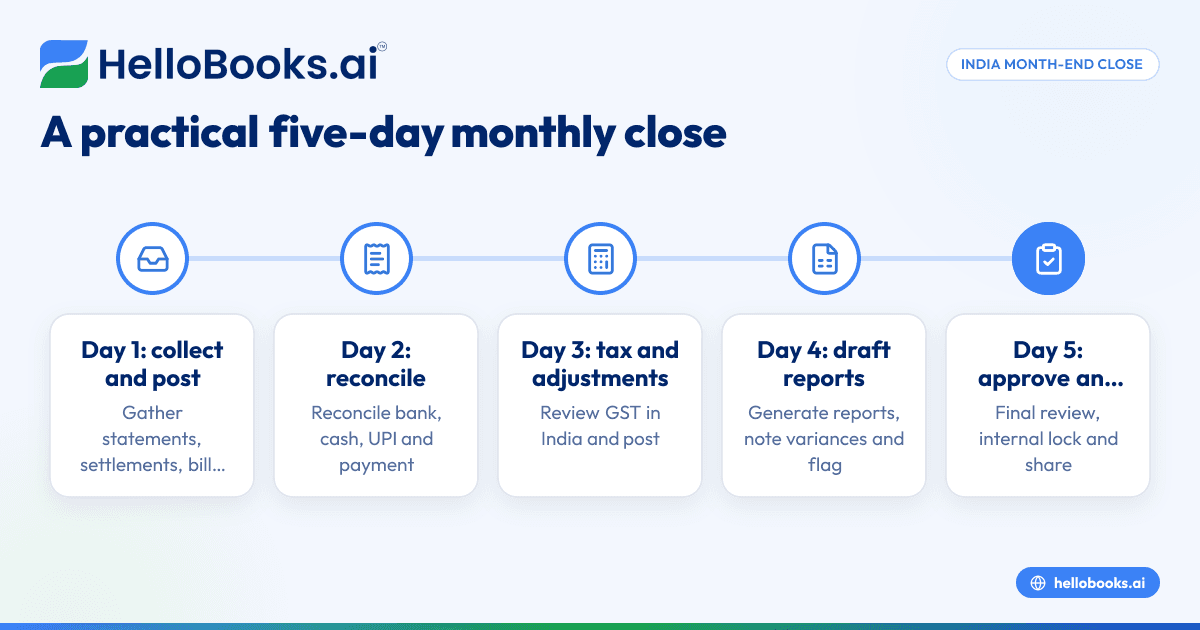
A close checklist works best with deadlines. Here is a practical five-working-day model.
Day 1: collect and post
- Gather all bank statements and settlement reports.
- Record routine sales, purchase and expense entries.
- Confirm payroll summary and recurring journals.
Day 2: reconcile
- Complete bank and payment reconciliation.
- Match customer receipts and vendor payments.
- Review missing bills and open items.
Day 3: review taxes and adjustments
- Review GST classifications.
- Post accruals, prepaids and depreciation.
- Review vendor and customer ageing.
Day 4: draft reports
- Generate P&L, balance sheet and cash flow.
- Prepare management notes on major variances.
- Flag issues that need owner approval.
Day 5: approve and close
- Final reviewer signs off.
- Lock the period internally.
- Share reports with management.
If your team is very small, one person may do most of this work. Even then, try to keep a separate review step by the founder, finance lead or external accountant. If you need support, you can find an accountant.
Common mistakes that delay month-end close
Many small businesses do not have a checklist problem. They have a process discipline problem.
1. Recording transactions from memory
Expenses and collections should come from source documents, not memory or message threads.
2. Mixing business and personal spending
This creates confusion in bank reconciliation and makes expense review difficult.
3. Ignoring payment gateway differences
UPI, settlement delays, refunds and charges can leave balances unreconciled.
4. Posting GST later
If tax codes are corrected after month-end, the close becomes unstable.
5. No owner for each task
A checklist without names and deadlines does not get completed on time.
6. Reopening old months casually
If prior periods are edited without control, current reports stop matching previous versions.
How to set up your own checklist template
You can create a useful monthly close checklist in one afternoon.
Use these columns in your template
- Task
- Description
- Owner
- Due date
- Status
- Review notes
- Final sign-off
Group tasks by section
Use sections like:
- Cash and bank
- Revenue
- Expenses and payables
- Payroll
- GST
- Adjustments
- Reporting
Add evidence requirements
For each task, mention what proof is needed. Examples:
- Bank reconciliation file
- Vendor ageing report
- Customer outstanding list
- GST summary
- Fixed asset schedule
Keep version control simple
Name the file clearly, such as:Monthly Close Checklist - April 2026
If your current process depends heavily on Tally exports and manual spreadsheets, it may be worth reviewing whether a Tally alternative or modern accounting software in India would reduce month-end effort.
When should you move from spreadsheets to software
Spreadsheets are fine at the start. They become risky when transaction volume, team size or compliance complexity grows.
You should consider moving to accounting software for small business if:
- You have multiple bank accounts.
- You collect payments through UPI and gateways.
- You issue a high volume of invoices.
- Your accountant spends hours on reconciliation.
- GST review is taking too long.
- Founders ask for reports before books are ready.
For many teams, the best software improvement is not just report generation. It is a smoother close process. That means cleaner data capture, faster reconciliations and clearer approvals.
HelloBooks is built for this kind of work. It helps small businesses automate bookkeeping, invoicing, GST work, reconciliation and reporting in one system. The goal is simple: less month-end chasing, more timely numbers.
If your team wants a faster and cleaner close, you can book a demo or compare options on the pricing page.
Frequently asked questions
What is a monthly close checklist in India?
A monthly close checklist is a month-end task list used to verify that your books are complete and accurate. In India, it usually includes bank reconciliation, invoice checks, expense review, GST data review and management reporting.
How long should monthly close take for a small business?
For a small business with a standard process, monthly close can often be completed in three to five working days. The exact time depends on transaction volume, document discipline and whether reconciliation is manual.
Who should own the monthly close process?
Usually, the accountant or finance executive prepares the close, and a finance manager, founder or external accountant reviews it. Even in a very small business, review should not be skipped.
What is the most important step in month-end close?
Bank and payment reconciliation is usually the most important step. If cash, UPI, gateway settlements and bank movements are not correct, the rest of the reports may also be wrong.
Should GST checks be part of the monthly close checklist?
Yes. Month-end is the right time to review GST classifications, invoice data and purchase records before filing work starts. This reduces errors and makes the filing cycle smoother.
Can I manage monthly close in Excel or Google Sheets?
Yes, many small businesses start that way. But once entries, reconciliations and compliance work increase, software usually gives better control, speed and audit trail.