
Key takeaways
What this article covers, in order:
- Key takeaways
- What is the month end close process?
- Why month end closing matters for Indian small businesses
- Common reasons the close gets delayed
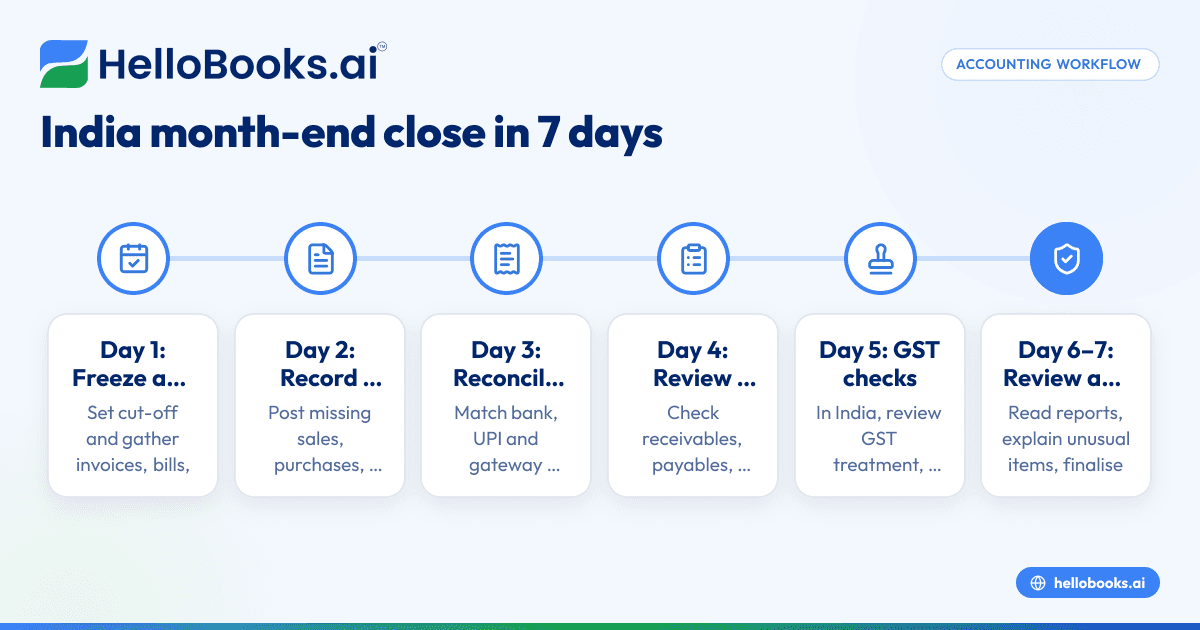
- The simple 7-day month end close workflow
- Day 1: Freeze the month and collect all documents
Closing the books every month does not need to take two weeks of chasing files, matching bank entries and fixing GST mistakes. A simple month end close process in India is a repeatable 7-day workflow that helps small businesses finish accounts faster, catch errors early and get reliable numbers for decisions.
If you run your books in spreadsheets, Tally or a mix of tools, the goal is the same. You want a practical month end close checklist in India that your team can actually follow every month.
Key takeaways
- A month end close is the process of reviewing, matching and finalising your books for a completed month.
- Small businesses in India can use a simple 7-day workflow to close faster without building a large finance team.
- The most important checks are bank reconciliation, sales and purchase review, expense coding, GST checks and receivable-payable follow-up.
- A good close process depends on cut-off rules, a shared checklist and one owner for each task.
- Monthly closing gives you cleaner profit numbers, better cash visibility and fewer surprises at GST filing time.
- Tools such as AI bookkeeping, bank reconciliation software and expense management software can reduce manual work.
What is the month end close process?
The month end close process is the set of tasks your business completes after a month finishes to make sure the books are accurate. It usually includes recording missing entries, reconciling bank accounts, reviewing invoices and bills, checking taxes and locking the period for reporting.
For an Indian small business, this often means bringing together data from bank statements, UPI collections, Razorpay settlements, GST invoices, vendor bills, petty cash and payroll records. If you skip this process, your monthly P&L and cash position can look fine on paper but be wrong in reality.
That is why a strong month end close checklist India businesses can follow should focus on speed and discipline. It should not depend on one accountant remembering everything from memory.
Why month end closing matters for Indian small businesses
Many founders only look closely at accounts when GST filing is due, when their CA asks for data or when cash gets tight. By then, fixing one month often means correcting two or three older months too.
A monthly close helps you in practical ways:
You get reliable numbers for decisions
If your books are current, you can see monthly revenue, gross margin, operating costs and cash flow. This helps with hiring, pricing and inventory decisions.
GST work becomes easier
When sales, purchases and expense records are reviewed monthly, GST preparation is smoother. You are less likely to miss tax invoices, duplicate entries or wrong tax treatment. If GST is a regular pain point, using GST return filing software can make the filing side easier.
Collections and vendor payments improve
A close process highlights old receivables, unpaid bills and settlement gaps. For example, a trading business in Pune may discover that marketplace settlements are short, or that a large customer invoice is still open after 45 days.
Year-end accounts become less stressful
A clean monthly close means fewer surprises at year-end. Your accountant spends less time on cleanup and more time on useful review.
Common reasons the close gets delayed
Before building a workflow, it helps to know what usually slows small teams down.
Data comes from too many places
Sales may be in one system, expenses in WhatsApp messages, bank receipts in email and vendor bills in folders. Without a standard process, finance spends days just collecting documents.
Bank and payment gateway reconciliation is pending
UPI, net banking and Razorpay settlements often create many small entries. If these are not matched regularly, month end becomes a pile-up.
Invoices and bills are entered late
Teams often issue invoices after the month ends or submit bills several days late. This affects revenue, expenses and GST reporting.
No one owns the checklist
When tasks are shared informally, everyone assumes someone else has done them. A close owner solves this problem.
The simple 7-day month end close workflow
This 7-day structure is designed for small businesses in India. You can use it whether you keep books manually, in Tally or in accounting software in India.
The exact timing can vary. The key is to follow the same order every month.
Day 1: Freeze the month and collect all documents
On the first working day after month-end, stop back-dated casual entries and define the cut-off clearly. Tell sales, operations and admin teams that all invoices, bills and approvals for the month must be submitted by a fixed time.
What to collect
- Customer invoices issued during the month
- Credit notes and debit notes
- Vendor bills and purchase invoices
- Bank statements for all accounts
- Razorpay or other payment gateway settlement reports
- UPI collection summaries
- Petty cash records
- Employee reimbursement claims
- Loan statements, if any
- Payroll summary and statutory deductions, where applicable
What to check
- Confirm that invoice numbering is complete.
- Check that all major purchases have supporting bills.
- Ask each department head if any month-related transaction is missing.
- Save documents in one shared location with clear file names.
A simple habit helps a lot here. Use one cut-off message every month on WhatsApp or email, and send it to every team involved.
Day 2: Record missing sales, purchases and expenses
Once documents are collected, enter all missing transactions. This includes sales invoices, vendor bills, recurring expenses and manual journals that belong to the month.
Focus on cut-off accuracy
The most common error at month-end is recording a transaction in the wrong month. For example:
- A bill dated 30/06/2026 should not be pushed to July only because it was shared late.
- A customer payment received on 01/07/2026 for a June invoice should not change June revenue.
- A courier expense for June should be recognised in June if the bill relates to that period.
Review recurring entries
Check recurring costs such as:
- Office rent
- Internet and software subscriptions
- Salaries
- Loan interest
- Depreciation, if you record it monthly
If you issue invoices manually, this is also the stage to confirm that all invoices were raised correctly. Businesses that still create invoices in spreadsheets often lose time here. Using invoice software can reduce missing invoice problems and improve record-keeping.
Day 3: Reconcile bank accounts, UPI and payment gateways
This is the most important day in the close. If the bank is not reconciled, your cash balance cannot be trusted.
Bank reconciliation checklist
- Match every bank receipt and payment to the corresponding invoice, bill or expense.
- Identify bank charges, interest, refunds and failed payments.
- Record bounced or reversed transactions.
- Review old unreconciled items from previous months.
- Confirm the closing bank balance matches your books after valid timing differences.
Don’t forget UPI and settlement platforms
In India, many small businesses collect money through UPI, QR codes and gateways. These often create timing differences:
- Customer pays instantly through UPI
- Settlement reaches the bank later
- Gateway fees are deducted before payout
- Refunds and charge reversals appear separately
If you do not reconcile these carefully, revenue and cash can both be misstated. This is where bank reconciliation software can save several hours every month.
Example
A D2C business in Bengaluru records ₹4,80,000 of online sales for June. The bank only shows ₹4,68,500 of settlements by 30/06/2026. The difference may be valid if gateway fees or pending settlements explain it. But it must be documented, not guessed.
Day 4: Review receivables, payables and advances
Once cash is reconciled, move to customer and vendor balances.
Accounts receivable review
Check:
- Unpaid customer invoices
- Old outstanding amounts
- Part payments not adjusted properly
- Customer advances sitting uncleared
- Credit notes pending against returns or discounts
Prepare a simple ageing view: 0-30 days, 31-60 days, 61-90 days, and over 90 days. This tells you where collection follow-up is needed.
Accounts payable review
Check:
- Vendor bills entered but not paid
- Payments made without bills
- Advances to suppliers
- Duplicate bills
- GST invoices missing from vendors
For many small businesses, month-end is the only time they realise they paid a supplier but never received the final tax invoice.
Day 5: Run GST and tax-related checks
This step matters because monthly books feed compliance work. This is general information, not tax or legal advice. If your treatment is unclear, confirm it with your accountant.
Basic GST checks for month-end
- Verify that sales invoices have the correct GST treatment.
- Check whether B2B invoices have complete GSTIN details.
- Review purchase entries for correct tax breakup.
- Flag bills where GST is missing or unclear.
- Review credit notes and debit notes issued during the month.
- Identify high-value transactions that may need extra documentation.
If your business is under e-invoicing rules in India, review whether applicable invoices were handled correctly and on time. Businesses with higher invoice volumes often use e-invoicing software to reduce manual errors.
Also review TDS and payroll items if applicable
If you deduct TDS or process payroll monthly, make sure the accounting entries are posted correctly and liabilities are visible. Do not leave these to quarter-end if you want clean books.
Day 6: Review the P&L, balance sheet and unusual movements
By day 6, the books should be mostly complete. Now read the reports like an owner, not just like a bookkeeper.
Review the profit and loss statement
Look for:
- Revenue that is sharply higher or lower than usual
- Gross margin changes
- Advertising or travel expenses that jumped unexpectedly
- Duplicate expense categories
- Negative balances that look wrong
Review the balance sheet
Look for:
- Bank balances that do not make sense
- Receivables or payables that are very old
- Suspense accounts
- Large employee advances
- Unadjusted loans or director-related entries
- Input tax balances that need review
Ask three practical questions
- Does the profit look believable for how the month felt operationally?
- Does the cash balance match what management expected?
- Are there any entries you cannot explain in one sentence?
If the answer to the third question is yes, do not close yet.
Day 7: Finalise, lock and share the close summary
The final day is for approval and communication. Without this step, the close stays half-finished and gets reopened repeatedly.
Final tasks
- Mark all checklist items complete.
- Post final adjustment entries.
- Lock the month or restrict back-dated changes.
- Export final reports.
- Share a short close summary with the founder or finance lead.
What to include in the monthly close summary
- Revenue for the month
- Net profit or loss
- Cash and bank balance
- Top overdue receivables
- Key payables due
- GST or tax issues requiring attention
- Any unusual one-time entries
A one-page summary is enough for most small businesses. The point is not to create a board pack. The point is to ensure the numbers were reviewed and understood.
A practical month end close checklist India teams can use
Here is a compact working checklist you can copy into your monthly process:
Pre-close setup
- Close calendar shared with all departments
- One owner assigned for each task
- Document submission deadline fixed
- Bank statement access confirmed
Transaction review
- All sales invoices recorded
- All vendor bills recorded
- Credit notes and debit notes updated
- Recurring entries posted
- Petty cash updated
- Reimbursements recorded
Reconciliation
- All bank accounts reconciled
- UPI receipts matched
- Payment gateway settlements checked
- Bank charges and interest posted
- Customer advances adjusted
- Supplier advances reviewed
Compliance review
- GST classification checked
- B2B invoice details reviewed
- Purchase tax entries reviewed
- E-invoicing applicability checked where relevant
- TDS and payroll entries posted where applicable
Reporting and sign-off
- P&L reviewed
- Balance sheet reviewed
- Receivable ageing shared
- Payable ageing shared
- Unusual entries explained
- Month locked after approval
How to make the close faster every month
A close process should become easier after three or four cycles. If it still feels chaotic, the system needs improvement.
Standardise inputs
Use fixed formats for invoices, bills and expense claims. Do not accept random screenshots and incomplete details unless someone verifies them first.
Set cut-off rules
Create simple rules for what counts in the month. Document them. Repeat them every month.
Reduce manual data entry
If your team spends hours copying entries from bank statements, PDFs and spreadsheets, software can help. Many businesses move from Tally-heavy manual work to a more automated setup when they need a Tally alternative that handles bookkeeping workflows better.
Use a monthly review owner
One person should be responsible for driving the close, even if multiple people do the tasks.
Track close time
Measure how many working days the close takes every month. If June took 9 days and July took 6, identify what changed and keep it.
When small businesses should consider automation
You do not need a large finance department to run a disciplined close. But if your business is growing, manual processes start breaking first at month-end.
You should consider automation if:
- You have multiple bank accounts or payment channels
- Your team handles more than a few hundred transactions a month
- Reconciliation takes more than one day
- GST review becomes a recurring problem
- Reports are always delayed
- Founders do not trust the numbers
At that point, moving to AI accounting software or accounting software for small business can make the close more consistent and less dependent on manual follow-up.
Final thoughts
A good month end close process in India is not about fancy accounting language. It is about finishing the month with confidence. If your team can collect documents quickly, reconcile cash, review GST-related entries and lock the books in seven working days, you will have better control over profit, cash and compliance.
If you want to simplify month-end with automation, you can book a demo to see how HelloBooks works, or compare options on the pricing page.
Frequently asked questions
What is the best month end close checklist India small businesses should follow?
The best checklist is one your team can complete every month without confusion. It should include document collection, transaction posting, bank reconciliation, receivable and payable review, GST checks, report review and final lock.
How many days should a month end close take for a small business in India?
For many small businesses, a 5 to 7 working day close is realistic. If your books are mostly manual or documents come late, it may take longer at first. The aim is to reduce delays month by month.
Is month end close the same as GST filing?
No. Month end close is an internal accounting process to finalise your books for the month. GST filing is a statutory compliance process that uses accounting data, but the two are not the same.