


Key takeaways
What this article covers, in order:
- Why this comes up / what goes wrong
- Step-by-step
- Example (fictional figures)
- Common mistakes
- Frequently asked questions
- Key takeaways
Manufacturing accounting systems are designed to handle the complex financial and inventory needs of manufacturing businesses. Unlike general accounting, these systems integrate cost tracking for raw materials, work-in-progress, and finished goods, alongside GST invoicing and compliance. Indian manufacturers, such as auto-components MSMEs in Pune or packaging manufacturers in Ahmedabad, require systems that can manage multiple cost layers, reconcile GST returns, and produce accurate financial reports.
Why this comes up / what goes wrong
Manufacturing businesses face unique accounting challenges. They deal with raw materials, labour costs, overheads, and finished goods inventory, all of which affect profitability. Without a dedicated manufacturing accounting system, owners and accountants often struggle with:
- Tracking the true cost of production accurately.
- Managing inventory levels to avoid stockouts or excess.
- Reconciling GST returns like GSTR-1 and GSTR-3B with purchase records.
- Handling multiple product lines with different HSN codes.
- Maintaining compliance with GST invoicing rules and e-invoicing requirements.
For example, a pump maker in Coimbatore may have complex bills of materials and multiple suppliers, making manual bookkeeping prone to errors and delays. This leads to mismatches in GSTR-2B reconciliation, incorrect ITC claims, and delayed filings.
Step-by-step
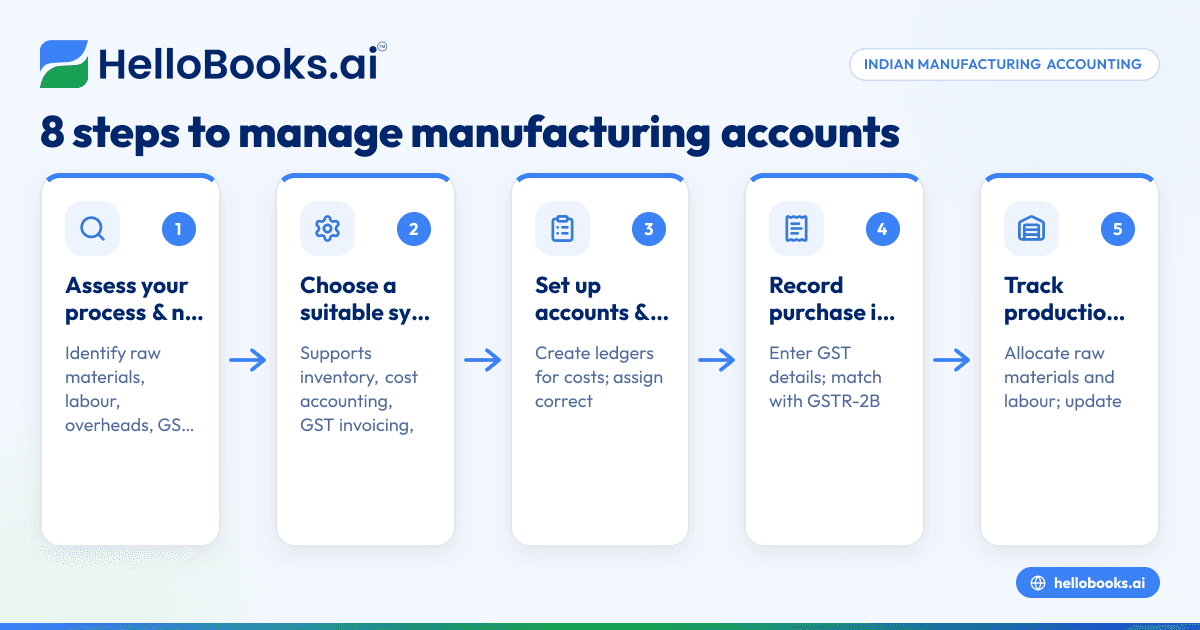
- Assess your manufacturing process and accounting needs.
- Identify raw materials, labour, overheads, and finished goods.
- List GSTINs, HSN codes, and compliance requirements.
- Choose an accounting system that supports manufacturing features.
- Look for inventory tracking, cost accounting, and GST invoicing.
- Ensure it can generate reports needed for GSTR-1 and GSTR-3B filings.
- Set up your chart of accounts and inventory items.
- Create accounts for raw materials, work-in-progress, finished goods, labour, and overheads.
- Assign correct HSN codes and GST rates to each product.
- Record purchase invoices with GST details.
- Enter supplier bills accurately, including GSTIN and tax amounts.
- Match purchase invoices with GSTR-2B to verify ITC eligibility.
- Track production costs and update inventory.
- Allocate raw material usage and labour costs to products.
- Adjust inventory quantities for consumption and finished goods.
- Issue GST-compliant sales invoices and e-invoices if applicable.
- Ensure all sales have correct GSTINs, HSN codes, and tax calculations.
- Generate e-invoices with IRN and QR codes as per rules.
- Reconcile bank statements and GST returns regularly.
- Match payments received and made with accounting records.
- File GSTR-1 and GSTR-3B accurately before deadlines.
- Generate financial reports for management decisions.
- Review profit and loss, inventory valuation, and GST reports.
For more detailed guidance on GST invoicing and compliance, see GST invoicing and for manufacturing business context, visit Manufacturing.
Example (fictional figures)
Consider an auto-components MSME in Pune manufacturing 1,000 units of a component in March 2024.
- Raw materials cost: ₹2,00,000
- Labour cost: ₹50,000
- Overheads: ₹30,000
Total production cost = ₹2,00,000 + ₹50,000 + ₹30,000 = ₹2,80,000
Finished goods inventory value at month-end = ₹2,80,000
Sales in March:
- 800 units sold at ₹500 each = ₹4,00,000
- GST rate assumed at 18%
GST on sales = ₹4,00,000 × 18% = ₹72,000
Total invoice value = ₹4,00,000 + ₹72,000 = ₹4,72,000
Purchase invoices recorded for raw materials with GST input tax credit claimed:
- Input GST = ₹2,00,000 × 18% = ₹36,000
In GSTR-3B filing for March, the MSME claims ITC of ₹36,000 against output GST liability of ₹72,000.
Net GST payable = ₹72,000 - ₹36,000 = ₹36,000
This example shows how production costs and GST transactions flow through the accounting system.
Common mistakes
- Not linking inventory usage to production costs.
- Prevent by regularly updating raw material consumption and work-in-progress.
- Incorrect GST rates or HSN codes on invoices.
- Prevent by verifying GST rates and HSN codes for each product.
- Ignoring reconciliation of purchase invoices with GSTR-2B.
- Prevent by monthly matching of purchase data with GST portal statements.
- Delays in filing GSTR-1 and GSTR-3B.
- Prevent by maintaining updated records and setting reminders for deadlines.
- Inadequate segregation of accounts for manufacturing costs.
- Prevent by creating detailed ledger accounts for raw materials, labour, and overheads.
- Overlooking e-invoicing requirements for eligible turnover.
- Prevent by checking turnover thresholds and generating IRNs timely.
For more on managing GST compliance, see HelloBooks for India.
Frequently asked questions
What features should a manufacturing accounting system have?
A manufacturing accounting system should support inventory management, cost accounting for raw materials and labour, GST-compliant invoicing, e-invoicing, and reconciliation of GST returns like GSTR-1 and GSTR-3B. It should also generate reports for financial analysis and GST compliance.
How does GST affect manufacturing accounting?
GST impacts manufacturing accounting by requiring correct classification of goods with HSN codes, timely invoicing with GST details, claiming ITC on inputs, and filing returns accurately. Manufacturing businesses must track input and output GST carefully to avoid penalties.
Can I use Excel or Tally for manufacturing accounting?
Yes, many small manufacturers use Excel or Tally. However, these may require manual effort for inventory tracking, cost allocation, and GST reconciliation. Dedicated manufacturing accounting systems can reduce errors and save time.
What is the importance of e-invoicing in manufacturing?
E-invoicing ensures that sales invoices are reported electronically to the GST system with an IRN and QR code. This improves compliance and reduces mismatches in GST returns. Manufacturers with turnover above the threshold must comply.
How often should I reconcile GST returns with accounting records?
Monthly reconciliation is recommended to ensure purchase invoices match GSTR-2B and sales invoices match GSTR-1. This helps avoid ITC denial and penalties.
What reports help manufacturing businesses manage finances?
Reports like profit and loss, inventory valuation, cost of goods sold, GST summary, and bank reconciliation statements help manufacturers monitor financial health and compliance.
Key takeaways
- Manufacturing accounting systems integrate cost tracking, inventory, and GST compliance.
- Accurate recording of raw materials, labour, overheads, and finished goods is essential.
- GST invoicing with correct HSN codes and e-invoicing is mandatory for eligible manufacturers.
- Regular reconciliation of purchase invoices with GSTR-2B and timely GST filings prevent penalties.
- Avoid common mistakes by maintaining detailed accounts and verifying GST details.
- Choose a system that suits your manufacturing complexity and compliance needs.
Start managing your manufacturing accounts efficiently. Start on the Free plan (200 transactions a year, GSTR-1 and 3B filing for one GSTIN).


