
Key takeaways
What this article covers, in order:
- Why this comes up / what goes wrong
- Step-by-step
- Example (fictional figures)
- Common mistakes
- Doing this in HelloBooks
- Frequently asked questions
Invoice numbers are unique identifiers assigned to each invoice a business issues. They must be consecutive and unique for each financial year to comply with GST rules. Using invoice numbers correctly helps you keep clear records, avoid duplication, and meet statutory requirements.
Why this comes up / what goes wrong
Small business owners often struggle with invoice numbers because they may manually create invoices using spreadsheets, Tally, or bill books without a clear system for numbering. This can lead to duplicate numbers, gaps, or non-consecutive sequences, causing confusion during GST filing, audits, or reconciliation. Also, GST Rule 46 requires invoices to have a unique consecutive serial number of up to 16 characters, which many small businesses overlook. Without proper invoice numbering, businesses risk non-compliance and difficulty tracking payments and tax credits.
Step-by-step
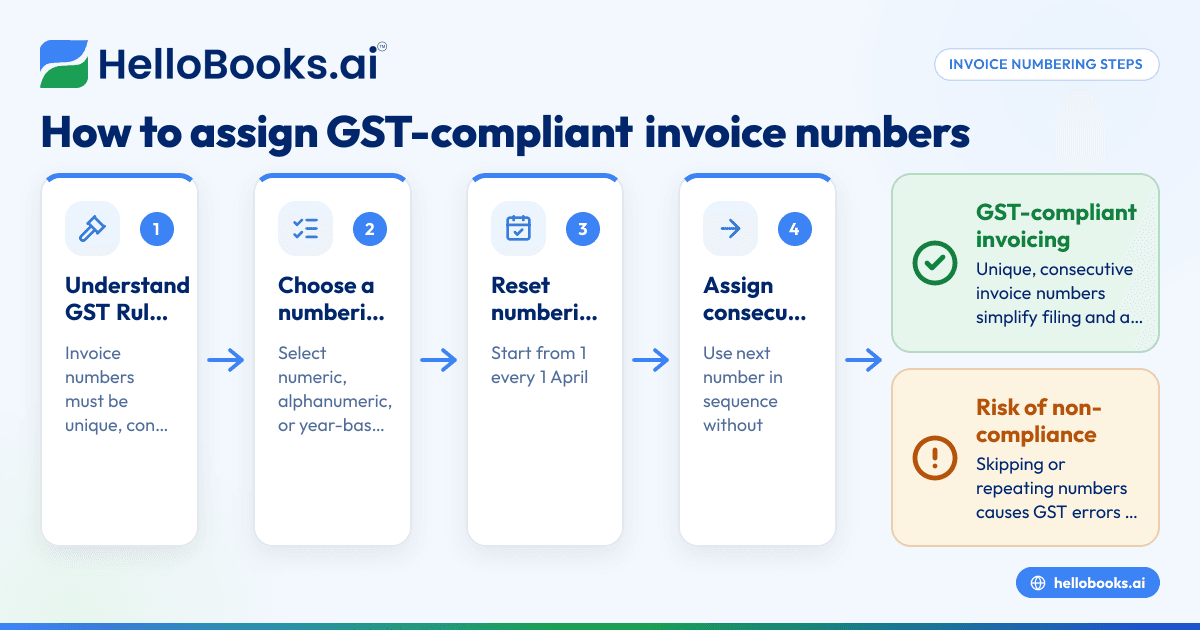
- Understand the requirement: Your invoice number must be unique and consecutive within a financial year, containing letters, numbers, or characters like '-' or '/'. It can be up to 16 characters long. (See Rule 46 particulars)
- Choose a numbering format: Decide on a format that suits your business, such as numeric only (e.g., 0001, 0002), alphanumeric (e.g., INV-001, INV-002), or including the year (e.g., 23-001).
- Start from 1 at the beginning of each financial year: Reset your numbering sequence every 1 April to comply with GST norms.
- Assign numbers consecutively: Every new invoice must have the next number in the sequence without skipping or repeating.
- Record invoice numbers securely: Maintain a log or system to track issued invoice numbers to avoid duplication.
- Check for duplicates before issuing: Always verify the next invoice number is not already used.
- Include invoice numbers on all invoices: Clearly print the invoice number on each invoice for easy reference.
- Use software or tools: Automate invoice numbering to reduce errors and save time. HelloBooks offers GST invoicing features to handle this.
Example (fictional figures)
Assume a small business starts invoicing from 1 April 2023 with the format INV-2023-001.
- First invoice number: INV-2023-001
- Invoice value: ₹1,00,000
- GST rate assumed: 18% (CGST 9%, SGST 9%)
Calculations:
Taxable value = ₹1,00,000
CGST = ₹1,00,000 × 9% = ₹9,000
SGST = ₹1,00,000 × 9% = ₹9,000
Total invoice value = ₹1,00,000 + ₹9,000 + ₹9,000 = ₹1,18,000
Next invoice number: INV-2023-002
This sequence continues without gaps or duplicates throughout the financial year.
Common mistakes
- Skipping numbers: Leads to confusion and audit queries. Prevent by maintaining a strict log and using software.
- Reusing numbers: Causes GST filing errors. Always check the last issued number before creating a new invoice.
- Non-consecutive numbering across branches: Use distinct series or prefixes for different locations or business verticals.
- Ignoring GST Rule 46 details: Ensure invoice numbers comply with the 16-character limit and allowed characters.
- Not resetting numbers yearly: Reset invoice numbers at the start of each financial year to avoid duplication.
- Manual entry errors: Automate invoice numbering with tools like HelloBooks to reduce mistakes.
Doing this in HelloBooks
HelloBooks provides GST invoicing that automatically creates compliant tax invoices with the correct CGST/SGST or IGST split and HSN/SAC codes derived from the customer's GSTIN. It ensures invoice numbers are unique and consecutive within the financial year. For businesses exceeding the ₹5 crore turnover threshold, HelloBooks supports e-invoicing by generating the Invoice Reference Number (IRN) and signed QR code at save time, eliminating the need to upload JSON files manually to the government portal. This streamlines compliance and reduces errors. Learn more about GST invoicing and e-invoicing.
Frequently asked questions
What is an invoice number and why is it important?
An invoice number is a unique identifier for each invoice issued, used to track sales and GST compliance. It helps avoid duplication and ensures clear records for audits and tax filing.
Can invoice numbers include letters and symbols?
Yes, invoice numbers can contain letters, numbers, and characters like '-' or '/'. They must be unique, consecutive, and up to 16 characters long as per GST Rule 46.
Do I have to reset invoice numbers every financial year?
Yes, GST compliance requires the invoice numbering sequence to restart at the beginning of each financial year (1 April) to avoid duplication.
What happens if I skip or repeat invoice numbers?
Skipping or repeating invoice numbers can cause confusion during GST filing and may lead to penalties or audit issues. Maintaining a strict sequence is essential.
How can I check if my invoice number complies with GST rules?
Use tools like the GST invoice validator to verify your invoices meet Rule 46 requirements, including invoice number format.
How does HelloBooks help with invoice numbering?
HelloBooks automates invoice numbering, ensuring unique consecutive numbers with GST-compliant invoices. It also handles e-invoicing requirements for businesses over ₹5 crore turnover. See HelloBooks for India for details.
Key takeaways
- Invoice numbers must be unique, consecutive, and up to 16 characters long per financial year.
- Choose a clear numbering format and reset it every 1 April.
- Avoid skipping or repeating numbers to maintain GST compliance.
- Use software or tools to automate numbering and reduce errors.
- HelloBooks provides GST invoicing and e-invoicing features to simplify invoice number management.
Start managing your invoice numbers correctly today. Start on the Free plan (200 transactions a year, GSTR-1 and 3B filing for one GSTIN) with HelloBooks to automate GST-compliant invoicing and e-invoicing.