


Key takeaways
What this article covers, in order:
- Why this comes up / what goes wrong
- Step-by-step
- Example (fictional figures)
- Common mistakes
- Doing this in HelloBooks
- Frequently asked questions
An invoice numbering system is essential for small businesses to maintain unique, sequential invoice numbers that comply with GST rules and simplify bookkeeping. It helps avoid duplication, supports audit trails, and ensures legal compliance. This article covers why invoice numbering matters, how to implement it step-by-step, a worked example, common mistakes, and how HelloBooks can assist with GST invoicing and e-invoicing.
Why this comes up / what goes wrong
Small business owners often look for an invoice numbering system when they face issues like duplicate invoice numbers, missing invoices, or non-compliance with GST rules. Without a clear system, manual invoice books or spreadsheets can lead to errors, confusion during GST filing, and difficulties in reconciliation. Choosing software or a method that ensures unique, continuous numbering aligned with GST Rule 46 is crucial. Businesses crossing the ₹5 crore turnover threshold must also consider e-invoicing requirements, which include generating an Invoice Reference Number (IRN).
Step-by-step
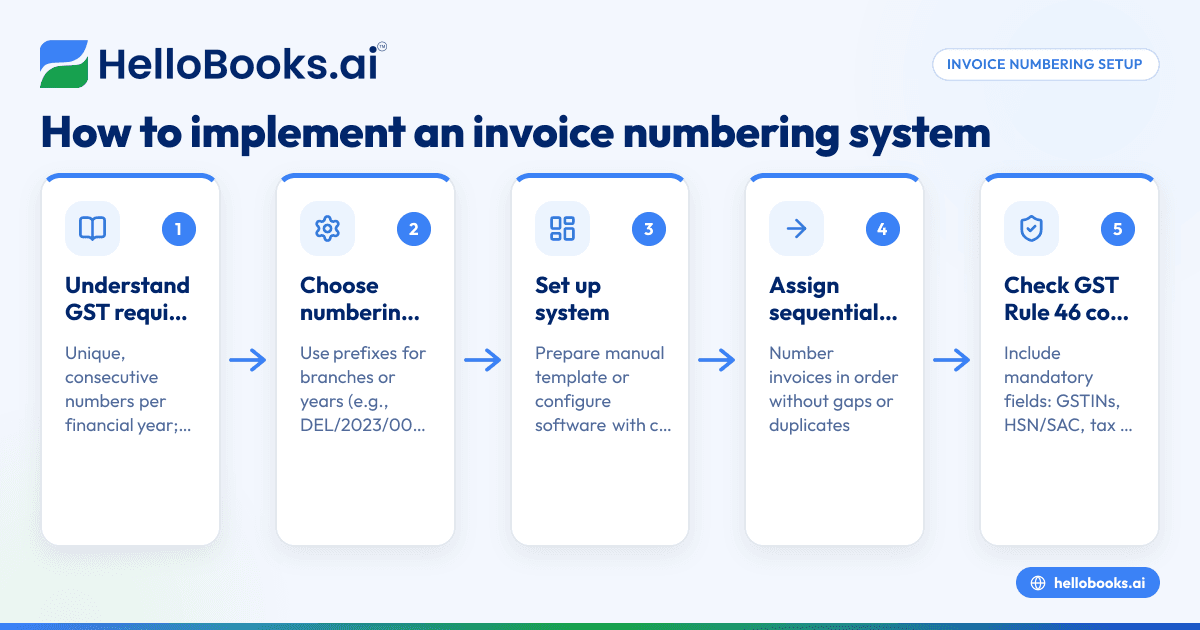
- Understand GST requirements for invoice numbering:
- The invoice number must be consecutive and unique for each financial year.
- It can contain letters, numerals, ‘-’ or ‘/’, up to 16 characters.
- Ensure the number resets or is distinct for each financial year to avoid duplication.
- Choose a numbering format:
- Decide on a prefix or code to identify branches or types of invoices (e.g., "DEL/2023/0001").
- Keep the format consistent and documented.
- Set up your numbering system:
- If using spreadsheets or manual books, prepare a template with columns for invoice number, date, customer details, and amounts.
- If using software, configure the invoice numbering settings according to your chosen format.
- Assign invoice numbers sequentially:
- Each new invoice should have the next number in the sequence.
- Avoid gaps or duplicate numbers.
- Check GST Rule 46 compliance:
- Ensure your invoice includes all mandatory fields such as supplier and recipient GSTIN, HSN/SAC codes, tax rates, and the unique invoice number.
- For invoices to unregistered recipients with taxable value ₹50,000 or more, include recipient details as specified.
- For businesses over ₹5 crore turnover:
- Implement e-invoicing to generate an IRN and QR code embedded in the invoice.
- The IRN replaces manual invoice numbering for B2B invoices above the threshold.
- Track and store invoices:
- Maintain a log or system to track issued invoice numbers.
- Keep backups and records for audit and GST filing.
- Review and reconcile regularly:
- Cross-check issued invoices against sales and GST returns (GSTR-1, GSTR-3B).
- Use tools like the GST invoice validator to verify compliance.
Example (fictional figures)
A Delhi-based small electronics supplier starts invoicing on 01/04/2023 for the financial year 2023-24. They choose the format DEL/2023/0001 for the first invoice.
- Invoice number: DEL/2023/0001
- Invoice date: 01/04/2023
- Taxable value (assumed GST rate 18%): ₹1,00,000
Calculations:
Taxable value = ₹1,00,000
CGST (9%) = ₹1,00,000 × 9% = ₹9,000
SGST (9%) = ₹1,00,000 × 9% = ₹9,000
Total tax = ₹9,000 + ₹9,000 = ₹18,000
Total invoice value = ₹1,00,000 + ₹18,000 = ₹1,18,000
The next invoice issued will be DEL/2023/0002, and so on, ensuring no gaps or duplicates.
Common mistakes
- Skipping or duplicating invoice numbers: Prevent by using automated numbering or a strict manual log.
- Not resetting or distinguishing numbers by financial year: Prevent by including the year in the invoice number or resetting numbering each year.
- Ignoring GST Rule 46 details: Prevent by checking mandatory invoice fields and using tools like HelloBooks or the GST invoice validator.
- Failing to generate IRN when required: Prevent by knowing the ₹5 crore turnover threshold and using e-invoicing software.
- Using inconsistent formats: Prevent by documenting and standardising the format across the business.
- Not backing up invoice records: Prevent by keeping digital copies and logs.
Doing this in HelloBooks
HelloBooks creates GST-compliant tax invoices with the correct CGST/SGST or IGST split and automatically fills HSN/SAC codes from the customer's GSTIN, ensuring the fields Rule 46 requires are consistent. For businesses exceeding the ₹5 crore e-invoicing threshold, HelloBooks generates the IRN and signed QR code at the time of saving a B2B invoice, saving time compared to manual JSON uploads to the government portal. This integration helps maintain a seamless invoice numbering system aligned with GST compliance. Learn more about GST invoicing and e-invoicing software in HelloBooks.
Frequently asked questions
What is the best format for an invoice number?
A good invoice number format is unique, sequential, and easy to track. Many businesses use a prefix with location or year codes, followed by a sequential number, e.g., DEL/2023/0001. Consistency matters more than complexity.
Can I use letters in invoice numbers?
Yes, GST Rule 46 allows invoice numbers to include letters, numerals, '-' or '/' up to 16 characters. This flexibility helps include branch codes or year identifiers.
Do I need to reset invoice numbering every financial year?
While not mandatory, resetting or including the financial year in the invoice number helps avoid duplicates and eases GST audit and filing.
What happens if I miss generating an IRN for e-invoicing?
Businesses over the ₹5 crore turnover threshold must generate an IRN for B2B invoices. Missing this can lead to compliance issues and penalties. Using software like HelloBooks ensures IRN is generated automatically when required.[einvoice-threshold-5cr/einv-5cr-from-2023-08-01]
How can I check if my invoice numbering complies with GST?
Use the GST invoice validator to verify invoice details, including numbering, GSTIN, HSN codes, and tax calculations.
Can I manually number invoices if I use HelloBooks?
HelloBooks automates invoice numbering to prevent duplicates and maintain compliance. Manual numbering is not recommended to avoid errors.
Key takeaways
- Invoice numbers must be unique, consecutive, and up to 16 characters including letters or symbols.
- Include financial year or branch codes in the numbering format to avoid duplicates.
- Follow GST Rule 46 for mandatory invoice details alongside numbering.
- Businesses with turnover over ₹5 crore must generate an IRN for B2B invoices via e-invoicing.
- Regularly reconcile invoices and use validation tools to ensure compliance.
- HelloBooks automates GST-compliant invoice numbering and e-invoicing for eligible businesses.
Start managing your invoice numbering system with HelloBooks and simplify GST invoicing. Start on the Free plan (200 transactions a year, GSTR-1 and 3B filing for one GSTIN).


