


Key takeaways
What this article covers, in order:
- Why this comes up / what goes wrong
- Step-by-step
- Example (fictional figures)
- Common mistakes
- Doing this in HelloBooks
- Frequently asked questions
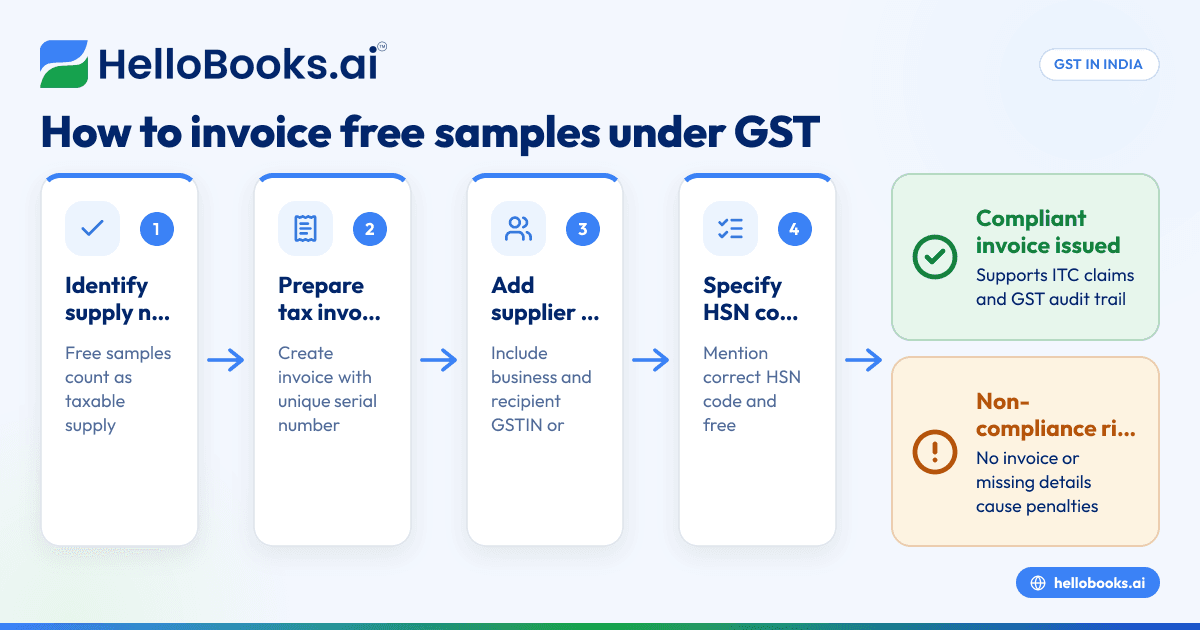
Under GST, free samples provided by a business are considered a supply and require a proper tax invoice. Even though the samples are given without charge, an invoice must be issued to document the transaction for GST compliance. The invoice should include all mandatory fields as per Rule 46, such as supplier and recipient details, HSN codes, and applicable tax rates. This ensures proper input tax credit (ITC) tracking and audit trail.
Why this comes up / what goes wrong
Small business owners often give free samples to promote products or for customer trials. However, confusion arises regarding whether to issue an invoice and how to treat GST on such supplies. Many skip invoicing or fail to include required details, risking non-compliance and penalties. Without an invoice, ITC claims by recipients and GST returns reconciliation become difficult. Proper invoicing of free samples helps maintain accurate records, supports ITC claims by recipients, and aligns with GST regulations.
Step-by-step
- Identify the supply nature: Confirm that free samples are a supply under GST, even if no sale consideration is received.
- Prepare a tax invoice: Create an invoice with a unique serial number and date of issue.
- Include supplier details: Add your business name, address, and GSTIN.
- Include recipient details: Add the recipient’s name, address, and GSTIN if registered. If unregistered, mention that accordingly.
- HSN code and description: Specify the HSN code of the goods and describe the free samples clearly.
- Quantity and unit: Mention the quantity of free samples supplied.
- Value and taxable value: Enter the value of the samples. For free samples, this is often the cost or deemed value for GST purposes. The taxable value is this amount.
- Tax rates and amount: Apply the applicable GST rates (CGST, SGST, or IGST) on the taxable value and calculate the tax amount.
- Place of supply and delivery address: Mention the place of supply state and delivery address if different.
- Signature: Sign or digitally sign the invoice.
- Issue the invoice: Share the invoice with the recipient and retain a copy for your records.
- Record in books and returns: Include the invoice details in your GST returns (GSTR-1) and accounts.
Check your invoices using a GST invoice validator to ensure compliance.
Example (fictional figures)
A small business in Maharashtra gives 10 free sample units of a product on 15/04/2024. The cost per unit is ₹500, and the applicable GST rate is 18% (CGST 9% + SGST 9%).
- Quantity = 10 units
- Cost per unit = ₹500
- Taxable value = 10 × ₹500 = ₹5,000
- CGST = ₹5,000 × 9% = ₹450
- SGST = ₹5,000 × 9% = ₹450
- Total GST = ₹450 + ₹450 = ₹900
- Total invoice value = ₹5,000 + ₹900 = ₹5,900
The invoice will show:
- Supplier details with GSTIN
- Recipient details with GSTIN (if registered)
- HSN code for the product
- Quantity: 10 units
- Taxable value: ₹5,000
- CGST: ₹450
- SGST: ₹450
- Total invoice value: ₹5,900
This invoice records the free supply for GST purposes and supports ITC claims for the recipient if applicable.
Common mistakes
- Not issuing an invoice: Always issue an invoice for free samples to maintain compliance. Prevent by setting a process for all supplies.
- Missing recipient GSTIN: If the recipient is registered, include their GSTIN. If unregistered, mention accordingly. Prevent by verifying recipient details before invoicing.
- Incorrect tax calculation: Apply the correct GST rate on the taxable value. Prevent by using GST invoicing software or a checklist.
- Not recording the invoice in returns: Include free sample invoices in GSTR-1 and other returns. Prevent by reconciling invoices monthly.
- Ignoring HSN code: Always mention the correct HSN code for goods. Prevent by referring to official HSN lists.
- Confusing free samples with gifts: Free samples are supplies; gifts may have different rules. Prevent by consulting your accountant for classification.
Learn more about GST invoicing to avoid errors.
Doing this in HelloBooks
HelloBooks GST invoicing creates compliant tax invoices with the correct CGST/SGST or IGST split and HSN/SAC codes automatically filled from the customer's GSTIN. For businesses crossing the ₹5 crore turnover threshold, HelloBooks supports e-invoicing with IRN and signed QR codes embedded in the invoice PDF. The software also builds GSTR-1 and GSTR-3B returns directly from recorded invoices, ensuring your free sample supplies are accurately reported. Visit HelloBooks for India to learn more.
Frequently asked questions
Do I have to pay GST on free samples?
Yes, free samples are considered a supply under GST and attract tax based on their value. You must issue an invoice and pay GST accordingly, though the actual payment may be zero if the supply is without consideration. This helps maintain compliance and supports ITC claims.
How do I value free samples for GST?
The value of free samples is generally the cost price or the transaction value if available. This taxable value is used to calculate GST. Consult your accountant if you are unsure about valuation methods.
Is e-invoicing mandatory for free sample invoices?
E-invoicing is mandatory for B2B supplies exceeding the ₹5 crore aggregate turnover threshold. If your business crosses this limit, free sample invoices to registered recipients must comply with e-invoicing rules and obtain an IRN.
Can I skip invoicing if the recipient is unregistered?
No, even if the recipient is unregistered, you must issue a tax invoice for free samples with all required details, marking the recipient as unregistered.
How often should I file GST returns for free samples?
Free sample invoices must be included in your periodic GSTR-1 and GSTR-3B filings. Monthly filers must submit GSTR-1 by the 11th and GSTR-3B by the 20th of the following month, while QRMP filers follow quarterly schedules. See official due dates for details.
Where can I check if my invoice complies with GST rules?
You can use the GST invoice validator tool to verify your invoice details against GST requirements.
Key takeaways
- Free samples are taxable supplies under GST and require a proper tax invoice.
- The invoice must include all mandatory details such as GSTINs, HSN code, quantity, value, and tax amounts.
- Value free samples at cost or transaction value to calculate GST.
- Include free sample invoices in GSTR-1 and GSTR-3B returns.
- Use tools like GST invoicing and GST invoice validator to ensure compliance.
- HelloBooks automates GST invoicing and filing, including e-invoicing for eligible businesses.
Start managing your GST compliance for free samples accurately and easily. Start on the Free plan (200 transactions a year, GSTR-1 and 3B filing for one GSTIN).
This article is general information, not tax or legal advice. Rules change; confirm the current position on gst.gov.in or with your chartered accountant before acting.


