


Key takeaways
What this article covers, in order:
- Why this comes up / what goes wrong
- Step-by-step
- Example (fictional figures)
- Common mistakes
- Doing this in HelloBooks
- Frequently asked questions
Insurance agencies and financial service businesses need software that ensures GST compliance and audit readiness before committing to long-term contracts. Such software should handle GST invoicing, e-invoicing, return filing, and reconciliation to reduce errors and ease audits.
Why this comes up / what goes wrong
Insurance agency owners and accountants often struggle with manual bookkeeping, GST compliance, and audit preparation. Errors in invoices, delays in filing GSTR-1 and GSTR-3B, or missing reconciliation can lead to penalties or complicated audits. Committing to multi-year software without verifying compliance features and audit support risks costly disruptions and non-compliance.
Step-by-step
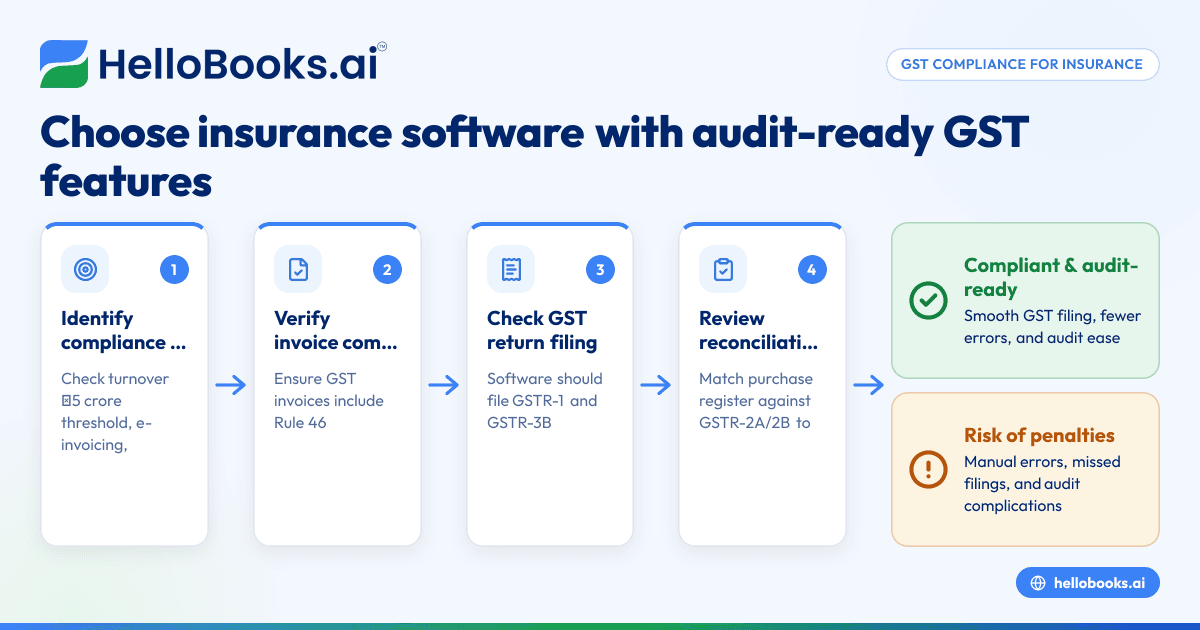
- Identify your compliance needs: Confirm if your business turnover requires e-invoicing (₹5 crore threshold) and regular GST return filing (monthly or quarterly under QRMP scheme). Check if you handle B2B supplies needing IRN and signed QR codes.
- Check invoice compliance features: Ensure the software generates GST-compliant tax invoices with all Rule 46 particulars, including supplier and recipient GSTIN, HSN/SAC codes, taxable value, tax rates, and QR code for e-invoices.
- Evaluate GST return filing capabilities: Look for software that builds and files GSTR-1 and GSTR-3B directly from recorded invoices to avoid mismatches and manual uploads.
- Review reconciliation and ITC tracking: The software should reconcile your purchase register against GSTR-2A/2B and flag missing or mismatched supplier invoices before claiming ITC.
- Assess audit support features: Check if the software maintains audit trails, allows easy retrieval of invoices with IRN and QR codes, and supports export of reports for audit purposes.
- Trial or demo before commitment: Use trial versions or demos to verify ease of use, accuracy of compliance features, and quality of support.
- Consider scalability and multi-GSTIN support: If your business has multiple GSTINs or plans to grow, ensure the software supports multi-GSTIN filing and consolidated reports.
Example (fictional figures)
An insurance agency in Mumbai with an aggregate turnover of ₹6 crore in FY 2023-24 must comply with e-invoicing from 1 August 2023. They issue a B2B invoice on 15/09/2023 for ₹1,20,000 plus 18% GST to a corporate client.
- Taxable value = ₹1,20,000
- GST @ 18% = ₹1,20,000 × 18% = ₹21,600
- Invoice total = ₹1,20,000 + ₹21,600 = ₹1,41,600
Using compliant software, the invoice is saved and an IRN and signed QR code are generated instantly. The invoice includes all Rule 46 particulars: supplier and recipient GSTIN, HSN code, tax rates, and QR code.
The software builds GSTR-1 from recorded invoices; the ₹1,41,600 is included automatically. The purchase register is reconciled nightly with GSTR-2B, flagging any missing supplier invoices before ITC is claimed in GSTR-3B.
Common mistakes
- Ignoring e-invoicing threshold: Not verifying if turnover exceeds ₹5 crore and missing IRN generation. Prevent by confirming turnover and enabling e-invoicing features.
- Using software without direct GST filing: Exporting JSON and manual uploads cause errors and delays. Use software with direct GSTR-1 and GSTR-3B filing.
- Skipping reconciliation checks: Claiming ITC without matching GSTR-2B leads to notices. Use software that flags missing or mismatched invoices.
- Not verifying invoice compliance: Missing Rule 46 details or QR code can invalidate invoices. Ensure software enforces these details.
- Committing without trial: Buying multi-year plans without testing usability and compliance can cause issues. Use free trials or demos.
- Ignoring multi-GSTIN needs: Businesses with multiple GSTINs need software supporting consolidated filing. Confirm multi-GSTIN capabilities.
Doing this in HelloBooks
HelloBooks supports insurance agencies with compliance-focused features including e-invoicing (IRN and signed QR) for businesses over the ₹5 crore threshold, generating the IRN at save time instead of manual JSON uploads. It builds and files GSTR-1 and GSTR-3B directly from recorded invoices to ensure figures match issued invoices. HelloBooks also reconciles purchase registers against GSTR-2A/2B nightly, highlighting missing supplier invoices before ITC claims in GSTR-3B. Learn more about HelloBooks for India here and its GST invoicing features here.
Frequently asked questions
What is the e-invoicing threshold for insurance agencies?
If your aggregate turnover across all GSTINs exceeds ₹5 crore in any financial year from 2017-18 onwards, you must issue e-invoices with IRN for B2B supplies from 1 August 2023.[einvoice-threshold-5cr/einv-5cr-from-2023-08-01]
How does e-invoicing help with audit support?
E-invoices carry an IRN and signed QR code embedded in the invoice, ensuring authenticity and easy retrieval during audits. This helps auditors verify invoice details quickly.[cgst-rule-46/rule46-qr-irn]
Can I file GSTR-1 and GSTR-3B directly from the software?
Yes, software like HelloBooks builds GSTR-1 and GSTR-3B directly from your recorded invoices and files them to GSTN, reducing manual errors and saving time.
Why is GSTR-2A/2B reconciliation important?
Reconciling your purchase register against GSTR-2A/2B flags missing or mismatched supplier invoices before you claim ITC in GSTR-3B, helping avoid GST notices.
What should I check before committing to a multi-year software plan?
Verify compliance features (e-invoicing, GST filing, reconciliation), audit support, multi-GSTIN handling, and usability through trials or demos to avoid costly issues later.
Are quarterly filing options available for smaller insurance agencies?
Taxpayers with turnover up to ₹5 crore may opt for quarterly GSTR-1 and GSTR-3B filing under the QRMP scheme with monthly tax payments.[qrmp-scheme/qrmp-eligibility-5cr]
Key takeaways
- Confirm your turnover and compliance needs including e-invoicing thresholds before choosing software.
- Ensure software generates GST-compliant invoices with Rule 46 details and IRN/QR codes for e-invoices.
- Use software that files GSTR-1 and GSTR-3B directly from recorded invoices to avoid mismatches.
- Reconcile purchase registers against GSTR-2A/2B to track ITC eligibility and avoid audit issues.
- Test software usability, audit support, and multi-GSTIN capabilities before multi-year commitments.
- HelloBooks offers integrated e-invoicing, GST filing, and reconciliation features suited for insurance agencies.
Choosing the right insurance agency software with compliance-focused features and audit support is critical. Review your needs carefully and try software before multi-year commitments. For detailed plan options, Compare plans for India.
This article is general information, not tax or legal advice. Rules change; confirm the current position on gst.gov.in or with your chartered accountant before acting.


