Key takeaways
What this article covers, in order:
- Key takeaways
- What are quarterly estimated tax payments and who must pay them?
- How do small businesses calculate their quarterly estimated tax payments?
- How can AI quarterly estimated tax tools help my small business?
- What IRS forms do I need to file and pay quarterly estimated tax?
- What happens if I overpay or underpay my quarterly estimated taxes?
How US small businesses calculate and file quarterly estimated tax payments is important for avoiding penalties and managing cash flow. Quarterly estimated tax payments are advance payments made four times a year to the IRS and possibly state tax agencies based on expected income; they ensure you meet your tax obligations steadily throughout the year.
Key takeaways
- Quarterly estimated tax payments apply if you expect to owe $1,000 or more in taxes.
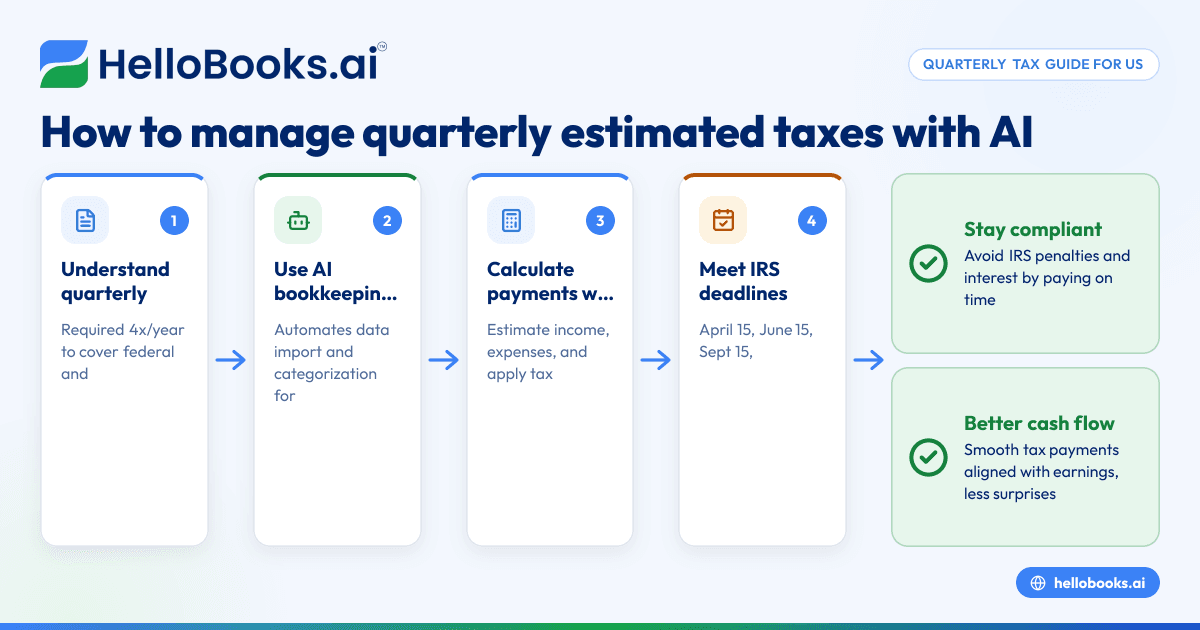
- Payments are due in April, June, September, and January of the following year.
- Accurate estimates avoid penalties and help manage your cash flow.
- Use IRS Form 1040-ES to calculate federal estimated taxes.
- AI quarterly estimated tax tools automate calculation and adjustments.
- Keep detailed records to reconcile payments with your annual tax filing.
What are quarterly estimated tax payments and who must pay them?
Quarterly estimated tax payments are advance payments of income and self-employment taxes made four times a year. Businesses, freelancers, and self-employed individuals who expect to owe at least $1,000 in taxes after withholdings and credits must make these payments to avoid underpayment penalties.
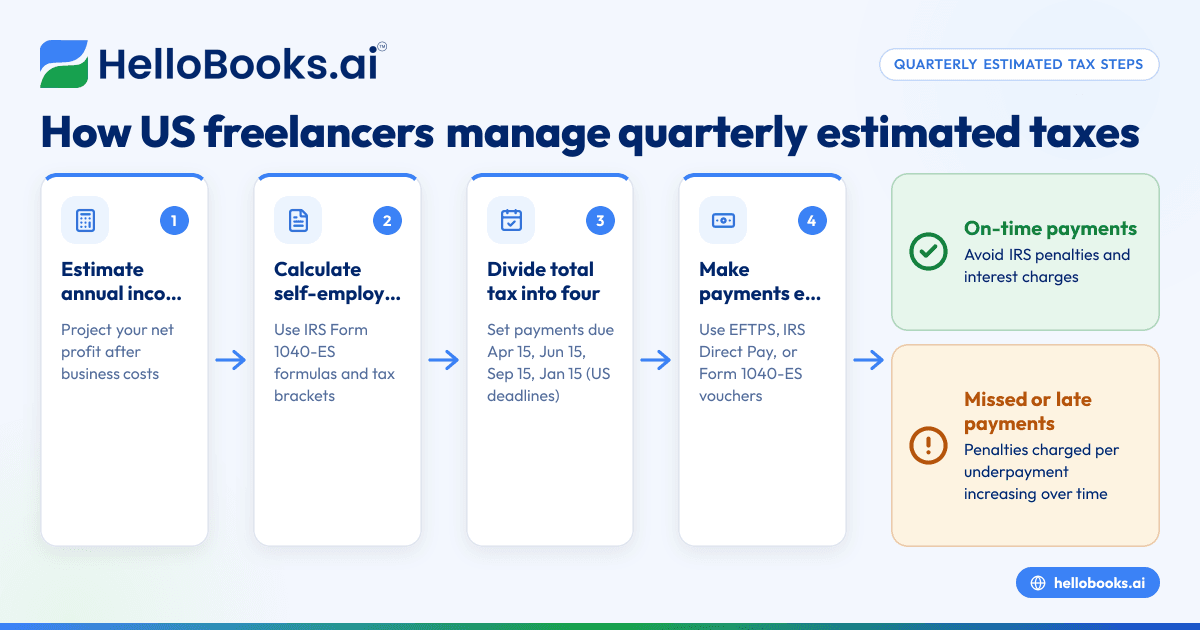
These payments are submitted to the IRS and often to state tax authorities if applicable. The due dates are April 15, June 15, September 15, and January 15 of the following year. State deadlines vary, so check your state’s requirements.
How do small businesses calculate their quarterly estimated tax payments?
Calculating quarterly estimated tax payments involves estimating your annual taxable income, applying deductions, and dividing the expected tax by four. Include self-employment tax if you’re self-employed.
- Estimate annual gross income from all sources.
- Subtract allowed business expenses to get net profit.
- Add other income such as investments.
- Calculate adjusted gross income (AGI) applying deductions.
- Determine taxable income after standard or itemized deductions.
- Use IRS tax rates to estimate income tax.
- Add self-employment tax at 15.3% if applicable.
- Subtract expected tax withheld or refundable credits.
- Divide the total by four for each quarterly payment estimate.
IRS Form 1040-ES provides worksheets to assist in these calculations. It’s wise to update your estimates each quarter reflecting changing income.
How can AI quarterly estimated tax tools help my small business?
AI quarterly estimated tax tools automate your tax calculations by analyzing real-time financial data. They reduce the risk of errors and adjust your payment amounts as your income fluctuates, helping avoid penalties and cash flow issues.
These tools integrate with your current accounting or bookkeeping software, like QuickBooks alternatives or bank reconciliation software, streamlining tax management. Automating these processes saves you valuable time and effort.
What IRS forms do I need to file and pay quarterly estimated tax?
Most small businesses use IRS Form 1040-ES for federal quarterly estimated payments. This form contains vouchers for each quarter, which you can mail or submit online through IRS Direct Pay or EFTPS.
If you have payroll or contractor payments, you might also file payroll tax forms and issue 1099s at year-end. State forms will vary, so consult your state tax agency for specific requirements.
Always pay by the due date to avoid penalties and keep copies of all filings.
What happens if I overpay or underpay my quarterly estimated taxes?
Overpayments credit toward your annual tax return and can be refunded or applied to next year’s payments. Underpayments may incur penalties unless your payments equal at least 90% of your current year’s tax or 100% of last year’s tax (110% if AGI is over $150,000).
AI quarterly estimated tools can help avoid underpayment by regularly updating tax obligations based on current income data.
How should small businesses keep records of quarterly estimated tax payments?
Keep clear, organized records of payment dates, amounts, payment methods, and confirmation numbers. Store them alongside your accounting files—digitally or physically.
Regular bank reconciliation ensures payments cleared and match your records. Good record-keeping simplifies your annual tax return and supports audit readiness.
Expense management and AI bookkeeping software like HelloBooks can track payments automatically with other financial data.
How do state estimated taxes relate to my federal quarterly estimated tax payments?
Many states require quarterly estimated tax payments similar to federal requirements but with variations in thresholds, forms, and due dates. States like Illinois and Michigan have specific rules, while Texas has a franchise tax system.
Check your state’s Department of Revenue website for details. Using accounting software that supports multi-state tax tracking can simplify managing these obligations.
What should I do if my business income fluctuates significantly during the year?
If your income varies widely, recalculate your estimated taxes each quarter to avoid penalties. The IRS permits the annualized income installment method, which measures tax payments based on actual income earned to date.
AI accounting software is particularly helpful here, automatically analyzing income changes and adjusting quarterly estimates accordingly.
How to file and pay quarterly estimated taxes efficiently?
- Prepare estimates using your bookkeeping data.
- Calculate payments using IRS Form 1040-ES or AI tools.
- Pay on time via IRS Direct Pay or EFTPS for digital convenience.
- Track payments carefully in your records or accounting software.
- Adjust payments quarterly for changing income or deductions.
Using accounting software for small business like HelloBooks.ai automates much of this process, making tax management smoother.
I keep my books in spreadsheets and QuickBooks — is there a better way?
If you rely on spreadsheets or basic QuickBooks, consider upgrading to an AI accounting software solution tailored for US small businesses. These tools automate data entry, sync bank transactions, reconcile accounts, and calculate taxes including quarterly estimated taxes with higher accuracy.
HelloBooks.ai reduces errors and saves time on bookkeeping and compliance. It connects to your bank and payment platforms, tracks expenses, and produces financial reports—simplifying tax time. This AI-powered approach also improves invoicing and expense management.
Conclusion
Accurately calculating and filing quarterly estimated tax payments is crucial for US small businesses to avoid penalties and manage cash flow. Understanding IRS rules, payment schedules, and good record-keeping reduces tax-time stress. Leveraging AI quarterly estimated tax tools and automated bookkeeping can simplify compliance and save time.
For an easier, more accurate way to handle your quarterly estimated taxes and bookkeeping, book a personalized demo with HelloBooks today at /book-a-demo or check out our pricing.
Frequently asked questions
What if I miss a quarterly estimated tax payment deadline?
Missing a deadline may trigger penalties and interest. Pay as soon as possible to reduce costs. You’ll reconcile any unpaid tax when filing your annual return.
Can I pay quarterly estimated taxes online?
Yes. The IRS accepts payments online via Direct Pay and EFTPS securely. Most states offer similar digital payment options.
How do I know if I need to pay quarterly estimated taxes?
Pay if you expect to owe $1,000 or more after withholding and credits. Self-employed businesses typically need to pay because no taxes are withheld from their income.
Can AI help with my accounting and tax preparation?
Yes. AI accounting software automates bookkeeping, reduces errors, calculates payments, and ensures compliance—saving you time and lowering stress.
Are there penalties for underpaying estimated taxes?
Yes. Penalties apply if you pay less than 90% of this year’s tax or 100% of last year’s (110% if income exceeds $150,000). Penalties accrue based on how long taxes are unpaid.
Do I need to make estimated tax payments if I have employees?
Payroll tax withholding reduces your overall tax liability, but you may still need quarterly estimated payments on other income. Include withholding when estimating taxes.
Read next
This article covers one part of a bigger topic. For the complete picture, read our guide to quarterly estimated tax.