
Key takeaways
What this article covers, in order:
- Why this comes up / what goes wrong
- Step-by-step
- Example (fictional figures)
- Common mistakes
- Doing this in HelloBooks
- Frequently asked questions
Numbering invoices correctly means giving each invoice a unique, consecutive serial number up to 16 characters. Allowed characters are letters, numbers, hyphens (-), or slashes (/). This number must be unique within a financial year (1 April to 31 March) to comply with Rule 46 of the CGST Rules, which governs GST invoicing in India. Proper numbering helps you track sales, manage GST returns like GSTR-1 and GSTR-3B, and avoid audit issues.
Why this comes up / what goes wrong
Many small business owners in India keep their books using spreadsheets, Tally, or manual bill books. Without a clear system for numbering invoices, they often face problems like duplicate invoice numbers, missing numbers, or inconsistent formats. These issues create confusion during GST audits and reconciliation of GSTR-2B or GSTR-2A. Incorrect numbering can also delay filing returns and cause compliance risks. Therefore, understanding how to number invoices properly is essential for smooth bookkeeping and GST compliance.
Step-by-step
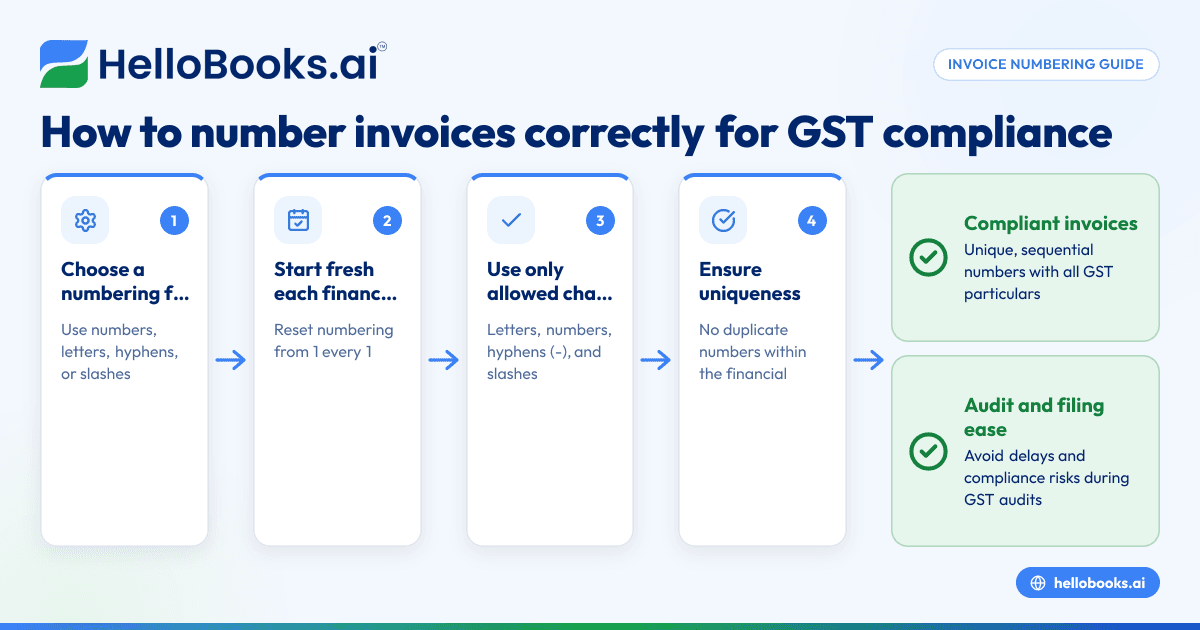
- Choose a numbering format: Decide on a clear format for your invoice numbers. You can use a simple numeric sequence like 0001, 0002, or add letters and year codes, for example, DEL-2023-001 for Delhi branch invoices in 2023.
- Start fresh each financial year: Reset your invoice numbers to start from 1 or 0001 at the beginning of every financial year (from 1 April). This keeps your records organised and compliant.
- Use only allowed characters: Your invoice number can include letters, numbers, hyphens (-), or slashes (/). Do not use other special characters like @, #, or spaces.
- Ensure uniqueness: Each invoice number must be unique within the financial year. Do not reuse numbers, even if an invoice is cancelled.
- Keep a log of issued invoice numbers: Maintain a physical or digital register to record all invoice numbers issued. This prevents duplicates and gaps.
- Include all Rule 46 particulars on your invoice: Apart from numbering, your invoice must contain supplier and recipient GSTIN, HSN or SAC codes, taxable value, tax rates and amounts, place of supply, and other details. Use tools like the GST invoice validator to check your invoices.
- For businesses with turnover over ₹5 crore, generate e-invoices: If your aggregate turnover exceeds ₹5 crore in any financial year from 2017-18 onwards, you must issue e-invoices for B2B supplies from 1 August 2023. These invoices carry an Invoice Reference Number (IRN) and a QR code embedded on the invoice. This replaces manual JSON uploads and improves compliance.
- Handle cancellations properly: If you cancel an invoice, do not reuse its number. Issue a new invoice with the next sequential number to maintain continuity.
- Use software where possible: Manual numbering is prone to errors. Consider GST invoicing software to automate numbering and compliance.
Example (fictional figures)
Business: ABC Traders
Financial year: 2023-24
Invoice date: 15/07/2023
Invoice number format: ABC/2023-24/001
- Invoice number: ABC/2023-24/001 (unique, includes business code and financial year)
- Invoice value (taxable): ₹1,00,000
- GST rate (assumed illustrative): 18%
Calculations:
₹1,00,000 × 18% = ₹18,000 (GST amount)
₹1,00,000 + ₹18,000 = ₹1,18,000 (Total invoice value)
This invoice number is unique and sequential for the financial year. The next invoice would be ABC/2023-24/002.
Common mistakes
- Using duplicate invoice numbers: This causes confusion and audit problems. Prevent by logging all invoice numbers carefully.
- Skipping numbers in sequence: Gaps in numbering may raise questions during GST audits. Avoid by issuing invoices consecutively.
- Including invalid characters: Only letters, numbers, hyphens (-), and slashes (/) are allowed. Check your format before issuing.
- Not resetting invoice numbers each financial year: This leads to duplicate numbers across years. Start numbering fresh every 1 April.
- Reusing cancelled invoice numbers: Never reuse invoice numbers of cancelled invoices. Always use the next number.
- Ignoring GST particulars apart from numbering: Numbering alone does not ensure compliance. Include all Rule 46 details on invoices.
Use the GST invoicing feature in HelloBooks to create GST-compliant invoices with correct numbering and all required particulars.
Doing this in HelloBooks
HelloBooks offers GST invoicing that creates compliant tax invoices with the correct CGST/SGST or IGST split and HSN/SAC codes based on your customer's GSTIN. It automatically fills all fields required by Rule 46, including a unique invoice number. For businesses exceeding the ₹5 crore turnover threshold, HelloBooks generates e-invoices with an IRN and signed QR code embedded on the PDF invoice. This saves time compared to manual JSON uploads and helps maintain compliance effortlessly.
Frequently asked questions
How to number an invoice?
Assign a unique, consecutive serial number up to 16 characters using letters, numbers, hyphens, or slashes. Start numbering from 1 each financial year and keep a record to avoid duplicates.
How to number your invoices to stay GST compliant?
Your invoice number must be unique and consecutive within the financial year, and your invoice must include all Rule 46 particulars. Using software or a clear manual log helps maintain compliance.
What is the best way to number invoices?
Use a simple, consistent format that includes year or branch codes if needed, and ensure numbers are sequential and unique. Avoid gaps and reuse of numbers.
Can I reuse invoice numbers if I cancel an invoice?
No. Once an invoice number is issued, even if cancelled, it should not be reused. Always use the next sequential number.
Do I need to generate e-invoices for all my invoices?
Only if your aggregate turnover exceeds ₹5 crore and the invoice is for B2B supplies above the threshold. Otherwise, normal GST invoices with unique numbering suffice.
Where can I check if my invoice complies with GST rules?
You can use the GST invoice validator to verify if your invoice contains all required fields and correct numbering.
Key takeaways
- Invoice numbers must be unique and consecutive within each financial year.
- Use only letters, numbers, hyphens, or slashes in invoice numbers.
- Maintain a clear log to avoid duplicate or skipped numbers.
- Include all Rule 46 particulars for GST compliance.
- Cancelled invoice numbers must not be reused.
- Businesses with turnover over ₹5 crore must issue e-invoices with IRN and QR code.
- HelloBooks GST invoicing and e-invoicing features simplify compliance and numbering.
Start numbering your invoices correctly today to avoid compliance issues. To simplify the process, start on the Free plan (200 transactions a year, GSTR-1 and 3B filing for one GSTIN) with HelloBooks.