
Key takeaways
What this article covers, in order:
- Why this comes up / what goes wrong
- Step-by-step
- Example (fictional figures)
- Common mistakes
- Doing this in HelloBooks
- Frequently asked questions
Generating an e invoice is mandatory for businesses with turnover exceeding ₹5 crore for B2B supplies. It involves creating a GST-compliant invoice, submitting it electronically to the Invoice Registration Portal (IRP), receiving an Invoice Reference Number (IRN) and signed QR code, and sharing the digitally signed invoice with the buyer. This article explains why e-invoicing is important, the exact steps to generate an e invoice, a detailed example with figures, common mistakes to avoid, and how HelloBooks software can simplify this process.
Why this comes up / what goes wrong
Many small business owners still prepare invoices manually or in offline formats like Excel or Tally without the IRN and QR code mandated by GST e-invoicing rules. This leads to non-compliance risks, delays in filing returns, and difficulty in reconciling invoices with GST portal data. Businesses above the ₹5 crore turnover threshold must generate e-invoices for B2B transactions from 1 August 2023 onwards. Without clear steps, owners struggle with filling all required invoice fields correctly, submitting JSON files to the IRP, and handling rejections or cancellations.
Step-by-step
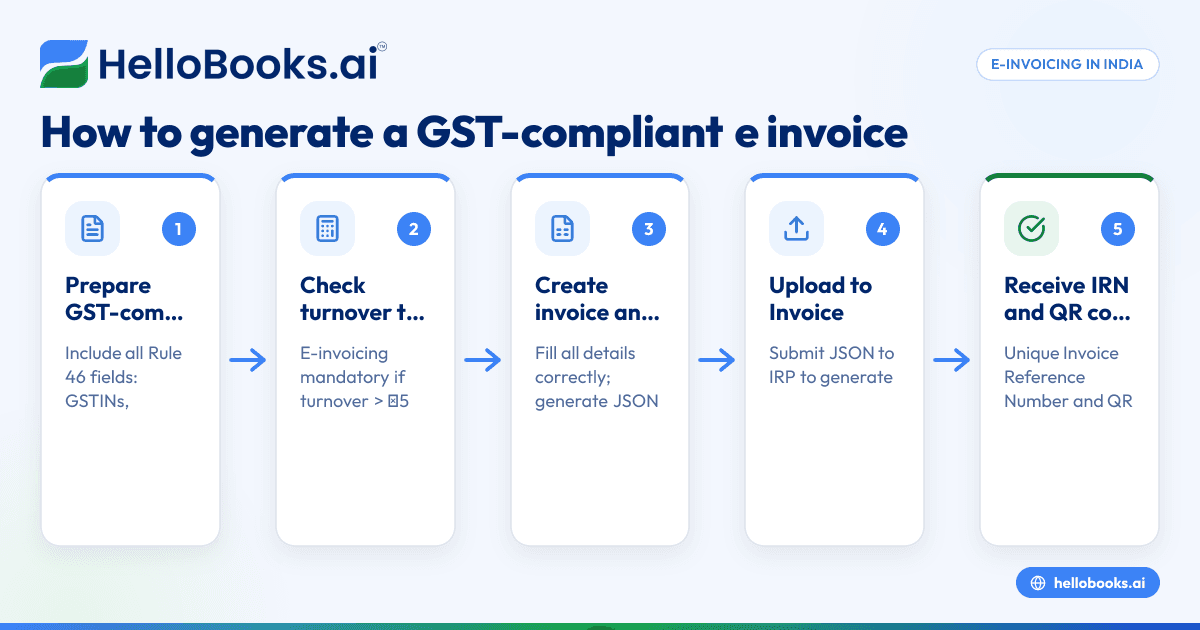
- Prepare a GST-compliant invoice: Include these particulars as per Rule 46 — supplier's name, address, and GSTIN; unique consecutive serial number; date of issue; recipient's name, address, and GSTIN/UIN; HSN or SAC codes; description, quantity, and unit of goods/services; total and taxable values; applicable CGST, SGST/UTGST, IGST, and cess rates and amounts; place of supply with state name; delivery address if different; reverse charge indication; and supplier's signature or digital signature. For details, see the GST invoice validator.
- Check if your turnover exceeds ₹5 crore (aggregate PAN-level turnover in any previous financial year from 2017-18). If yes, e-invoicing is mandatory for your B2B supplies.
- Create the invoice in your accounting software or manually ensuring all Rule 46 fields are correctly filled. If the recipient is unregistered and the taxable value is ₹50,000 or more, include recipient name, address, delivery address, and state code.
- Generate the e-invoice JSON file containing the invoice data in the prescribed format.
- Upload the JSON to the Invoice Registration Portal (IRP) or use software integrated with the IRP to generate the Invoice Reference Number (IRN) and signed QR code.
- Receive the IRN and QR code from the IRP. The IRN is a unique identifier for the invoice. The QR code includes the IRN and other invoice details.
- Attach the IRN and QR code to the invoice and share the digitally signed invoice PDF with the buyer.
- Use the e-invoice data for GST return filing (GSTR-1) and e-way bill generation if applicable.
For businesses below the turnover threshold or exempt entities, e-invoicing is not mandatory but recommended for consistency and compliance.
Example (fictional figures)
A Delhi-based business issues a B2B invoice on 15/06/2024 to a Mumbai-based registered customer.
- Invoice serial number: INV-2024-001
- Supplier GSTIN: 07AAAAA0000A1Z5
- Recipient GSTIN: 27BBBBB1111B2Z2
- Place of supply: Maharashtra
- Goods description: Office chairs
- Quantity: 20 units
- Unit price: ₹2,500
- Total value: ₹50,000
- Discount: ₹2,500
- Taxable value: ₹50,000 - ₹2,500 = ₹47,500
- CGST @9%: ₹47,500 × 9% = ₹4,275
- SGST @9%: ₹47,500 × 9% = ₹4,275
- Invoice total: ₹47,500 + ₹4,275 + ₹4,275 = ₹56,050
Calculations:
₹50,000 - ₹2,500 = ₹47,500 (Taxable value)
₹47,500 × 9% = ₹4,275 (CGST)
₹47,500 × 9% = ₹4,275 (SGST)
₹47,500 + ₹4,275 + ₹4,275 = ₹56,050 (Total invoice value)
The business creates the invoice with all required details, generates the JSON, uploads it to the IRP, receives the IRN and QR code, attaches them to the invoice PDF, and sends it to the customer.
Common mistakes
- Missing or incorrect GSTIN of supplier or recipient: Always verify GSTINs before invoicing to avoid IRP rejections.
- Incorrect HSN or SAC codes: Use the correct codes for goods or services to ensure proper tax rates.
- Not including mandatory fields like place of supply or delivery address: Check Rule 46 requirements carefully.
- Duplicate invoice serial numbers: Maintain a unique consecutive serial number for each financial year.
- Uploading incorrect or incomplete JSON files to the IRP: Validate JSON format before submission using tools or software.
- Ignoring IRP rejection error codes: Review error codes and fix issues promptly to get the IRN.
For more detailed checks, use the GST invoice validator.
Doing this in HelloBooks
HelloBooks automates GST invoicing by creating compliant tax invoices with the correct CGST/SGST or IGST split and HSN/SAC codes from the customer's GSTIN, ensuring all Rule 46 fields are consistently filled. For businesses above the ₹5 crore e-invoicing threshold, HelloBooks generates the IRN and signed QR code automatically when you save a B2B invoice, saving time compared to manual JSON uploads. The e-invoice record also feeds into e-way bill generation, so consignment details need not be typed twice. Learn more about e-invoicing (IRN and QR) and GST invoicing with HelloBooks.
Frequently asked questions
What is an e invoice and who must generate it?
An e invoice is a GST-compliant invoice with an Invoice Reference Number (IRN) and QR code generated electronically via the government portal. Businesses with aggregate turnover exceeding ₹5 crore from 1 August 2023 must generate e-invoices for B2B supplies.
Can I generate e invoices for B2C sales?
Currently, e-invoicing is mandatory only for B2B supplies above the turnover threshold. B2C invoices are not required to be e-invoices under the current rules.
What if my invoice is rejected by the IRP?
The Invoice Registration Portal returns error codes explaining the rejection reason. Review the error, correct the invoice data or JSON file accordingly, and resubmit.
Is it mandatory to generate e invoices if my turnover is below ₹5 crore?
No, businesses below the ₹5 crore aggregate turnover threshold are exempt from e-invoicing but can opt to generate e invoices voluntarily.
How does e-invoicing help with GST return filing?
The e-invoice data is automatically fed into your GSTR-1 returns, reducing manual data entry and reconciliation errors.
Can I generate e-way bills from e invoices?
Yes, the e-invoice record contains all consignment details, allowing you to raise e-way bills without re-entering information.
Key takeaways
- E-invoicing is mandatory for businesses with turnover above ₹5 crore for B2B supplies from 1 August 2023.
- A GST-compliant invoice must include all Rule 46 particulars like GSTINs, HSN/SAC codes, tax rates, and place of supply.
- Upload the invoice JSON to the government portal to get an IRN and signed QR code.
- Attach the IRN and QR code to the invoice and share it with the buyer.
- Common mistakes include missing GSTINs, incorrect HSN codes, duplicate serial numbers, and ignoring IRP error codes.
- HelloBooks automates GST invoicing, e-invoice generation with IRN and QR, and e-way bill creation to save time.
Start generating accurate e invoices today with HelloBooks. Start on the Free plan (200 transactions a year, GSTR-1 and 3B filing for one GSTIN).