
Key takeaways
What this article covers, in order:
- Key takeaways
- What accounts receivable follow up means
- Why overdue invoices happen in the first place
- A practical accounts receivable follow up schedule
- How to write follow-up messages that get responses
- A simple AR follow-up workflow for small businesses
If you want to improve cash flow without damaging goodwill, your accounts receivable follow up needs to be consistent, polite, and documented. In the United States, the best approach is a clear reminder schedule, simple payment options, and fast escalation only when a customer stops responding.
Key takeaways
- Accounts receivable follow up works best when you start early, not after an invoice becomes severely overdue.
- A structured sequence of email, phone, and internal escalation helps you collect faster and stay professional.
- Most late payments come from missed approvals, invoice errors, or unclear payment terms, not bad intent.
- Every follow-up should reference the invoice number, amount due, due date, and payment link or instructions.
- Strong invoicing habits reduce follow-up work before it starts.
- If your team is spending hours chasing payments, tools like invoice software and AI accounting software can reduce manual work.
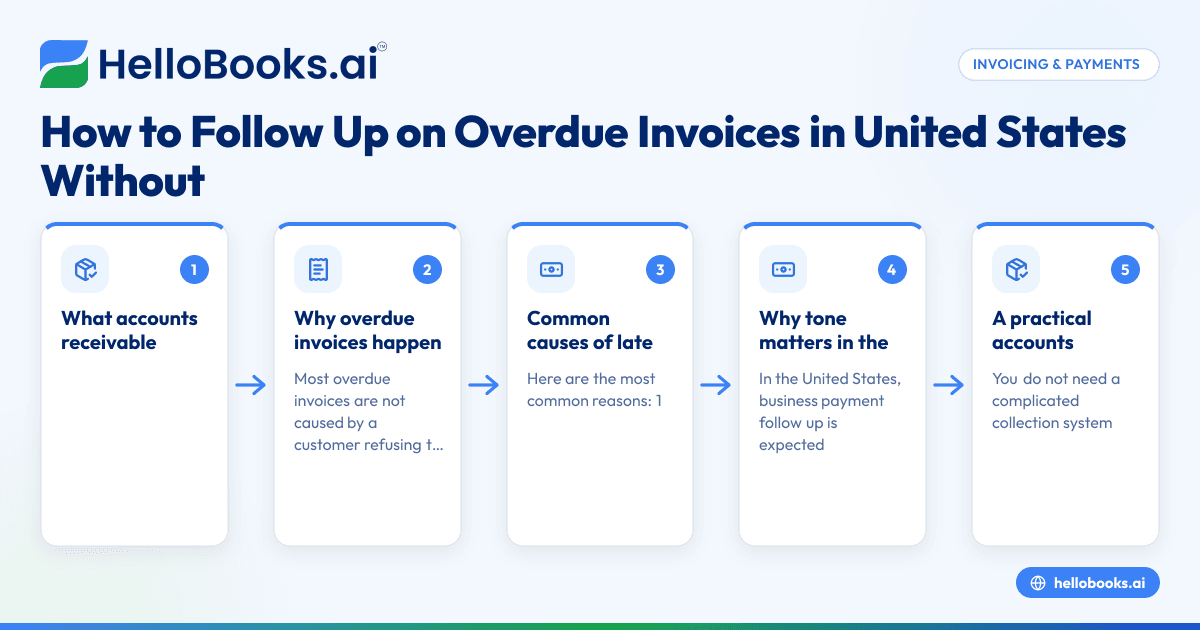
What accounts receivable follow up means
Accounts receivable follow up is the process of contacting customers about unpaid invoices and moving them toward payment. It includes reminders before the due date, notices after the due date, phone calls for delayed accounts, and escalation for invoices that remain unpaid.
For a US business, this process sits between billing and collections. It is still part of normal customer relationship management. The goal is to get paid on time while keeping the customer informed and respected.
That matters because overdue invoices affect more than revenue. They create pressure on payroll, inventory purchases, rent, and vendor payments. A small manufacturer in Detroit, a design agency in Chicago, and a distributor in Houston all feel the same problem when cash is tied up in unpaid receivables.
A strong follow-up process also helps your accounting records stay accurate. When receivables are monitored closely, your team can spot disputes, duplicate invoices, unapplied payments, or credit issues sooner.
Why overdue invoices happen in the first place
Most overdue invoices are not caused by a customer refusing to pay. They usually happen because something in the process broke down.
Common causes of late payment
Here are the most common reasons:
- The invoice went to the wrong contact.
- The customer needs a purchase order number.
- The invoice has an error in amount, date, or line items.
- Payment terms were never clearly agreed.
- The approver is out of office.
- The customer pays only on fixed weekly or monthly cycles.
- The invoice was received but forgotten.
- The customer has a cash flow problem.
When you know the likely cause, your follow-up message becomes better. Instead of sounding aggressive, it becomes useful. That often gets faster results.
Why tone matters in the United States
In the United States, business payment follow up is expected. But buyers also expect professionalism. A harsh email too early can create friction with an otherwise good customer. A vague email can be ignored.
The best tone is firm, short, and easy to act on. State the facts. Attach the invoice if needed. Include the amount due in dollars. Offer a simple way to resolve any issue.
For example, “Invoice #1048 for $2,350 was due on 05/15/2026” works better than “Your account is overdue.” The first version is specific. The second version creates confusion.
A practical accounts receivable follow up schedule
You do not need a complicated collection system. You need a routine that your team follows every time.
Step 1: Send a reminder before the due date
A reminder 3 to 5 business days before the due date can prevent many delays. This is especially useful for customers with internal approvals.
Keep it short. Confirm the invoice details. Include the due date and payment method.
Example:
- Subject: Reminder: Invoice #1048 due on 05/15/2026
- Body: Hi Sarah, this is a reminder that Invoice #1048 for $2,350 is due on 05/15/2026. I have attached the invoice here for convenience. Please let me know if you need anything to process payment.
This type of note feels helpful, not pushy.
Step 2: Follow up on the day after the due date
If payment has not arrived, send a follow-up one business day after the due date. Many businesses simply need a prompt.
Example:
- Subject: Past due: Invoice #1048 for $2,350
- Body: Hi Sarah, Invoice #1048 for $2,350 was due on 05/15/2026 and appears to be unpaid. I am reattaching the invoice here. Please share the payment status, or let me know if there is any issue we can help resolve.
This message stays neutral. It assumes there may be an issue instead of bad intent.
Step 3: Follow up again at 7 days overdue
If there is no response, follow up again after 7 days. At this stage, be slightly firmer. Ask for a specific update.
Example:
- Subject: Follow-up needed: Invoice #1048 now 7 days past due
- Body: Hi Sarah, I am following up on Invoice #1048 for $2,350, which is now 7 days past due. Please confirm the expected payment date today. If there is an approval or billing issue, let me know and I will help resolve it quickly.
The phrase “Please confirm the expected payment date today” gives the customer a clear action.
Step 4: Make a phone call at 10 to 14 days overdue
Email is easy to ignore. A polite phone call often moves things forward faster. Call the billing contact first. If needed, call the business contact who approved the work.
Your call should be short:
- Confirm they received the invoice.
- Ask whether there is any issue blocking payment.
- Request a firm payment date.
- Send a recap email after the call.
A quick call can uncover missing documents, vendor setup issues, or internal delays that email never surfaces.
Step 5: Escalate internally and externally at 15 to 30 days overdue
At this stage, your team should review the account carefully. Check whether the customer has multiple overdue invoices. Check whether any recent payment was received but not applied. Review notes from sales or account management.
Then escalate in a professional way:
- Copy the buyer or business stakeholder if the billing contact is unresponsive.
- Pause new work if your contract allows it and the account is materially overdue.
- Send an account statement showing all open invoices.
- Ask for a call to resolve the balance.
For larger balances, involve a manager on your side. Senior-to-senior communication can speed resolution.
Step 6: Decide on final escalation
If invoices remain unpaid well beyond your normal payment cycle, you may need stronger action. That could include a formal demand letter, a payment plan, or referral to a collections attorney or agency. The right choice depends on the amount, your contract terms, and the customer relationship.
This is general information, not tax or legal advice. If you are considering legal escalation or contract enforcement in the United States, speak with a qualified attorney.
How to write follow-up messages that get responses
Many follow-up emails fail because they are too long, too emotional, or too vague. Keep yours easy to scan.
Include these details every time
Each follow-up should include:
- Customer name
- Invoice number
- Invoice date
- Due date
- Amount due
- Payment link or instructions
- Your contact information
- A clear request
If you leave out key details, the customer has to search for them. That creates delay.
Keep the tone firm but respectful
Do not guilt the customer. Do not write in all caps. Do not threaten action too early. A message that sounds calm and confident is usually more effective.
Good phrases include:
- “Please confirm the payment status.”
- “Let me know if any issue is holding this up.”
- “Please share the expected payment date.”
- “I have attached the invoice again for convenience.”
Avoid phrases like:
- “This is unacceptable.”
- “You need to pay immediately.”
- “Final warning” unless it truly is one.
Use email and phone together
Email creates a written record. Phone creates urgency and resolution. Using both channels gives you a better chance of getting paid without conflict.
If you call, always follow up with a recap email. That protects your team and reduces future confusion.
A simple AR follow-up workflow for small businesses
Small businesses often do accounts receivable follow up manually in spreadsheets, email threads, and calendar reminders. That works for a while, but it breaks as invoice volume grows.
A simple workflow is enough for most teams.
Weekly AR review process
Run this process every week:
- Export or review all open invoices.
- Group them by current, 1 to 7 days overdue, 8 to 14 days overdue, 15 to 30 days overdue, and over 30 days.
- Prioritize by invoice amount and customer importance.
- Check for disputes, unapplied payments, and duplicate invoices.
- Send the next follow-up based on your schedule.
- Log every contact attempt and response.
- Escalate accounts that exceed your threshold.
This gives your team consistency. It also prevents old invoices from being forgotten.
What to track in your AR notes
For each overdue invoice, record:
- Date of each follow-up
- Channel used
- Person contacted
- Summary of response
- Promised payment date
- Next action date
Good notes matter when accounts are handed from one employee to another. They also help if a customer disputes what was said.
If your finance team is managing this in spreadsheets today, moving to accounting software in the USA or dedicated bank reconciliation software can reduce errors and save time.
How to prevent overdue invoices before follow-up starts
The easiest overdue invoice to collect is the one that was set up correctly from the start. Prevention saves more time than chasing payment later.
Set clear payment terms
Your invoice and contract should clearly state:
- Net terms
- Accepted payment methods
- Late fee terms, if applicable under your agreement
- Billing contact details
- Any purchase order requirement
Do not assume the customer knows your process. Spell it out early.
Send invoices quickly and accurately
Late invoicing leads to late payment. Send invoices as soon as work is completed or the billing milestone is reached.
Check for basic errors before sending:
- Legal entity name
- Billing address
- Purchase order number
- Tax treatment where relevant
- Quantity, rate, and total
- Correct due date
A wrong invoice can sit in a customer queue for weeks.
Make payment easy
If you want faster payment, reduce friction. Offer the payment methods your customers already use. Include a direct payment link when possible. Make sure remittance instructions are clear for ACH or wire payments.
The fewer back-and-forth emails required, the faster you get paid.
Align sales, operations, and finance
Late collections often start with a handoff problem. Sales agrees to custom terms. Operations finishes work without confirming billable items. Finance sends an invoice missing key details.
A short internal checklist solves many of these issues. Every customer should have a confirmed billing contact, approved pricing, terms, and required documentation before the invoice is sent.
When to get stricter without hurting the relationship
Being professional does not mean being passive. Some customers need firmer boundaries.
Signs you should escalate
Escalate sooner if:
- The customer repeatedly misses promised payment dates
- They stop responding to both email and phone
- Multiple invoices are overdue
- The amount is large enough to affect your cash flow
- Your team is still delivering work with no payment plan
In these cases, a direct but respectful message is appropriate. State the balance due. State the requested action. State what happens next, such as account review or a pause on new work if your terms allow it.
Offer solutions when possible
Not every late-paying customer should be treated the same way. A long-term customer with temporary cash flow trouble may be worth handling differently.
Options can include:
- Partial payment now and balance on a defined date
- A short payment plan
- Consolidating several invoices into one statement
- Fixing a disputed line item quickly
Flexibility can preserve revenue and the relationship. But document every exception.
Using software to reduce follow-up work
As invoice volume grows, manual collections become hard to manage. Reminders get missed. Notes stay in personal inboxes. Reconciliations take too long.
That is where systems help.
What to automate
A good process can automate:
- Invoice generation
- Due date reminders
- Overdue alerts
- Payment status tracking
- Customer statements
- Follow-up task lists
- Matching incoming payments to open invoices
This reduces human error and makes follow-up more consistent. It also gives owners and finance leads a clearer view of aging receivables.
If your team is outgrowing spreadsheets or basic workflows in QuickBooks, modern accounting software for small business can help centralize invoicing, receivables, and reporting. Businesses that want less manual entry may also look at AI bookkeeping tools to keep records current.
Build a follow-up process your team can actually sustain
The best accounts receivable follow up process is not the most aggressive one. It is the one your team follows every week. Consistency beats intensity.
Start with a reminder before the due date. Follow up quickly after the due date. Move from email to phone when needed. Keep records. Escalate based on facts, not frustration. Over time, customers learn your process, and payment behavior usually improves.
If you want to spend less time chasing invoices and more time running the business, HelloBooks can help you streamline invoicing, receivables tracking, and bookkeeping workflows. You can book a demo or compare options on the pricing page.
Frequently asked questions
What is the best time to start accounts receivable follow up?
Start before the invoice is due. A reminder 3 to 5 business days before the due date prevents many delays. Then follow up again one business day after the due date if payment has not arrived.
How often should I follow up on overdue invoices?
A common rhythm is a reminder before due date, then follow-ups at 1 day, 7 days, and 10 to 14 days overdue. After that, move into escalation based on the balance, customer history, and your contract terms. The key is to use a consistent schedule.
Should I call customers about unpaid invoices or just email them?
Use both. Email gives you a written record and invoice details. Phone calls are often better for uncovering approval issues, disputes, or payment timing. A short call followed by a recap email works well.
How do I follow up without hurting the customer relationship?
Keep the tone calm, specific, and helpful. Focus on the invoice facts and ask whether anything is blocking payment. Do not assume bad intent too early, and avoid emotional language.