
Key takeaways
What this article covers, in order:
- Key takeaways
- What is bank reconciliation for small business?
- Why bank reconciliation matters for small businesses
- How bank reconciliation works
- Step-by-step bank reconciliation process
- Example of a small business bank reconciliation
Bank reconciliation for small business means matching the transactions in your books with the transactions shown in your bank statement. The goal is simple: confirm that your cash balance is correct, find missing entries, and catch errors or fraud early.
For small businesses, bank reconciliation is one of the most important monthly bookkeeping tasks. It helps you trust your numbers, close books faster, and avoid GST, tax, and cash flow surprises.
Key takeaways
- Bank reconciliation compares your cash book balance with your bank statement balance.
- Small businesses should usually reconcile bank accounts at least once a month, and often weekly if transaction volume is high.
- Common differences include uncleared cheques, bank charges, interest, failed payments, and duplicate entries.
- A good reconciliation process improves reporting, tax filing, and cash flow control.
- Automation and bank reconciliation software can reduce manual matching and errors.
- Reconciliation is not just for auditors. It is a practical control for every small business.
What is bank reconciliation for small business?
Bank reconciliation is the process of checking whether the cash transactions recorded in your books match the activity in your bank account. If the balances do not match, you identify the reason and correct it.
In a small business, this usually means reviewing sales receipts, vendor payments, bank transfers, charges, interest, refunds, loan debits, and salary payments. You compare these entries against the bank statement for the same period.
This process matters because your bank balance is not always the same as your book balance. A payment may be recorded in your books but not yet cleared by the bank. A bank fee may appear in the statement but not yet in your books. A customer receipt may have been posted to the wrong account or twice by mistake.
Without reconciliation, your profit and cash reports can become unreliable very quickly. That can lead to bad decisions, missed follow-ups, and messy month-end closings.
Why bank reconciliation matters for small businesses
Many small businesses still manage cash records in spreadsheets, Tally, or a mix of bank emails and manual entries. That setup often works at the start, but it becomes risky as volume grows.
Here is why bank reconciliation for small business is worth doing consistently.
It keeps your cash balance accurate
Cash is the most watched number in a small business. If your books show more money than the bank actually holds, you may overspend. If the books show less, you may delay useful purchases or miss growth opportunities.
Reconciliation helps you confirm the true available cash position.
It catches errors early
Small mistakes happen all the time. A ₹5,000 payment can be entered as ₹50,000. A vendor bill can be posted twice. A receipt can be recorded on the wrong date. Reconciling helps you spot these errors before they affect reports, GST working, or tax calculations.
It helps detect fraud and unauthorised activity
Unexpected bank withdrawals, duplicate supplier payments, or altered amounts can show up during reconciliation. The earlier you review them, the easier they are to investigate.
It improves month-end closing
If your bank accounts are not reconciled, your financial reports are usually not ready. Reconciliation supports a cleaner month-end close and more reliable balance sheet and cash flow reporting.
It supports compliance and audit readiness
A reconciled bank account creates a clear trail between books and bank records. That is useful during internal reviews, statutory audits, tax reviews, and investor due diligence.
This article is general information, not tax or legal advice. If you are unsure about treatment or reporting, speak with your accountant.
How bank reconciliation works
At a basic level, bank reconciliation starts with two balances:
- The closing balance as per your bank statement.
- The closing balance as per your cash book or ledger.
You then compare transactions line by line and explain every difference.
Some differences are timing differences. These are normal. For example, a cheque issued on 31 March may clear on 2 April.
Other differences are errors or omissions. These need action. For example, your bank may have charged fees that were never recorded in the books.
After you account for all differences, the adjusted bank balance and adjusted book balance should agree.
Common items that create differences
These are the issues small businesses see most often:
- Cheques issued but not yet presented
- Deposits recorded in books but not yet credited by bank
- Bank charges and fees
- Interest credited by bank
- Loan EMIs auto-debited by bank
- Payment gateway settlements net of charges
- UPI, card, or NEFT transactions posted late or to the wrong account
- Failed or reversed payments
- Duplicate entries
- Wrong amounts or wrong dates
- Transactions posted in books but to the wrong ledger
Step-by-step bank reconciliation process
A clear routine makes reconciliation faster and less stressful. Use the same process each time.
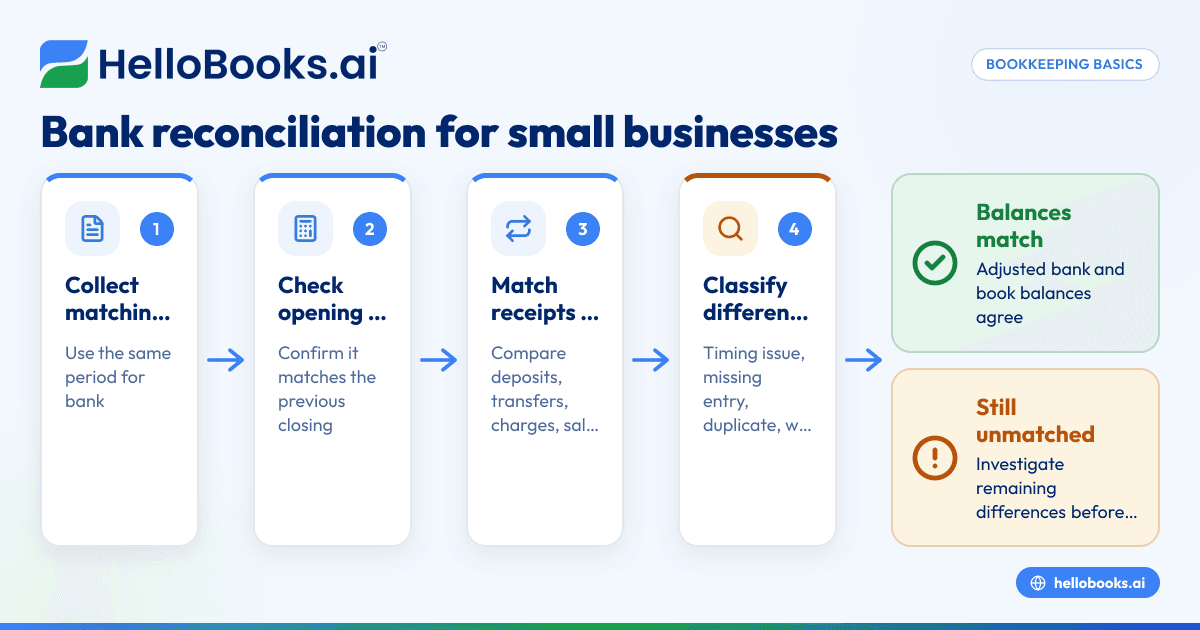
1. Collect the records for the same period
Start with the bank statement for the account and period you want to reconcile. Then pull the matching cash book, bank ledger, or transaction report from your accounting system.
Make sure the date range is the same in both places.
2. Check the opening balance
Before reviewing the month, confirm that the opening balance matches the closing balance from the previous reconciliation.
If the opening balance is wrong, the current reconciliation will not be reliable.
3. Match deposits and receipts
Tick off customer receipts, transfers in, interest credits, and other deposits that appear in both records. Watch carefully for settlement dates if you collect money through cards or payment gateways.
If a receipt is in your books but not in the bank statement, it may still be in transit or posted incorrectly.
4. Match payments and withdrawals
Now compare supplier payments, expense payments, salaries, bank transfers, loan instalments, and withdrawals. Match amount, date, and reference where possible.
If a payment appears in the bank statement but not in the books, you may need to record it.
5. Identify unmatched transactions
List every item that does not match. Then classify it:
- Timing difference
- Missing entry in books
- Bank-side item not recorded
- Duplicate entry
- Wrong amount
- Wrong date
- Wrong account or ledger
This classification helps you decide what to do next.
6. Pass adjustment entries where needed
Record bank charges, interest, direct debits, bounced payments, and corrections in your books. Remove duplicates and fix wrong postings.
Do not edit old entries casually without a clear audit trail. Use proper correcting entries if needed.
7. Prepare the reconciliation statement
After adjustments, prepare a reconciliation statement showing:
- Bank statement closing balance
- Additions and deductions for timing differences
- Adjusted bank balance
- Book balance after corrections
These balances should now match.
8. Review and approve
If someone else prepares the reconciliation, a reviewer should check it. Even in a small team, a simple review control is useful.
Keep supporting documents with the reconciliation. That includes the bank statement, transaction report, and notes on unusual items.
Example of a small business bank reconciliation
Suppose your books show a closing bank balance of ₹2,45,000 on 31 August. Your bank statement shows ₹2,38,500.
You compare the records and find these differences:
- Bank charges of ₹1,500 were not recorded in the books.
- Interest of ₹2,000 was credited by the bank but not recorded.
- A cheque of ₹10,000 issued to a supplier was not yet presented.
- A customer deposit of ₹5,000 recorded in the books was credited by the bank on 1 September.
Now adjust the balances.
Start with the bank statement balance of ₹2,38,500.
Add the cheque issued but not presented: ₹10,000
Add the deposit in transit: ₹5,000
Adjusted bank balance: ₹2,53,500
Now adjust the book balance of ₹2,45,000.
Less bank charges: ₹1,500
Add interest income: ₹2,000
Adjusted book balance: ₹2,45,500
The balances still do not match. That means there is still another difference to investigate. This is exactly why reconciliation matters. It forces you to resolve every item instead of assuming the books are correct.
Common bank reconciliation problems and how to fix them
Reconciliation gets difficult when records are incomplete or inconsistent. Here are frequent issues and practical fixes.
Duplicate entries
This often happens when a payment is imported from the bank and also entered manually. Compare amount, date, and narration. Reverse the duplicate and check whether linked invoices or expenses are still correct.
Missing bank charges
Banks may debit account maintenance fees, cheque charges, or other service fees. If these are not recorded, your expenses and cash balance will both be wrong. Add them promptly.
Payment gateway mismatch
Businesses using gateways often record gross sales but receive net settlements after fees and refunds. Reconcile the settlement report along with the bank statement. Record fees separately instead of forcing a single match.
Wrong transaction date
A transfer made late in the evening may appear on the next bank day. This can create a month-end difference. If the amount and reference match, treat it as a timing issue, not an error.
Bounced or reversed payments
A customer payment may be received and then reversed. A supplier payment may fail. Record both the original entry and the reversal correctly. Otherwise receivables or payables will stay wrong.
Unclear narrations
Bank statement descriptions are often cryptic. Save payment references, UTR numbers, cheque numbers, and invoice links where possible. Better references make future reconciliation easier.
How often should a small business reconcile bank accounts?
Most small businesses should reconcile at least once a month. That is the minimum for clean books and reliable reports.
But monthly is not always enough. Consider weekly reconciliation if you have:
- High transaction volume
- Daily online collections
- Frequent vendor payments
- Tight cash flow
- Multiple bank accounts
- Loan covenants or investor reporting needs
Some businesses benefit from near-daily reconciliation, especially if they process many small payments through UPI, cards, or marketplaces.
The right frequency depends on risk, volume, and how quickly you need accurate numbers.
Best practices for faster and cleaner reconciliation
A few habits make bank reconciliation much easier over time.
Keep bank accounts organised
Use separate bank accounts for business and personal spending. Mixed spending creates confusion and weakens control.
Record transactions regularly
Do not wait until year-end. Post receipts, expenses, and transfers through the month. The longer you delay, the harder it becomes to remember what happened.
Use clear references
Add invoice numbers, vendor names, payment modes, and notes. Clean references improve matching and reduce follow-up work.
Reconcile all active accounts
Do not stop with the main current account. Reconcile savings accounts, loan accounts, petty cash transfers, and payment collection accounts too.
Review old outstanding items
An unreconciled entry that stays open for months often points to a deeper problem. Review old items regularly and clear them with evidence.
Separate duties when possible
If one person makes payments, another person should review the reconciliation. In a very small business, the owner can review unusual items monthly.
Manual reconciliation vs software
Manual reconciliation in spreadsheets can work when transactions are few. But it becomes slow and risky as the business grows.
Manual methods usually involve:
- Downloading bank statements
- Copying entries into Excel
- Matching rows by amount and date
- Marking differences manually
- Passing entries separately in accounting software
This approach often creates version issues, missed matches, and weak audit trails.
Software can make reconciliation easier by importing transactions, suggesting matches, and highlighting exceptions. If your team is evaluating accounting software for small business, bank reconciliation should be one of the key features you test.
For Indian businesses, this matters even more when bank activity needs to line up with invoicing, expenses, and GST records in one flow. A modern accounting software in India setup can reduce manual work across the month-end close.
When to use automation for bank reconciliation
Automation is useful when your business has grown beyond simple cash tracking. It can save time, but only if the underlying process is sound.
Look for automation when you have:
- More than one bank account
- Hundreds of monthly transactions
- Payment gateways or marketplace settlements
- Frequent recurring expenses
- A finance team spending too much time on matching
- Delays in closing books
Tools with AI bookkeeping features can help identify likely matches, recurring patterns, and exceptions that need human review. That does not remove the need for checks, but it can cut repetitive work.
If you want one system for bookkeeping, invoicing, expenses, reports, and reconciliation, AI accounting software can be worth exploring. The main goal is not automation for its own sake. The goal is cleaner books with less effort.
A simple monthly bank reconciliation checklist
Use this checklist at month-end:
- Download the latest bank statement for each account.
- Export or review the matching bank ledger from your books.
- Confirm opening balances.
- Match receipts and deposits.
- Match payments and withdrawals.
- Identify unmatched items.
- Record bank charges, interest, reversals, and corrections.
- Review old outstanding items.
- Prepare the reconciliation statement.
- Get owner or manager review for unusual items.
- Save the statement, reports, and notes together.
A repeatable checklist reduces missed steps and helps your books stay audit-ready.
How HelloBooks can help
If your team is spending too much time matching bank lines manually, software can help standardise the process. HelloBooks brings bookkeeping, invoicing, expenses, and reconciliation into one workflow, which makes it easier to keep records current and review exceptions quickly.
If bank matching is your biggest pain point, start by evaluating bank reconciliation software features alongside the rest of your finance process. The right setup should reduce data entry, improve visibility, and help you close books with confidence.
If you want to simplify reconciliation and month-end bookkeeping, you can book a demo or compare options on the pricing page.
Frequently asked questions
What is the main purpose of bank reconciliation for small business?
The main purpose is to make sure the cash balance in your books is correct. It helps identify timing differences, missing transactions, mistakes, and possible fraud.
How often should a small business do bank reconciliation?
At least once a month is a good baseline. If your business has many transactions or tight cash flow, weekly reconciliation is often better.
What documents are needed for bank reconciliation?
You usually need the bank statement, the bank ledger or cash book, and supporting transaction records. For some items, you may also need invoices, payment references, or settlement reports.
Why does my bank balance not match my book balance?
This usually happens because of timing differences or missing entries. Common reasons include uncleared cheques, deposits in transit, bank charges, interest, reversals, and data entry errors.