
Key takeaways
What this article covers, in order:
- Why this comes up / what goes wrong
- Step-by-step
- Example (fictional figures)
- Common mistakes
- Doing this in HelloBooks
- Frequently asked questions
To deduct TDS on a GST bill, you must follow a clear process to ensure compliance and proper accounting. The key is to calculate the TDS only on the taxable value of the invoice, excluding the GST amount, and then deduct this TDS from the payment to the supplier. Properly recording the TDS deduction against the supplier's bill helps avoid reconciliation errors and ensures smooth GST and TDS filings.
Why this comes up / what goes wrong
Small business owners often receive GST-compliant invoices from suppliers and need to deduct TDS where applicable under the Income Tax Act. Many get confused about whether to include GST in the TDS calculation. The common mistake is deducting TDS on the invoice total including GST, which is incorrect. Others fail to record the TDS against the supplier bill, leading to mismatches in accounts and difficulties during GST return filing and TDS reconciliation.
Additionally, many businesses still track TDS in separate spreadsheets or manual records, increasing the risk of errors and time spent on data entry. Ensuring the invoice contains all mandatory details as per Rule 46 of the CGST Rules is also crucial for compliance.
Step-by-step
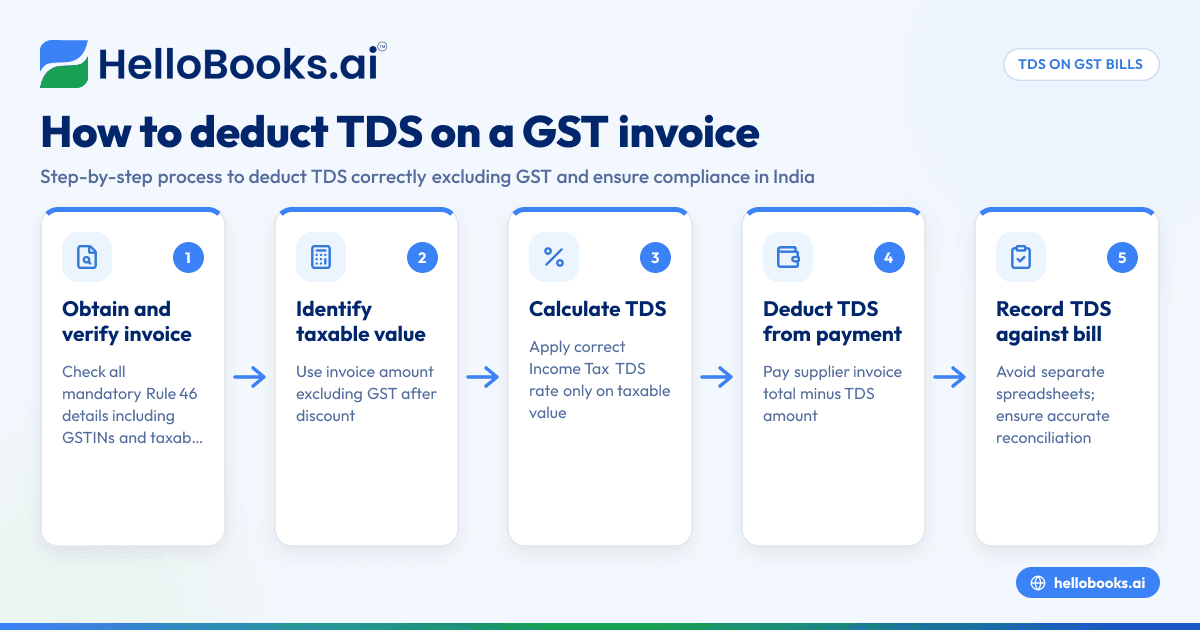
- Obtain the GST invoice from the supplier. Check the invoice for all mandatory particulars as per Rule 46, including supplier and recipient GSTINs, HSN/SAC codes, taxable value, tax amounts, and invoice serial number. Use a GST invoice validator if you want to verify the invoice details.
- Identify the taxable value on the invoice. This is the invoice amount excluding GST but after any discount.
- Confirm the applicable TDS rate. This depends on the type of payment and the relevant Income Tax provisions. (NEEDS EXPERT REVIEW)
- Calculate the TDS amount on the taxable value only. Do not include GST in this calculation.
- Deduct the TDS amount from the total payment to the supplier. The supplier receives the invoice value minus the TDS.
- Record the TDS deduction against the supplier bill in your books. Avoid using separate spreadsheets for TDS; proper recording ensures accurate reconciliation in GST returns and TDS filings.
- Issue the TDS certificate to the supplier after filing the TDS return. (NEEDS EXPERT REVIEW)
Example (fictional figures)
Assume a GST invoice dated 15/05/2024 for supply of goods:
- Taxable value (after discount): ₹1,00,000
- GST @ 18% (CGST 9% + SGST 9%): ₹18,000
- Total invoice value: ₹1,18,000
- Applicable TDS rate: 1%
Calculate TDS:
₹1,00,000 × 1% = ₹1,000
Payment to supplier:
₹1,18,000 − ₹1,000 = ₹1,17,000
You deduct ₹1,000 as TDS and pay ₹1,17,000 to the supplier. Record the ₹1,000 TDS against the supplier's bill for reconciliation.
Common mistakes
- Including GST in the TDS calculation: TDS must be calculated only on the taxable value excluding GST. Prevent this by carefully verifying invoice details using a GST invoice validator.
- Not recording TDS against the bill: This causes reconciliation problems and confusion during GST and TDS filings. Use accounting software or maintain clear records to avoid this.
- Using incorrect TDS rates: Always confirm the correct TDS rates applicable under the Income Tax Act. Consult your chartered accountant if unsure.
- Ignoring Rule 46 invoice particulars: Missing details on the invoice can cause compliance issues and delays. Use a GST invoice validator to check invoice completeness.
- Delaying issuance of TDS certificates: Issue the TDS certificate promptly after filing returns to avoid supplier disputes.
Doing this in HelloBooks
HelloBooks offers GST invoicing that creates compliant tax invoices with the correct CGST/SGST or IGST split and HSN/SAC codes from the customer's GSTIN, ensuring all Rule 46 fields are filled consistently. It handles TDS deductions on supplier bills by recording TDS directly against the bill instead of in separate spreadsheets. For businesses above the ₹5 crore turnover threshold, HelloBooks supports e-invoicing with IRN and signed QR codes generated at save time, simplifying GST compliance. Learn more about GST invoicing and HelloBooks for India at HelloBooks for India.
Frequently asked questions
Can I deduct TDS on the GST amount of the invoice?
No, TDS is deducted only on the taxable value excluding GST. GST is not subject to TDS.
What if the supplier is not registered under GST?
You still deduct TDS as applicable under the Income Tax Act. However, GST invoicing rules differ. Consult a tax expert for specifics. NEEDS EXPERT REVIEW
How do I verify the GSTIN on the invoice?
Use the GST portal or a GST invoice validator to confirm the GSTIN and invoice details.
When must TDS deducted on GST bills be deposited?
TDS deducted must be deposited with the government within prescribed timelines under the Income Tax Act. Confirm current deadlines with your chartered accountant. NEEDS EXPERT REVIEW
Can HelloBooks help calculate and record TDS?
Yes, HelloBooks records TDS deductions against bills and helps reconcile ITC and TDS amounts, reducing manual errors and saving time.
Key takeaways
- Deduct TDS only on the taxable value excluding GST on the supplier's GST invoice.
- Verify invoice details carefully using a GST invoice validator.
- Record TDS deductions against the supplier bill for accurate accounting and reconciliation.
- Use correct TDS rates as per Income Tax rules; consult your CA if unsure.
- HelloBooks automates GST invoicing, TDS handling, and e-invoicing to simplify compliance.
Start managing your GST invoices and TDS deductions easily with HelloBooks. Start on the Free plan (200 transactions a year, GSTR-1 and 3B filing for one GSTIN).
This article is general information, not tax or legal advice. Rules change; confirm the current position on gst.gov.in or with your chartered accountant before acting.